
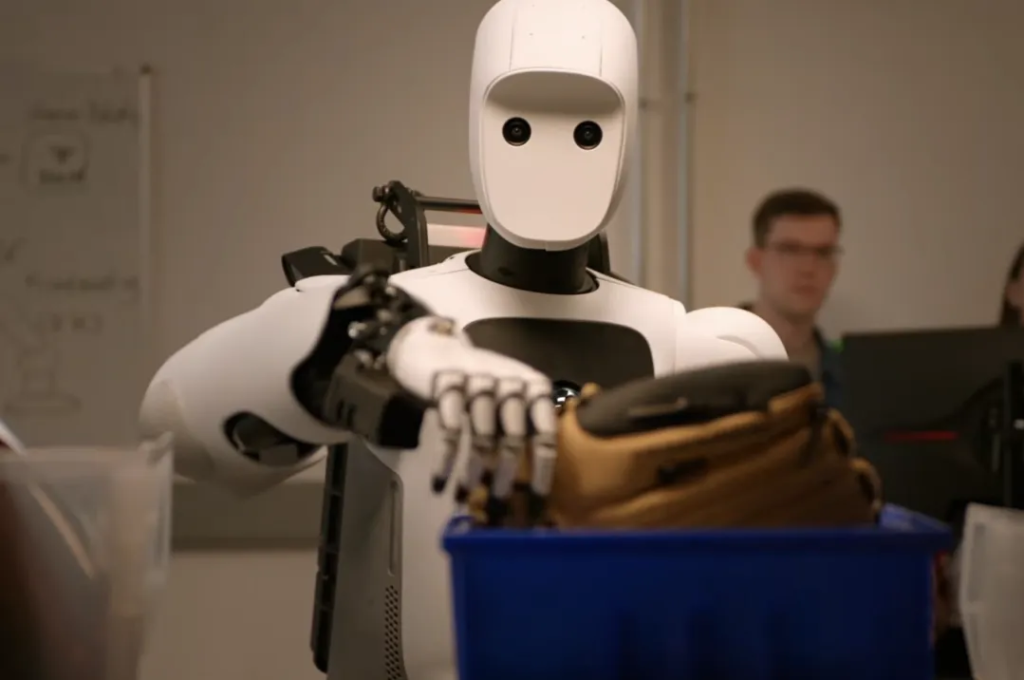
Imagine watching a robot walk into a messy kitchen, bend down to pick up a dropped spoon, walk over to the sink, put the spoon inside, and then pivot gracefully to close an open cupboard door.
For decades, scenes like that existed only in movies. In the real world, robots were stiff, clumsy, and limited. A robotic arm could assemble a car part on a factory line, but ask that same arm to walk across a room and grab a cup without knocking over a vase, and the whole system would freeze up.
Google DeepMind has just taken a massive leap toward making intelligent physical machines a reality. Their newest artificial intelligence development focuses on complete physical coordination. Instead of training separate software scripts for arms, legs, hands, and balance, DeepMind created a unified AI model capable of controlling a robot’s entire body at the same time.
At WhatsBuzzN, we are all about keeping you connected to the biggest updates changing our world. If you love keeping up with modern digital trends, feel free to check out our Technology & AI category for more simple breakdowns on the latest news.
Here is a detailed look at how this new system works, why it matters, and what it means for the future.
The $0 Secret To Launching Your Entire Online Empire
Why pay hundreds every month for separate software? Build funnels, send emails, and make sales with Systeme.io completely free.
Get Started For $0Free Forever • No Credit Card Needed • Beginner-Friendly
What Makes Google DeepMind’s New Robot AI Different?
To understand why this is a massive deal, it helps to look at how robots were built in the past.
Traditionally, robotics engineering relies on modular software. One computer code controls the wheels or legs so the robot can move around. A second piece of software controls the mechanical arm so it can stretch forward. A third piece manages the robotic hand or gripper to pinch objects. A fourth system constantly checks balance sensors to keep the entire machine from falling over.
Because all these individual systems had to talk to each other through complicated code, the robot’s movement often felt jerky and delayed. If the leg slipped slightly on a rug, the arm would miscalculate its position, and the robot would drop whatever it was holding.
Google DeepMind changed this basic setup by treating the physical machine as one complete system.
The new AI acts as a single centralized brain. It looks at the world using visual sensors, processes what needs to be done, and sends movement commands to every motor in the body simultaneously.
How Does Full-Body AI Control Actually Work?
The secret behind this leap forward comes down to how AI models process information. DeepMind adapted the same core technology behind modern language models—the software that powers systems like ChatGPT or Google Gemini—and modified it to process physical actions instead of just written words.
Researchers call these Vision-Language-Action models.
When you give the robot a command, the AI breaks down the task into simple steps. Here is how the process flows inside the system:
- Visual Perception: Cameras attached to the robot capture live video of the environment. The AI identifies objects, measures distances, and spots potential obstacles.
- Understanding Instructions: The model processes plain spoken or written commands, like “pick up the red bottle and place it on the top shelf.”
- Whole-Body Planning: Instead of planning just an arm movement, the AI calculates how the hips, legs, spine, and arm joints must move together to balance the weight of the object.
- Real-Time Corrections: If the robot slips or the object is heavier than expected, the AI instantly adjusts every motor across the body to keep balance.
Instead of writing millions of lines of custom code for every possible situation, engineers give the AI model data, and the model figures out how to move naturally.
Why Full-Body Coordination Was So Hard to Solve
Scientists have wrestled with robotic movement for more than fifty years. In computer science, there is a famous concept known as Moravec’s paradox. It points out that things humans find difficult—like complex math calculations or playing master-level chess—are very easy for computers. But things humans find effortless—like balancing on one foot, tying a shoelace, or catching a ball—are insanely hard for machines.
Humans learn movement naturally as babies through continuous trial and error. When you reach for a glass of water on a high shelf, your brain automatically adjusts your posture, shifts your weight to your toes, engages your core muscles, and shapes your fingers before you even touch the glass.
Robotics engineers found it nearly impossible to write manual math equations for every tiny muscle adjustment the human brain performs naturally.
Earlier robot models failed in unpredictable environments because engineers could not code for every possible variable. If a chair was moved three inches to the left, or if a carpet was slightly thicker than usual, the old robot would get confused and fail.
DeepMind’s new full-body AI solves this because it does not rely on static rules. It relies on generalized learning. It adapts on the fly just like a human body does.
How DeepMind Trained an AI to Move Like a Person
Teaching an AI to control physical limbs requires huge amounts of experience. Since you cannot let a physical robot crash thousands of times in a real room without destroying expensive hardware, DeepMind used clever training methods to speed up the learning process.
Send, Spend & Hold Money Worldwide Without Hidden Fees
Transfer money internationally at the real exchange rate and hold 40+ currencies in one account.
Open a Wise AccountMid-market rate • Fast transfers • 40+ currencies
1. Training in Virtual Simulations
Before the AI ever touches real hardware, it is placed inside a digital simulator. Inside this virtual world, physics engines mimic gravity, friction, weight, and momentum.
The AI practices tasks millions of times in fast-forward mode. It learns how to balance, step over objects, and carry heavy loads in seconds of real-world time.
2. Human Demonstration Data
Engineers also use teleoperation, where a human operator wears motion-capture gear or uses remote controllers to perform daily tasks like sweeping, clearing tables, or sorting items.
The AI records the human’s movements and links visual cues to physical actions. It learns what success looks like when a human handles delicate items.
3. Transfer Learning to Real Robots
Once the model understands movement in digital space, researchers upload the software into physical humanoid robots. The robot uses its real-world cameras and motor sensors to fine-tune what it learned in the simulator.
The result is a physical machine that moves with remarkable fluidity. It can step forward, reach out, adjust its balance, and hold an object without pausing to recalculate every step.
Real-World Applications: Where Will We See These Robots?
Full-body AI control opens up doors that were previously closed to basic factory automation. Many people are interested in how modern technology can automate everyday work—an trend seen everywhere from automated physical labor to content platforms like YouTube Automation.
When an AI can control physical movement reliably, practical uses expand across multiple industries:
Household Assistance
Cleaning up toys, folding clothes, carrying groceries up stairs, and assisting people with mobility challenges are complex tasks. A robot with full-body control can navigate tight living rooms without knocking over furniture.
Healthcare and Caregiving
Nurses spend a large part of their day lifting patients, carrying heavy equipment, and delivering meals. Humanoid robots powered by body-wide AI could support staff by handling physical heavy lifting, lowering the risk of back injuries for healthcare workers.
The $0 Secret To Launching Your Entire Online Empire
Why pay hundreds every month for separate software? Build funnels, send emails, and make sales with Systeme.io completely free.
Get Started For $0Free Forever • No Credit Card Needed • Beginner-Friendly
Warehouses and Supply Chains
While fixed robotic arms are great at pulling items off a conveyor belt, whole-body robots can move freely down crowded aisles, bend down to reach low shelves, and carry odd-shaped boxes safely across uneven floors.
Emergency Response and Hazardous Environments
In natural disasters, search and rescue teams often face unstable buildings, dangerous gas leaks, or extreme heat. An adaptable whole-body robot can climb over rubble, clear heavy debris, and enter environments that are too dangerous for human first responders.
The Biggest Technical Challenges Still Remaining
While this technology is impressive, we are not going to see full-body AI assistants in every living room tomorrow. Researchers and engineers still have major challenges to work through before these machines become common household items.
- Power Consumption: Controlling dozens of electric motors simultaneously requires massive amounts of power. Current battery technology limits most full-body humanoid robots to only a few hours of operation before needing a recharge.
- Safety Concerns: A physical robot that weighs over one hundred pounds needs to be completely safe around children, pets, and adults. If an AI glitch causes a leg to stumble, the machine cannot afford to fall onto someone.
- Hardware Manufacturing Costs: High-precision motors, advanced pressure sensors, and durable joints are expensive to manufacture. Bringing costs down to an affordable consumer level will take time.
- Unpredictable Real-World Scenarios: While AI models handle controlled spaces well, extreme conditions—such as slippery ice, heavy rain, or chaotic crowds—can still push the system past its current limits.
What This Breakthrough Means for the Future of Work
Whenever major AI announcements occur, people naturally ask how their jobs and daily lives will change.
Full-body AI robotics will likely follow the pattern of previous technological shifts. Instead of completely replacing human workers overnight, these machines will first take over dangerous, repetitive, or physically exhausting work.
In factories, robots will handle toxic chemicals or lift heavy components. In offices and hospitals, they will manage night-shift deliveries and trash removal. This shift will allow human workers to focus on tasks that require deep empathy, creative strategy, and complex decision-making.
The progress coming out of labs like Google DeepMind shows that the gap between digital AI (software on screens) and physical AI (robots in the real world) is closing much faster than experts predicted five years ago.
Frequently Asked Questions
What is Google DeepMind’s new robot AI model?
It is a unified artificial intelligence software model designed to control a robot’s entire body at once. Instead of using separate programs for arms, legs, and balance, one central AI system processes visual information and coordinates smooth movements across all joints simultaneously.
How is this different from older robotics systems?
Older robotics systems relied on separate, pre-written code scripts for each physical limb. This made movements rigid and clumsy. DeepMind’s new AI model learns complete physical movements as a single process, allowing robots to adjust their balance and actions naturally in real time.
When will these full-body robots be available in homes?
While progress is moving quickly, affordable consumer robots for homes are still several years away. Current challenges include high hardware costs, limited battery life, and the need for absolute safety testing around humans. Initial uses will focus on industrial warehouses, factories, and research labs.
Can this AI run on different types of robot bodies?
Yes. Because the system is built on generalized learning architectures, researchers can adapt the underlying AI model to work with various robot designs, including two-legged humanoids, four-legged robot dogs, and complex industrial arms.
Final Thoughts
Google DeepMind’s development of full-body AI control marks a real turning point in robotics. By moving away from rigid code and teaching a single AI brain to coordinate an entire machine, we are moving closer to a future where robots can operate safely and fluidly alongside humans.
As hardware costs drop and software models become even smarter, the boundary between digital intelligence and physical work will continue to blur.
Want to learn more about the team behind our articles? Visit our About Us page to see what drives our passion for coverage. Have a story tip or a question for our editors? Head over to our Contact page and drop us a line.
You can also join our growing community across social media to catch new updates as soon as they drop:
- Follow us on Instagram
- Connect with us on Facebook
- Stay updated on X (formerly Twitter)
