
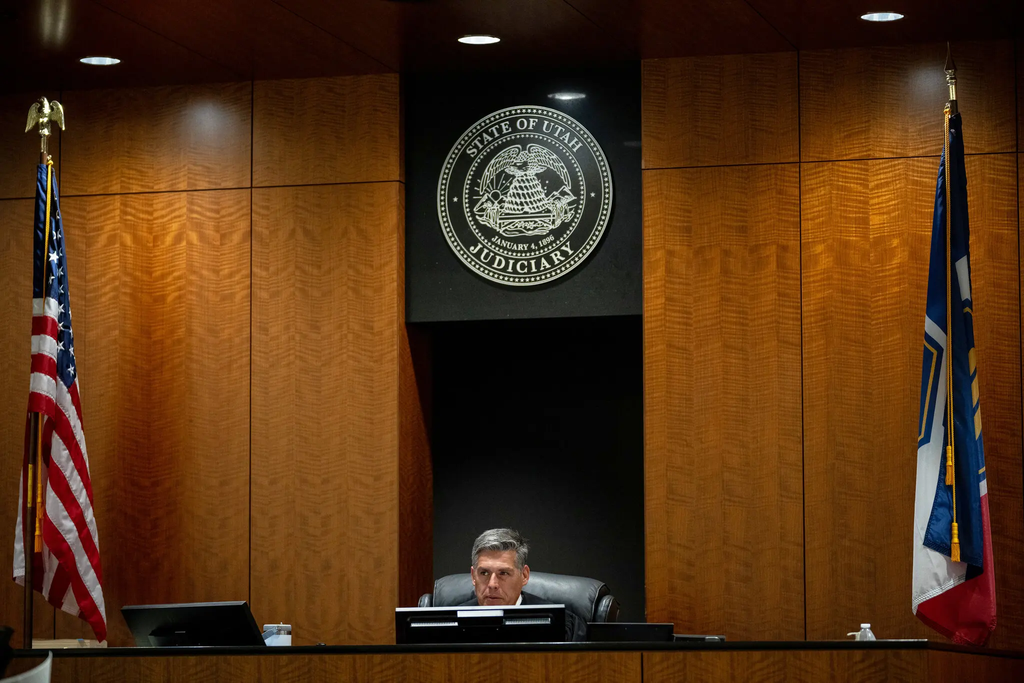
A major legal update has arrived in one of the most closely watched court cases in recent American history. Utah District Judge Tony Graf Jr. ruled that 23-year-old Tyler Robinson must stand trial for the murder of conservative activist Charlie Kirk. Judge Graf also decided that state prosecutors have enough legal grounds to seek the death penalty against Robinson if he is found guilty. Immediately following the judge’s ruling, Robinson entered a plea of not guilty to all seven counts against him.
The landmark decision came after a high-stakes preliminary hearing at the Fourth Judicial District Courthouse in Provo, Utah. Prosecutors presented weeks of forensic evidence, digital messages, and witness statements to show why the case should move forward. The decision clears the way for a full criminal trial that could end in capital punishment for the suspect.
Understanding the Ruling: Why the Case Is Moving to Trial
A preliminary hearing is not the actual trial where a jury decides if someone is innocent or guilty. Instead, it acts as a safety check in the legal system. During this stage, a judge looks at all the evidence gathered by law enforcement to determine if there is enough probable cause to hold a full trial.
Judge Graf announced his decision directly from the bench after listening to extensive closing arguments. He stated that when you view the evidence in the light most favorable to the prosecution, there is a reasonable belief that Robinson committed the crime.
Because the judge found probable cause on every single charge, the entire case moves directly into the trial phase. This means a jury will eventually hear the arguments, view the physical evidence, and decide Robinson’s fate.
The $0 Secret To Launching Your Entire Online Empire
Why pay hundreds every month for separate software? Build funnels, send emails, and make sales with Systeme.io completely free.
Get Started For $0Free Forever • No Credit Card Needed • Beginner-Friendly
The Legal Battle Over the Death Penalty
The biggest point of disagreement during the hearing was whether prosecutors should be allowed to ask for the death penalty. In Utah, simple murder carries a sentence of 15 years to life in prison. For prosecutors to ask for capital punishment, they must charge the suspect with aggravated murder. Aggravated murder requires specific factors, such as knowingly placing other people in danger during the crime.
The Defense Argument: “One Shot, One Victim”
Defense attorneys Staci Visser and Richard Novak made a strong push to take the death penalty off the table entirely. They argued that the state was trying to force the facts to fit Utah’s aggravated murder law.
The defense pointed out that the shooter fired a single bullet from a rooftop more than 400 feet away. They noted that Charlie Kirk was sitting on an elevated stage and was not standing right next to anyone when he was struck in the neck.
Attorney Staci Visser emphasized this point to the judge: “There is one shot. There is one bullet. There is one victim. There is zero evidence that there was any action taken towards other people”. Based on that logic, the defense claimed that nobody else in the crowd was placed in direct physical danger, making capital punishment inapplicable under Utah state law.
The Prosecution Counter: A Packed Crowd and Open Fire
Utah County prosecutors strongly rejected the defense’s view of the event. Prosecutor Ryan McBride argued that shooting a high-powered bolt-action rifle toward a stage surrounded by thousands of people creates an automatic life-threatening risk to everyone present.
Prosecutor Chad Grunander added that Robinson did not just bring one single bullet to the rooftop. He brought a high-powered rifle loaded with extra ammunition, showing that he was fully prepared to keep firing if necessary.
Judge Graf ultimately agreed with the prosecution’s line of reasoning for this stage of the case. He ruled that the setup of the event, the crowd density, and the placement of the tent support a reasonable inference that the shooter knew others could easily be hit or killed.
Key Evidence Presented During the Hearing
Throughout the preliminary proceedings, prosecutors built what they described as a “mountain of evidence” linking Robinson to the shooting. According to news reports from major legal outlets like the Associated Press, investigators spent months putting together forensic and digital data.
Forensic and DNA Analysis
State forensic experts testified that DNA matching Tyler Robinson was found on key parts of the bolt-action rifle recovered near the scene. Investigators also presented evidence showing that Robinson’s DNA was present on a specialized tool used to engrave markings onto shell casings.
While defense lawyers questioned how reliable the DNA testing methods were, the judge found the scientific connection strong enough for the case to move forward.
Digital Messages and Confessions
The prosecution introduced private text messages exchanged between Robinson and his former roommate and romantic partner, Lance Twiggs. In these messages, Robinson allegedly discussed his dislike for Kirk’s political opinions.
One text message retrieved by investigators read: “I had enough of his hatred. Some hate can’t be negotiated out”. Prosecutors also played excerpts from police interviews with Twiggs, where he told officers that Robinson expressed regret after the shooting and admitted he wished he had not done it.
Additional evidence included posts from the online communication platform Discord, where Robinson allegedly shared statements about his political views and intentions prior to the event.
Retracing the Day of the Shooting
To understand why this case has drawn national interest, it helps to review what happened on September 10, 2025. Charlie Kirk, the 31-year-old co-founder of the conservative youth organization Turning Point USA, was visiting Utah Valley University in Orem, Utah.
Kirk was speaking outdoors under a large tent to a crowd of more than 3,000 students, supporters, and visitors. As Kirk was taking questions and addressing the crowd, a single shot rang out from a nearby building rooftop. Kirk was struck in the neck and fell to the ground. Panic broke out as thousands of people scrambled to find safety, not knowing if more shots were coming.
Send, Spend & Hold Money Worldwide Without Hidden Fees
Transfer money internationally at the real exchange rate and hold 40+ currencies in one account.
Open a Wise AccountMid-market rate • Fast transfers • 40+ currencies
Emergency responders rushed Kirk to the hospital, but he was pronounced dead shortly after arriving. Law enforcement launched an immediate manhunt across the area. The following day, Tyler Robinson turned himself in to authorities.
Reactions Inside and Outside the Courtroom
The courtroom in Provo was packed with family members, security personnel, and journalists throughout the hearing.
The Kirk Family
Charlie Kirk’s family attended the proceedings together under heavy police escort. His parents, Robert and Kathryn Kirk, walked into the courthouse arm in arm alongside his widow, Erika Kirk. During emotionally heavy parts of the testimony—such as when prosecutors detailed the moment of the shot—the family briefly stepped out of the room.
Following Judge Graf’s decision, the Kirk family released an official statement expresssing gratitude:
“Every step in this process carries the weight of all that Charlie’s murder has taken from his family, especially his children who will grow up without their father… As the next phase of the judicial process begins, our family remains united in our love for Charlie, our commitment to the pursuit of justice, and our prayer for a transparent and timely process”.
The Defendant’s Family
Tyler Robinson showed very little visible emotion as the judge read the ruling. He sat quietly beside his legal defense team. In the gallery behind him, his mother, Amber Robinson, wept softly, while his father, Matt Robinson, sat with his head bowed low.
Public Presence
Outside the courthouse steps, a small group of Turning Point USA members gathered holding signs in support of Erika Kirk and the family. Courthouse security kept the crowd controlled and maintained strict rules inside and around the building to ensure the legal process remained orderly.
How Capital Punishment Laws Work in Utah
Because this is a capital case, the legal process works differently than a standard criminal trial. Utah is one of 27 U.S. states where the death penalty remains legal by statute.
When a defendant faces capital murder charges, the trial is divided into two distinct parts:
- The Guilt Phase: The jury first listens to all evidence and determines if the defendant is guilty or not guilty of aggravated murder. If the jury finds the defendant not guilty or guilty of a lesser murder charge, the death penalty is removed from consideration.
- The Penalty Phase: If the jury finds the defendant guilty of aggravated murder, the trial moves to a second phase. The same jury must hear additional arguments regarding mitigating factors (reasons to spare the defendant’s life) and aggravating factors (reasons the crime deserves capital punishment).
In Utah, a jury must be completely unanimous to issue a death sentence. If even a single juror disagrees, the sentence automatically defaults to life in prison without the possibility of parole.
The $0 Secret To Launching Your Entire Online Empire
Why pay hundreds every month for separate software? Build funnels, send emails, and make sales with Systeme.io completely free.
Get Started For $0Free Forever • No Credit Card Needed • Beginner-Friendly
Media, Technology, and Modern Legal Trials
This court case highlights how modern technology shapes criminal investigations and court proceedings today. From DNA analysis tools to digital records retrieved from platforms like Discord, modern technology gives law enforcement new ways to build a case.
If you want to understand how emerging tech tools and digital systems are changing the world around us, explore our updates on Technology & AI.
At the same time, high-profile trials generate millions of views across online video platforms. Content creators routinely break down legal filings, stream hearing reactions, and analyze evidence for online audiences. If you are interested in how modern creators build audiences around news events, check out our guide to YouTube Automation.
What Happens Next in the Trial?
Now that Judge Graf has bound the case over for trial and Robinson has entered a non-guilty plea, the legal process enters a pre-trial motion phase.
The next scheduled court date is set for October 23, where both sides will meet to establish a clear timeline for the upcoming trial. Because this case has received so much public attention, both the prosecution and defense must handle several complex steps before a jury can be picked:
- Selecting an Unbiased Jury: Finding 12 impartial jurors who have not already formed an opinion about the case will take time.
- Potential Change of Venue: Defense lawyers may request to move the trial to a different city in Utah to ensure a fair trial.
- Evidence Motions: Both sides will file motions to decide which pieces of physical evidence and expert testimony can be shown to the jury.
Legal experts expect the actual trial to be one of the most covered legal events of the year.
Frequently Asked Questions
Who is the suspect in the Charlie Kirk murder case?
The suspect is 23-year-old Tyler Robinson. He was arrested in September 2025 after turning himself in following the shooting at Utah Valley University.
Why is Tyler Robinson eligible for the death penalty?
Judge Tony Graf ruled that prosecutors presented enough evidence to charge Robinson with aggravated murder. Under Utah law, shooting into a crowd of over 3,000 people can be considered knowingly putting others in danger, which is an aggravating factor that allows for capital punishment.
What did the defense team argue during the hearing?
Robinson’s defense attorneys argued that there was only one shot fired and only one person targeted, meaning no one else was directly placed in danger. They asked the judge to drop the aggravated murder charge so Robinson would not face the death penalty.
What charges does Tyler Robinson face?
Robinson faces seven total charges, including aggravated murder, discharge of a firearm causing serious bodily harm, obstruction of justice, witness tampering, and committing a violent crime in the presence of a child. He has pleaded not guilty to all counts.
Has a trial date been set yet?
A final trial date has not been set yet. The court will meet again on October 23 to discuss scheduling and upcoming pre-trial motions.
Following court proceedings like this reminds us how important it is to have clear, accurate facts when major events occur. As this trial moves forward into its next phase, public interest will remain high across the country.
To learn more about our mission to bring you clear stories on breaking events, visit our About Page or get in touch through our Contact Page. You can also follow our official social channels on Instagram, Facebook, and X (Twitter) to join the conversation and receive the latest updates.
