
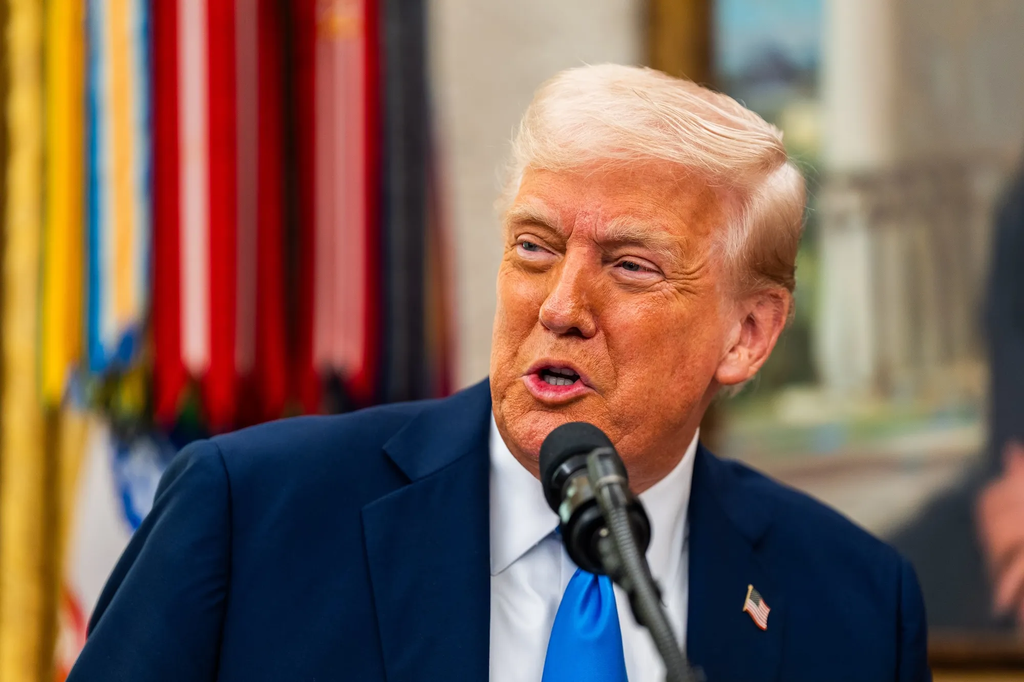
President Donald Trump created another major media stir outside the White House on Saturday, September 26, 2026, during a tense question-and-answer session with journalists on the South Lawn. Right before boarding Marine One for a trip to Tennessee, the president engaged in a heated exchange with MS NOW reporter Akayla Gardner. After lifting his index finger and telling her to be “quiet,” Trump pivoted to address comments made earlier in the week by former President Barack Obama regarding women in political leadership. Trump dismissed Obama’s suggestion that the world would be better off if women ran every government as “ridiculous”.
The double drama captured instant attention across news networks and social media platforms. On one side, the exchange reopened intense debates about White House press access and how public officials treat journalists. On the other side, it reignited a long-standing conversation about gender, power, and political leadership on the global stage.
Here is the step-by-step breakdown of what happened on the White House lawn, what Obama originally said, and why this clash is dominating headlines today.
The South Lawn Incident: How the Exchange Unfolded
The confrontation took place as reporters gathered outside the White House to question President Trump before his departure. Press access had already been a sore subject throughout the week following administration efforts to restrict certain news organizations from oval office briefings.
MS NOW reporter Akayla Gardner pressed Trump on his media policy, asking whether he only wanted news outlets in the White House press pool that actively support his administration.
The $0 Secret To Launching Your Entire Online Empire
Why pay hundreds every month for separate software? Build funnels, send emails, and make sales with Systeme.io completely free.
Get Started For $0Free Forever • No Credit Card Needed • Beginner-Friendly
Trump responded quickly, insisting that his only standard is accuracy rather than favorable coverage.
“No, no,” Trump said. “I want real news, not fake news like you. Listen, I want real news. I love an open, free press. What I don’t like is the fake press.”
Gardner tried to follow up by asking if the president was simply trying to avoid tough questions from journalists. At that moment, Trump raised his index finger toward the reporter to cut off her question.
“Wait, wait,” Trump said. “Quiet. What I don’t like is fake news. And they’re fake news.”
The brief encounter immediately drew attention because it came right on the heels of major legal battles over press credentials. A federal judge had recently ruled against White House attempts to restrict access for reporters from major networks. For readers following the broader standoff, you can catch up on the details in our coverage of how the court slams White House media ban and orders full access restored.
The Broader Context of White House Press Battles
Tension between political leaders and the press corps is nothing new in American history, but the current relationship between the White House and major news outlets has reached an unusually hostile point. Over the past several weeks, the administration has repeatedly criticized several mainstream television networks and digital outlets over their coverage.
The dispute escalated when the White House attempted to bar representatives from CNN, MS NOW, and Politico from key presidential events. That decision triggered swift pushback from news organizations, press freedom groups, and legal advocates who argued that selective exclusion violates long-established press norms.
Journalists and legal scholars pointed out that the First Amendment protects free press rights, meaning access to public government events cannot be granted or revoked based on whether coverage is favorable. When the federal court issued an order directing the administration to allow blocked reporters back into press gatherings, it set up a tense dynamic for every subsequent press interaction. You can explore more background on this ongoing feud in our report on Trump banning press and blacklisting news outlets.
In response to press bans and heated exchanges, several major broadcast groups have taken unprecedented steps in how they broadcast White House statements. If you want to understand how television executives are responding behind the scenes, check out our piece on how major TV networks drop Trump coverage following access disputes.
What Did Barack Obama Say About Women Leaders?
Shortly after the shushing incident with Gardner, another reporter asked Trump about comments made earlier in the week by former President Barack Obama.
During a widely shared C-SPAN interview, Obama reflected on his time in office and shared a hypothetical thought experiment about world leadership. Obama suggested that placing women in charge of global governments could lead to significant improvements in governance.
“Even when I was president, I sometimes fantasized about if you put women in charge of every government for like two years and then just kind of saw, all right, how are things going?” Obama remarked during the discussion.
Obama acknowledged that female leadership would not solve every global challenge overnight, but he expressed strong confidence that overall outcomes would improve.
“I have a strong belief that things would — they wouldn’t be perfect. But they’d be better. I’m confident about that. I really do,” Obama added.
Obama had shared a similar perspective years earlier during a 2019 leadership event in Asia, where he argued that many world problems stem from older men holding on to power for too long. His latest comments quickly circulated across social media platforms, drawing praise from supporters and criticism from political opponents who saw the remark as overly simplistic.
Send, Spend & Hold Money Worldwide Without Hidden Fees
Transfer money internationally at the real exchange rate and hold 40+ currencies in one account.
Open a Wise AccountMid-market rate • Fast transfers • 40+ currencies
Trump’s Direct Response to Obama’s Statement
When asked on Saturday whether he agreed with Obama’s view on female governance, Trump did not hold back. He immediately rejected the concept and labeled Obama’s thesis completely absurd.
“It’s ridiculous,” Trump told reporters on the lawn. “I love women. I think they’re great. But what a ridiculous statement that is.”
Trump looked at the press corps and added, “Even you would say that.”
Trump’s argument centers on the idea that leadership capabilities depend on individual qualifications, character, and strategic decision-making rather than gender alone. Supporters of Trump’s position argue that sweeping generalizations about gender in politics ignore the complex reality of international diplomacy, economics, and national defense. They point out that female heads of state throughout history have displayed a wide range of political philosophies and governing styles, ranging from peaceful diplomacy to hardline military action.
Critics, however, argue that Trump’s dismissive reaction ignores real structural barriers that women face in politics. They contend that Obama was highlighting systemic differences in leadership approaches, collaboration, and executive decision-making.
Historical Clashes with Female Journalists
Saturday’s encounter with Akayla Gardner is not the first time Trump’s interactions with female reporters have drawn public scrutiny. Over the course of his political career, several high-profile exchanges between Trump and female journalists have sparked nationwide debate.
In previous press briefings and campaign stops, Trump has used sharp language when challenged by female correspondents. During past Oval Office briefings, he told CNN reporter Kaitlan Collins that she had “hatred in her eyes” and previously called her questions “nasty.” During another press conference, he instructed a Bloomberg reporter to be “quiet” when asking questions about high-profile legal cases.
When questioned about these exchanges, White House representatives have repeatedly defended the president’s direct style. Officials emphasize that Trump treats all journalists with the same bluntness regardless of gender, noting that he frequently argues with male reporters as well. They maintain that the president values directness and will push back firmly whenever he feels a reporter is asking loaded or unfair questions.
Press freedom organizations offer a different perspective. Groups like the Reporters Committee for Freedom of the Press argue that public officials have a responsibility to answer tough questions from the media, as journalists serve as an essential bridge between the government and the public.
How the Public and Political World Reacted
As video clips of both moments went viral online, reactions split predictably along political lines.
The $0 Secret To Launching Your Entire Online Empire
Why pay hundreds every month for separate software? Build funnels, send emails, and make sales with Systeme.io completely free.
Get Started For $0Free Forever • No Credit Card Needed • Beginner-Friendly
Supporters of President Trump applauded his firm stance against mainstream news outlets. Many social media commentators argued that reporters often interrupt public officials and that Trump was justified in keeping control of the briefing. On the topic of Obama’s comments, conservative commentators agreed with Trump’s assessment, arguing that hiring or electing leaders based on identity metrics rather than merit is counterproductive.
On the other side of the aisle, political opponents and media analysts strongly condemned Trump’s behavior. Critics claimed that telling a journalist to be quiet demonstrates a lack of respect for press freedom and public accountability. Furthermore, women’s advocacy groups argued that calling Obama’s comments “ridiculous” missed a broader point about the need for greater representation of women in executive power around the world.
Political analysts note that these exchanges play directly into the messaging strategies of both major political parties. With midterm elections on the horizon, key voter demographics—particularly suburban women and independent voters—are watching these cultural and political debates closely.
Gender and Political Leadership: What Does the Research Say?
The debate sparked by Obama and Trump touches on an ongoing question in political science: Does the gender of a nation’s leader significantly change how a government functions?
Researchers who study political leadership have uncovered several interesting trends over recent decades:
- Policy Priorities: Studies published by political research institutions show that governments with higher proportions of female leaders often prioritize healthcare, public education, family leave policies, and social welfare programs at higher rates.
- Diplomacy and Conflict: Some international relations experts suggest that female leaders are statistically more likely to use multilateral agreements and diplomatic channels before resorting to military force, though notable exceptions exist throughout history.
- Government Collaboration: Evidence suggests that female legislators frequently introduce bipartisan legislation at higher rates than their male counterparts, fostering a more collaborative legislative environment.
At the same time, historians caution against making absolute claims. Famous female heads of state—such as Margaret Thatcher in the United Kingdom, Indira Gandhi in India, or Golda Meir in Israel—were known for their decisive, uncompromising military leadership during national crises. Leadership style is ultimately shaped by national security demands, economic conditions, political party affiliation, and individual personality far more than gender alone.
Frequently Asked Questions (FAQs)
What exactly did Donald Trump say to the female reporter?
During a press exchange on the White House South Lawn, President Donald Trump raised his index finger and told MS NOW reporter Akayla Gardner to be “quiet” after she questioned him about restricting media access for specific news outlets. Trump accused her network of producing “fake news” and stated that he only wants accurate reporting in White House press pools.
What was Barack Obama’s claim about women running governments?
Barack Obama stated during a televised interview that he believed the world would be significantly better off if women were placed in charge of every government for a two-year period. While acknowledging that female leadership would not make things perfect, he expressed confidence that governance, stability, and societal outcomes would improve overall.
Why did Donald Trump call Obama’s claim ridiculous?
Donald Trump rejected Obama’s claim by stating that governing ability depends on individual competence rather than gender. Trump stated, “I love women. I think they’re great. But what a ridiculous statement that is,” arguing that suggesting one gender automatically governs better is fundamentally flawed.
Why are media outlets and the White House currently in court?
The White House attempted to bar reporters from CNN, MS NOW, and Politico from attending Oval Office events. News organizations challenged the ban in federal court, arguing that excluding specific outlets based on their reporting violates the First Amendment. A federal judge issued an order directing the administration to temporarily restore media credentials while legal proceedings continue.
This latest clash highlights the intense political and cultural friction surrounding press freedom, gender dynamics, and executive power in modern American politics. As campaigns intensify across the country, voters will continue to weigh in on how leaders communicate with the press and how representation shapes government decision-making.
Want to share your thoughts on this story or submit a tip? Learn more about our editorial team by visiting our about page or drop us a message directly on our contact page. You can also stay connected with us on social media for real-time news updates and trending discussions on Instagram, Facebook, and X.
