
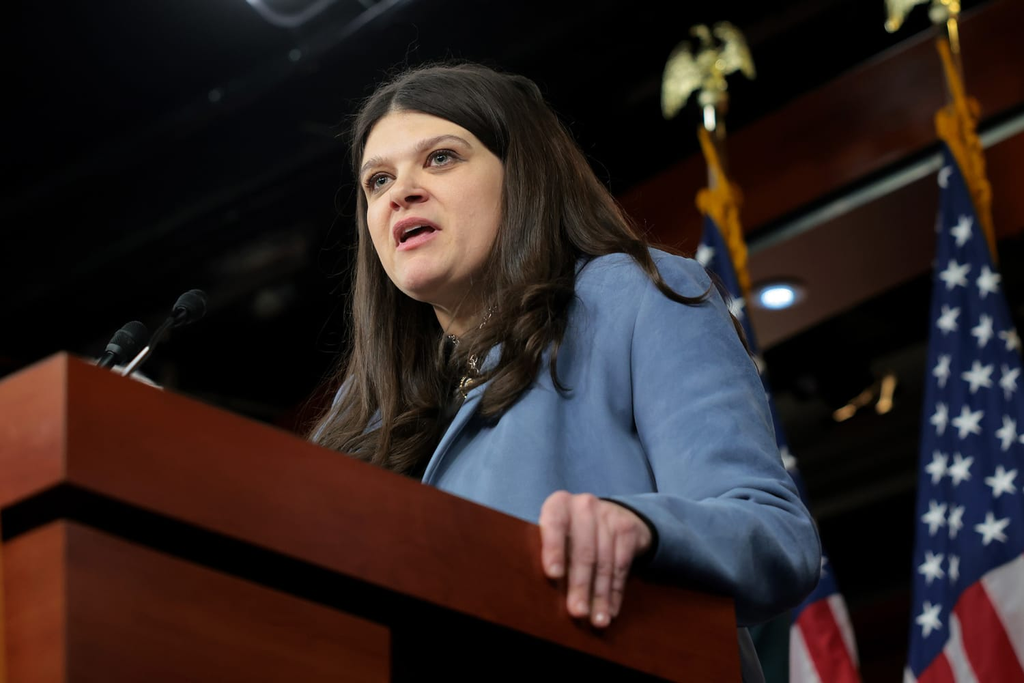
Democratic Congresswoman Haley Stevens dropped a political bomb right in the middle of Michigan. Just 48 hours before polls opened in the critical 2026 midterm elections, Stevens walked away from her own party and endorsed Republican Mike Rogers for the United States Senate.
The shocking move sent immediate tremors across Washington and Detroit. Stevens did not merely release a quiet written statement. She appeared side by side with Rogers at Perfecting Church in Detroit, swaying to gospel music in the pews while her fellow Democrats held their own campaign events only a few miles away.
The decision is one of the rarest cross-party defections in modern American political history. It leaves Democratic Senate nominee Abdul El-Sayed facing a major internal party fracture at the exact moment unity mattered most.
What actually drove a seated Democratic representative to throw her weight behind a Republican rival? The answer involves months of personal animosity, bitter campaign battles over foreign policy, controversial public figures, and an irreconcilable fallout that finally boiled over in the public eye.
The Boiling Point: What Led to Haley Stevens’ Dramatic Endorsement?
Haley Stevens did not wake up on the Sunday before Election Day and decide on a whim to back the opposing party. The rupture was months in the making, tracing directly back to Michigan’s fiercely contested Democratic primary in August 2026.
The $0 Secret To Launching Your Entire Online Empire
Why pay hundreds every month for separate software? Build funnels, send emails, and make sales with Systeme.io completely free.
Get Started For $0Free Forever • No Credit Card Needed • Beginner-Friendly
In that race, Stevens and El-Sayed went head-to-head to secure the Democratic nomination for Michigan’s open Senate seat. The primary contest turned into one of the most expensive and vicious battles of the entire election cycle. Outside super PACs poured tens of millions of dollars into television and digital advertisements. Much of the funding on Stevens’ behalf came from groups affiliated with the American Israel Public Affairs Committee (AIPAC), targeting El-Sayed’s outspoken progressive positions on Middle Eastern policy and the war in Gaza.
When El-Sayed narrowly won the nomination, the wounds from that primary never properly healed. While Stevens gave a standard nominal endorsement after her defeat, party insiders privately noted that tension between the two camps remained thick.
The friction escalated into a full public crisis in the final stretch of the general election campaign. A third-party campaign attack ad surfaced in Michigan, sparking sharp outrage among Stevens’ supporters. The Stevens camp accused El-Sayed’s political network of tolerating inflammatory rhetoric and antisemitism. Just days before the election, Stevens’ own fiancé told reporters at The Detroit News that he could not support El-Sayed and planned to cast his ballot for Republican Mike Rogers.
Stevens then took to national television, urging El-Sayed’s campaign to forcefully call out and shut down hateful rhetoric within its ranks. Rather than bringing the party together, the interview underscored just how wide the divide had become.
The Sunday Split-Screen: A Tale of Two Detroit Churches
The collapse reached the point of no return over a planned unity event. Michigan Democrats had carefully arranged a high-profile “Souls to the Polls” rally in Detroit for Sunday, November 1, 2026. The event was meant to bring party leaders together to energize voters across Wayne County. Stevens was scheduled to share a stage with El-Sayed and veteran South Carolina Congressman James Clyburn.
Before attending, Stevens laid down a strict condition: El-Sayed had to publicly denounce the third-party ads targeting her community and offer a clear apology for rhetoric she considered offensive.
The El-Sayed campaign refused to issue an apology, reiterating that his campaign had not created the ad in question and did not agree with its contents. El-Sayed publicly stated that Stevens was attempting to relitigate a primary that had concluded three months earlier.
With no apology forthcoming, the unity event collapsed. While El-Sayed and Clyburn spoke to voters at Northend Church of God in Christ, Stevens pulled off an unprecedented maneuver. She joined Republican nominee Mike Rogers at Detroit’s Perfecting Church.
In a video statement released shortly after the service, Stevens declared her support for Rogers:
“Our Democratic nominee for Senate said I was no longer welcome in his campaign and that I should stay away. And he’s right. And that’s why I am endorsing Mike Rogers for the United States Senate today.”
Speaking to reporters outside the church, Stevens pointed specifically to prominent left-wing figures and content creators who had rallied around El-Sayed’s campaign. Stevens singled out progressive political streamer Hasan Piker, declaring:
“We can’t stand with hate. We can’t stand with Hasan Piker… I’m still a very proud Democrat. I’m just letting you know where I am.”
Stevens insisted that her endorsement of Rogers was a standalone decision. She stated that she planned to vote for Democrats up and down roughly 90 percent of the ballot, but simply could not support El-Sayed for the US Senate.
How Did Abdul El-Sayed and Democratic Leaders React?
The reaction from party leadership was swift, furious, and uncompromising.
Senate Democratic Leader Chuck Schumer, who had originally backed Stevens in the August primary against El-Sayed, publicly blasted her decision on social media, calling it a “despicable betrayal”. Within hours, Stevens’ own top congressional aide resigned in protest.
Send, Spend & Hold Money Worldwide Without Hidden Fees
Transfer money internationally at the real exchange rate and hold 40+ currencies in one account.
Open a Wise AccountMid-market rate • Fast transfers • 40+ currencies
In Michigan, state party leaders moved to sever ties immediately. Michigan Democratic Party Chairman Curtis Hertel declared that Stevens was officially stripped of her standing in the state party.
“The people of Michigan are betrayed,” Hertel told reporters during the Souls to the Polls gathering. “Haley Stevens is not a current member of the Michigan Democratic Party, nor will she be in the future.”
For his part, Abdul El-Sayed sought to downplay the endorsement entirely. When reporters pressed him outside the church in Detroit, the nominee insisted that ordinary voters were not focused on political infighting.
“At the end of the day, I actually don’t think about Haley Stevens,” El-Sayed told reporters. “None of this matters. You know what matters? There are families who are preparing to send their kids to school tomorrow… They’re worried about what they’re going to feed their kids for lunch. They’re worried that if one of their kids gets sick, they’re not going to be able to pay the bills.”
El-Sayed framed the endorsement as political noise designed for social media attention, urging working-class voters to keep their focus on healthcare access, inflation, and public education.
Republicans Celebrate an Unprecedented Campaign Win
While Democrats scrambled to manage the political fallout, Republicans embraced Stevens’ announcement as a game-changing breakthrough.
President Donald Trump wasted no time praising the congresswoman on Truth Social, hailing what he described as remarkable personal courage. Trump later told campaign reporters that Stevens “said what few people are willing to say,” calling the defection a major validation for the Republican campaign in the battleground state.
Speaker of the House Mike Johnson, traveling with Trump ahead of midterm rallies, echoed those remarks. Johnson described the Michigan contest as a critical “contrast election” and revealed that he sent Stevens a personal note applauding her decision to break party ranks.
For Mike Rogers, a former member of Congress with deep experience on national security committees, having a sitting Democratic representative endorse his candidacy two days before the vote provided an unexpected burst of mainstream credibility with suburban swing voters.
This cross-party move fits right into a broader pattern seen during the 2026 election cycle. Voters have watched several unexpected cross-aisle endorsements, including when outgoing Democrat Jared Golden endorsed Republican Mike Lawler in a major midterm twist. These splits illustrate how internal ideological tensions on both sides of the aisle are reshaping traditional party loyalties.
The $0 Secret To Launching Your Entire Online Empire
Why pay hundreds every month for separate software? Build funnels, send emails, and make sales with Systeme.io completely free.
Get Started For $0Free Forever • No Credit Card Needed • Beginner-Friendly
The Bigger Picture: Ideological Rifts in Michigan Politics
Michigan has long been a bellwether for American national politics. The Wolverine State combines major union manufacturing hubs, influential suburban swing counties in Oakland and Macomb, and significant Arab American, Muslim American, and Jewish American communities.
The bitter primary between Stevens and El-Sayed exposed fault lines that extend far beyond a single seat:
- Foreign Policy and Middle East Debates: The war in the Middle East has profoundly impacted Michigan’s political climate. Stevens, a staunch ally of Israel backed heavily by pro-Israel organizations, clashed directly with El-Sayed, who has been an outspoken advocate for Palestinian rights and a critic of US foreign military aid.
- Moderate Establishment vs. Progressive Wing: Stevens represents the centrist, suburban wing of the Democratic Party that proved vital to reclaiming seats in 2018. El-Sayed represents the energetic, progressive wing aligned with grassroots organizers and younger digital creators.
- The Ripple Effects for 2028: National political analysts at major networks like PBS NewsHour and Al Jazeera note that the bitterness between centrists and progressives in Michigan will not evaporate when the polls close. It signals a deeper identity struggle within the party ahead of the 2028 presidential primaries.
Earlier in the campaign cycle, observers saw hints of intense national focus when Donald Trump took aim at Abdul El-Sayed in the Michigan Senate showdown. With the seat crucial to determining which party controls the US Senate, every fraction of a percent matters.
The high stakes have prompted both major parties to spend heavily in Michigan, as detailed by coverage from CBS News and The Guardian. In an election where control of the upper chamber hangs on a knife’s edge, Stevens’ late departure gave Republicans a powerful narrative talking point at the finish line.
At the same time, this volatility is occurring against a backdrop of wider midterm campaign pressure, where national leaders are crisscrossing the country, as seen when Donald Trump promised a full campaign blitz for the midterms.
What Does This Mean for Voters Heading to the Polls?
For Michigan voters preparing their ballots, the endorsement presents an unusual dynamic.
- Suburban Swing Voters: Moderate voters in counties like Oakland who supported Stevens in previous congressional runs must decide whether to follow her advice and split their tickets, or stick with the party line.
- Progressive Turnout: Progressive activists argue that Stevens’ defection will actually mobilize core Democratic voters who were unenthusiastic about centrist infighting, pushing them to turn out in larger numbers for El-Sayed.
- Republican Momentum: For Mike Rogers, the endorsement serves as a late-stage surge of energy, allowing his campaign to appeal directly to moderate Democrats and independents who might be hesitant about far-right rhetoric.
Frequently Asked Questions (FAQs)
Who is Haley Stevens?
Haley Stevens is a Democratic member of the US House of Representatives representing Michigan’s 11th Congressional District. She first won her seat in 2018 and ran unsuccessfully in August 2026 for the Democratic nomination for the US Senate.
Why did Haley Stevens endorse Republican Mike Rogers?
Stevens stated that she felt unwelcome in Abdul El-Sayed’s campaign following an unresolved dispute over negative campaign ads and controversial political rhetoric. She voiced strong objections to political streaming figures like Hasan Piker supporting El-Sayed and stated that standing against what she viewed as hateful rhetoric led her to cast her vote for Rogers.
Is Haley Stevens switching to the Republican Party?
No. Stevens stated publicly that she remains a Democrat and plans to vote for Democratic candidates in approximately 90 percent of the contests on her ballot. However, the Michigan Democratic Party announced that she has been removed from the state party rolls and is no longer recognized as a party member.
Who is Mike Rogers?
Mike Rogers is a Republican politician and former US Representative from Michigan who served as the chairman of the House Intelligence Committee. He is running for the US Senate seat in Michigan against Democratic nominee Abdul El-Sayed.
How did Abdul El-Sayed respond to the endorsement?
El-Sayed brushed aside the announcement, telling reporters that ordinary voters do not care about internal political drama. He emphasized that his campaign remains focused on everyday kitchen-table issues such as healthcare, food costs, and public education.
The sudden endorsement of Mike Rogers by Haley Stevens highlights the deep divisions that can erupt when primary rivalries remain unaddressed until the bitter end. Whether this dramatic move will swing the balance of power in the US Senate or simply mark the end of Stevens’ future within the Michigan Democratic Party is a question voters will answer at the ballot box.
