
President Donald Trump signed an executive order directing federal agencies to change the official name of Lake Ontario to “Lake America” across all official United States government records. The move comes as trade negotiations between the United States and Canada broke down, sparking fresh tariffs and heated statements from political leaders on both sides of the border.
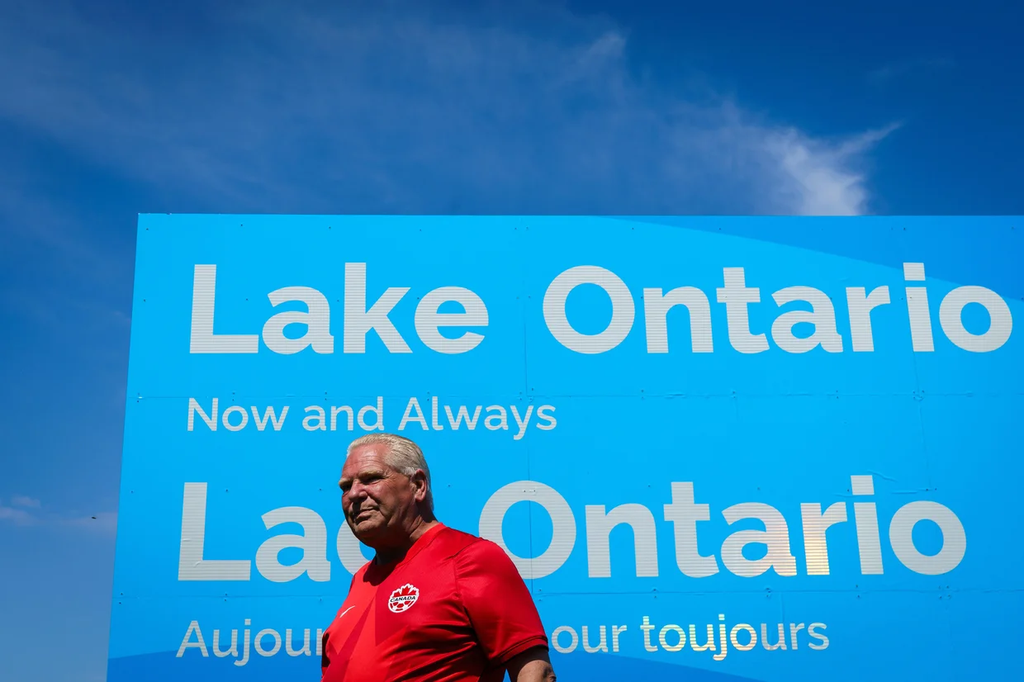
The announcement triggered immediate pushback from Canadian leaders and Indigenous nations. Ontario Premier Doug Ford responded by traveling to the shores of the lake and erecting a massive blue sign that reads “Lake Ontario – Now and Always.”
At the same time, leaders from the Seneca Nation called for an immediate reversal of the order, warning that attempting to rename the body of water violates centuries of treaty law and disrespects Native American history.
The political feud has quickly turned a major international waterway into the focal point of a growing diplomatic dispute. As the 30-day deadline for federal agencies to update geographic databases approaches, the move has raised legal, historical, and practical questions about who gets to name a body of water shared by two sovereign nations.
What Does Trump’s Executive Order Actually Do?
The decree signed by President Trump orders the United States Department of the Interior and Secretary Doug Burgum to remove references to Lake Ontario from federal records. Under the directive, the United States Geographic Names Information System has 30 days to update its official mapping database to reflect the new name, “Lake America.”
The $0 Secret To Launching Your Entire Online Empire
Why pay hundreds every month for separate software? Build funnels, send emails, and make sales with Systeme.io completely free.
Get Started For $0Free Forever • No Credit Card Needed • Beginner-Friendly
In the text of the order, the administration argues that the United States does more than Canada to maintain and protect the Great Lakes freshwater system. The order points to federal investments made by the U.S. Coast Guard, including icebreaking operations and environmental funding, as the justification for claiming naming rights over the lake.
However, the legal reach of an executive order is strictly limited to federal agencies within the United States. A presidential decree cannot force foreign governments, international mapping agencies, or private organizations to adopt a new name. Canadian officials made it clear immediately that their government, mapping systems, and public signs will continue to use Lake Ontario.
For everyday citizens and businesses, the practical changes remain confined to U.S. government documents and federal websites. Private mapping tools, GPS navigation systems, and digital platforms are under no legal obligation to alter their labels.
News outlets and digital media platforms are closely monitoring how software platforms update geographic data, a topic often explored in discussions around modern technology and AI applications in digital mapping.
Lake Ontario Quick Facts
- Shared Border: Connects the province of Ontario, Canada, and New York State, USA.
- Indigenous Origin: Derived from the Huron/Iroquoian word “oniatarí:io” meaning “lake of shining waters” or “beautiful lake.”
- U.S. Federal Order: Directs U.S. agencies to use “Lake America” within 30 days.
- Canadian Position: Rejects the change completely; keeps “Lake Ontario” official
Premier Doug Ford Erects Shoreline Sign in Protest
Ontario Premier Doug Ford took direct action to counter the U.S. executive order by unveiling a billboard-sized sign on the Canadian shoreline of the lake. Standing at Fifty Point Conservation Area in Grimsby, Ontario, Ford wore a Team Canada soccer jersey as he unveiled the large blue sign displayed in both English and French.
The sign reads “Lake Ontario – Now and Always” on one line, followed by the French translation, “Lac Ontario – Aujourd’hui et pour toujours.” In a video posted to social media, Premier Ford addressed the Canadian public directly from the waterfront, criticizing the White House for targeting a landmark simply because Canada defended its economic interests during trade talks.
Ford stated during his speech:
“Long after President Trump is gone, it will still be called Lake Ontario. We put up this sign to remind everyone that it is Lake Ontario now and forever.”
The Premier also noted that the name Ontario existed long before the founding of the United States or the Confederation of Canada. The province of Ontario itself was named after the lake when the province was created in 1867, not the other way around.
The feud between Premier Ford and President Trump has grown increasingly personal in recent weeks. After trade talks stalled, Trump publicly criticized Ford, while Ford pointed out that the economic friendship between the United States and Canada was being damaged by unnecessary political spats. Ford’s shoreline sign serves as both a public statement and a symbol of national pride for Canadians who reject any attempt to rebrand their geography.
Seneca Nation Calls for Immediate Reversal
While Canadian politicians responded with public signs and statements, Indigenous leaders raised serious legal and historical objections. Seneca Nation President J. Conrad Seneca issued a formal statement calling on President Trump to rescind the executive order immediately, as reported by CBS News.
The leader of the Seneca Nation emphasized that Lake Ontario is not the property of the United States government. Indigenous peoples lived along the shores of the Great Lakes for thousands of years before European settlement or the establishment of modern nation-states. Trying to erase that history with a political stroke of a pen, he argued, shows blatant disrespect to Native American communities.
President J. Conrad Seneca stated:
“The President cannot assert ownership over our culture or erase it through irresponsible political action. The name Lake Ontario should remain as a reflection of the Indigenous people who lived along the lake long before the creation of either nation.”
Send, Spend & Hold Money Worldwide Without Hidden Fees
Transfer money internationally at the real exchange rate and hold 40+ currencies in one account.
Open a Wise AccountMid-market rate • Fast transfers • 40+ currencies
The Seneca Nation also pointed to a foundational legal document: the 1794 Treaty of Canandaigua. Signed by President George Washington and the Six Nations of the Haudenosaunee Confederacy (also known as the Iroquois Confederacy), the treaty established peace and explicitly recognized the sovereignty and lands of Indigenous nations. Seneca leaders argue that unilaterally renaming land and water features in traditional territories undermines the spirit of those historical agreements.
Other Indigenous leaders across the region shared similar concerns. Grand Chief Pierre Picard of the Huron-Wendat Nation expressed outrage over the directive, pointing out that the word “Ontario” originates from the Huron word oniatarí:io, which translates to “lake of shining waters” or “beautiful lake”. In the traditional Seneca language, the lake is called sga:nyodai:yoh, which carries a similar meaning of a grand, beautiful body of water.
Trade War Dynamics Behind the Name Dispute
The debate over the name of the lake did not happen in a vacuum. It is directly tied to an escalating economic conflict between Washington and Ottawa. Negotiation sessions between the U.S. administration and Canadian Prime Minister Mark Carney collapsed after both sides failed to agree on trade tariffs and market access.
Following the breakdown of those meetings, the White House announced fresh tariffs on key Canadian goods. Canada responded by announcing dollar-for-dollar retaliatory tariffs scheduled to take effect in early September. President Trump then publicly suggested that the United States might reduce its business relationships with Ontario, eventually leading to the executive order targeting the lake’s name.
Canadian Prime Minister Mark Carney rejected the U.S. executive order in a public statement released shortly after the signing, as covered by the Associated Press. Carney emphasized that Canada remains firm in its identity and sovereignty, noting that respecting reality means calling the lake by its rightful name.
Other Canadian provincial leaders weighed in with strong statements. Manitoba Premier Wab Kinew commented on the situation, suggesting that political attempts to rename international landmarks look out of touch and do not help solve real economic challenges facing working families.
Despite the political tension, trade experts point out that the supply chains connecting Ontario and neighboring U.S. states like New York, Michigan, and Ohio are deeply integrated. Shipping along the Great Lakes remains vital for both economies, regardless of political statements made in Washington or Toronto.
Viral Culture, Online Media, and Public Reaction
As news of the executive order spread, the topic quickly dominated social media platforms, commentary channels, and digital news outlets. Online creators and political analysts immediately began breaking down the story for millions of viewers across video sharing sites.
The intersection of breaking news, political satire, and viral content creation plays a massive role in how the public receives news today. Many independent creators cover these rapid political developments on popular channels, utilizing modern strategies related to YouTube automation to publish timely updates and explanations as stories unfold.
Online reactions ranged from serious commentary on international law to lighthearted satire. Canadian citizens posted photos of the lake with local geography facts, while historians shared detailed breakdowns of the 1794 Treaty of Canandaigua to educate the public on Indigenous land rights.
The $0 Secret To Launching Your Entire Online Empire
Why pay hundreds every month for separate software? Build funnels, send emails, and make sales with Systeme.io completely free.
Get Started For $0Free Forever • No Credit Card Needed • Beginner-Friendly
Meanwhile, major news agencies faced practical decisions regarding their style guides and mapping references. While official U.S. government websites may update their terminology to comply with the executive order, global news organizations and cartographers typically follow established international naming standards. Because the lake lies halfway inside Canadian territorial waters, international databases continue to list the body of water as Lake Ontario.
How to Follow the Story and Join the Conversation
Staying informed on international news, policy changes, and trending global events requires clear and reliable updates. You can connect with our community and join ongoing discussions across our official social media channels:
- Follow our visual updates on Instagram.
- Connect with our community page on Facebook.
- Get real-time news commentary and alerts on X (formerly Twitter).
If you have feedback, questions, or news tips about breaking political events or trending cultural stories, feel free to visit our contact page to reach out directly to our writing team. To learn more about our mission and editorial standards, check out our about page.
Frequently Asked Questions
Can a U.S. President unilaterally rename a body of water shared with another country?
A U.S. President can issue executive orders directing U.S. federal agencies to use specific names in official government databases, maps, and documents. However, an executive order has no legal authority over foreign nations, international cartography organizations, or private companies. Canada retains full authority over its territory and will continue using Lake Ontario.
What is the Treaty of Canandaigua, and why is the Seneca Nation citing it?
The Treaty of Canandaigua was signed in 1794 between President George Washington’s administration and the Six Nations of the Haudenosaunee Confederacy. It established peace and acknowledged the lands belonging to Indigenous nations. Seneca Nation leaders cite this treaty because attempting to erase Indigenous names from traditional lands violates historical agreements and respects sovereign rights.
What does the word “Ontario” mean?
The word “Ontario” comes from the Huron/Iroquoian language word oniatarí:io, which means “lake of shining waters” or “beautiful lake.” The name was used by Indigenous peoples long before European explorers arrived in North America and predates both the United States and Canada.
Will private companies like Google Maps or news outlets change the name to Lake America?
Private companies, news publishers, and mapmakers are not legally required to follow executive orders regarding geographic names. Most international cartographers and global platforms follow international consensus and official names recognized by both bordering nations, meaning the name Lake Ontario will likely remain standard across private software.
What did Ontario Premier Doug Ford do in response to the order?
Premier Doug Ford traveled to Fifty Point Conservation Area along the shore of Lake Ontario and unveiled a billboard sign that reads “Lake Ontario – Now and Always” in English and French. He also posted a video message asserting that the lake’s original name will outlast any political administration.
The debate surrounding Lake Ontario highlights the deep connections between history, diplomacy, and cultural identity. While executive orders can change domestic federal databases in the United States, they cannot easily rewrite centuries of shared history or erase the Indigenous roots of the Great Lakes region. As economic negotiations between the United States and Canada continue, local communities on both sides of the border remain focused on protecting their shared natural resources and preserving the historical names that define the region.
