
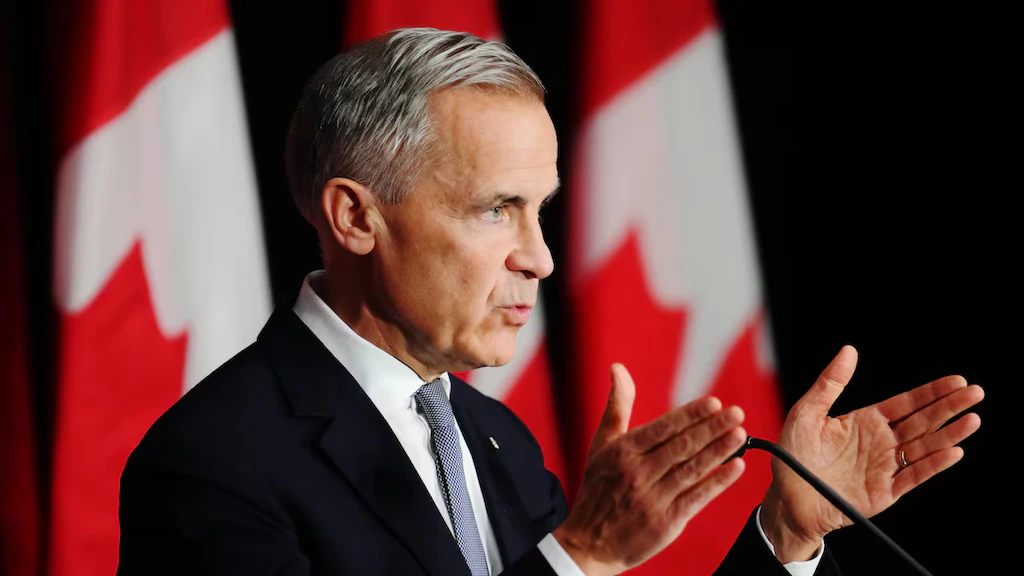
Canada is facing one of the most critical political showdowns in its modern history as voters in Alberta prepare to cast their ballots on their future within the federation. Canadian Prime Minister Mark Carney traveled straight into the heart of oil country this week, delivering an urgent plea for national unity and warning that the stakes could not possibly be higher. Speaking before packed crowds in Calgary and across the province, the Prime Minister cautioned that treating this vote as a casual political bluff risks triggering years of economic chaos and deep national division.
With advance polls already recording record turnout numbers, hundreds of thousands of Albertans have cast their ballots early. The tension across the province is thick, conversations around kitchen tables are heated, and the federal government in Ottawa is watching every single move with held breath. This is not just routine provincial politics. It is a genuine crossroads moment that could redefine Canada forever.
What Sparked the Crisis in Calgary?
Prime Minister Mark Carney took his message directly to local workers, community organizers, and pro-Canada volunteers in Alberta just days before the final vote on Monday, October 19. Standing before supporters, Carney made it clear that breaking away or even flirting with separation at this exact moment in global history is a massive mistake.
He pointed to a global landscape filled with shifting alliances, fierce economic competition, and foreign trade pressure. Carney argued that outside powers would love nothing more than to see Canada divided and weakened from within. When a country is split, it loses its leverage on trade deals, its voice on world matters, and its power to protect its own people.
His message was blunt: you cannot build massive national projects on geological fault lines. If Canada begins to crack down the middle, every major economic initiative—from coast-to-coast energy transport to new housing networks—grinds to an immediate halt. Carney stressed that generations of Albertans helped build Canada into what it is today, and that staying together is the only real shield against global instability.
The $0 Secret To Launching Your Entire Online Empire
Why pay hundreds every month for separate software? Build funnels, send emails, and make sales with Systeme.io completely free.
Get Started For $0Free Forever • No Credit Card Needed • Beginner-Friendly
Unpacking the Ballot: What Are Albertans Actually Voting On?
Many people following the headlines assume Albertans are simply checking a single box that says “leave Canada tomorrow.” That is not what is happening on October 19.
Voters across the province are answering a massive ten-question ballot designed to reshape how the province interacts with the rest of the nation. The list covers everything from social services to federal power balance. Five of the questions focus on provincial control over immigration, residency requirements for social assistance, and requiring official citizenship documents to cast ballots in provincial elections. Four questions target the Canadian Constitution, asking whether Alberta should work with other provinces to abolish the federal Senate, pick its own provincial judges, and opt out of Ottawa-run programs while keeping the federal funding.
The final item on the sheet—Question 10—is the heavyweight that has Ottawa on edge. It asks voters whether Alberta should stay as a province inside Canada or direct its provincial government to begin the official legal process toward holding a binding referendum on outright separation. For a comprehensive look at the ballot, you can read the CBC News guide to Alberta’s 10 referendum questions.
Question 10 is essentially a referendum on whether to have a future breakup referendum. Even though a “yes” vote does not immediately create an independent country called Alberta on Tuesday morning, it triggers a legal and political domino effect that could prove impossible to stop.
Why Are Albertans So Angry with Ottawa?
To understand why this vote is happening at all, you have to look at decades of deep-seated frustration in Western Canada. Albertans often talk about “western alienation,” which is the feeling that decisions about their jobs, resources, and families are made thousands of miles away by politicians in Ottawa who do not understand or respect their way of life.
Alberta is the powerhouse of the Canadian energy industry. It holds the world’s fourth-largest proven oil reserves and produces the vast majority of the oil and natural gas that keeps the country running and brings billions of export dollars into the national economy. For decades, Albertans have watched their tax dollars flow east through federal equalization payments to fund schools, roads, and hospitals in other provinces.
Yet, when Alberta needed pipelines built to get its oil to overseas markets, Ottawa passed strict environmental regulations, delayed pipeline reviews, and canceled key projects. Many workers in towns like Fort McMurray, Red Deer, and Grande Prairie felt abandoned. Small businesses folded, energy investments fled abroad, and local families struggled through bruising economic downturns.
To many Albertans, it feels like Ottawa loves spending Alberta’s oil revenue, but hates the oil workers who generate it. That sense of unfair treatment built up year after year until it reached a boiling point.
Mark Carney’s Strategy: Deliver Results Instead of Lectures
Prime Minister Mark Carney is taking a very different path than previous federal leaders when speaking to the West. Instead of dismissing Albertan anger or lecturing the province, Carney has openly acknowledged that federal mistakes were made in the past.
His unity tour across the province carries a clear pitch: “Let Alberta lead, not leave”.
To back that up with real action, Carney recently announced federal approval and designated the massive Pacific Link pipeline as a project of urgent national interest. This proposed pipeline is planned to carry crude oil directly from Alberta’s energy heartland straight to the Pacific coast for international export, creating over 140,000 jobs along the way. For ongoing coverage of the Prime Minister’s campaign, check out the Associated Press report on Carney’s Alberta unity tour.
Carney is telling voters that a united Canada is finally delivering the market access Alberta has demanded for decades. By backing the pipeline, Carney aims to prove that working within Confederation delivers tangible jobs and paychecks, while walking away offers only legal gridlock and financial turmoil.
Danielle Smith’s Balancing Act: Walking the Tightrope
Alberta Premier Danielle Smith finds herself in an extraordinary position throughout this entire referendum campaign.
Smith leads the United Conservative Party and was the leader who placed these questions on the ballot in the first place. She has spent years fighting federal carbon taxes, challenging Ottawa’s emissions caps, and demanding stronger provincial powers.
Yet, when advance voting opened this week, Premier Smith cast her personal ballot and publicly confirmed she voted against separation. She stated clearly that she wants Alberta to remain inside Canada, adding that while the system needs major structural changes, the country can still work.
Send, Spend & Hold Money Worldwide Without Hidden Fees
Transfer money internationally at the real exchange rate and hold 40+ currencies in one account.
Open a Wise AccountMid-market rate • Fast transfers • 40+ currencies
Why put separation on the ballot if you intend to vote against it?
Smith is balancing two massive forces. On one side are hardline independence supporters inside her political base who want an immediate divorce from Canada. On the other side is the broad majority of Albertans who are deeply frustrated with Ottawa but do not want to tear up their Canadian passports, surrender the Canadian dollar, or risk their life savings on an untested political experiment.
By putting Question 10 to a vote, Smith gave separatists their platform while using the threat of separation as maximum leverage in her ongoing negotiations with Ottawa. However, as the Prime Minister warned, playing high-stakes poker with the future of a country can quickly spin out of control if voters decide to call the bluff.
The Legal and Constitutional Reality: Can Alberta Just Walk Away?
Even if Question 10 passes with a majority “yes” vote, Alberta cannot simply declare itself an independent nation overnight.
Canada has an explicit legal framework for secession, established by the Supreme Court of Canada in its landmark 1998 decision following the Quebec independence referendum. The highest court ruled that a Canadian province has no right under domestic or international law to separate unilaterally.
If a clear majority of citizens vote “yes” on a clear question regarding independence, the rest of Canada has an obligation to negotiate terms. Those negotiations would be long, painful, and messy. They would involve:
- Dividing up Canada’s massive national debt, requiring an independent Alberta to take on hundreds of billions of dollars in federal debt obligations.
- Renegotiating borders and access rights, since international law does not guarantee that a breakaway region keeps all its current territory intact.
- Resolving binding treaties signed with First Nations and Indigenous communities, whose ancestral lands cover Alberta and who hold direct constitutional agreements with the Canadian Crown.
- Deciding the fate of currency, postal delivery, national defense, border checkpoints, and trade access across Canada.
Because Alberta is entirely landlocked, surrounded by other Canadian provinces and the United States, an independent Alberta would remain completely dependent on Canadian and American goodwill just to get its oil, beef, and grain to foreign seaports. Walking away from the country does not eliminate geographic reality.
The Economic Question: What Happens to Ordinary Families?
Beyond the political speeches, the practical economic questions for everyday families living in Calgary, Edmonton, Lethbridge, and Red Deer are enormous.
Think about everyday banking. If Alberta separates, what happens to mortgages, bank accounts, and car loans held at major Canadian banks? Would Alberta create its own currency, or would it try to use the US dollar or the Canadian dollar without having any say in national interest rates?
What happens to retirement savings? Albertans have paid billions of dollars into the Canada Pension Plan over their working lives. Pulling out to build an isolated provincial pension plan carries enormous startup costs and financial risks, especially if energy markets experience a sudden downturn.
The $0 Secret To Launching Your Entire Online Empire
Why pay hundreds every month for separate software? Build funnels, send emails, and make sales with Systeme.io completely free.
Get Started For $0Free Forever • No Credit Card Needed • Beginner-Friendly
Then there is the issue of border security and trade. Right now, goods and workers move seamlessly between Alberta, British Columbia, Saskatchewan, and the rest of Canada without customs delays or tariffs. Establishing a hard national border would create supply chain bottlenecks for local groceries, manufacturing parts, and retail goods, driving prices higher for ordinary shoppers.
Economic analysts have estimated that breaking away could cost the province tens of billions of dollars in initial transition costs, sparking capital flight and spooking international corporations looking for safe places to invest. That is why business groups and chamber of commerce leaders across Calgary and Edmonton have urged stability over separation.
What the Opposition and Other Provinces Are Saying
The Alberta vote has ignited debates across every corner of Canadian politics.
Federal Conservative Leader Pierre Poilievre has made stops in Calgary to make his own passionate pitch for Canadian unity. While Poilievre agrees with Albertans that Ottawa has overreached with costly regulations and taxes, he argues that the solution is to elect a common-sense federal government that respects provincial jurisdiction—not to destroy the country from within.
Leaders in neighboring provinces like Saskatchewan and British Columbia are watching closely as well. Saskatchewan Premier Scott Moe shares many of Alberta’s policy frustrations regarding natural resources, but he has consistently pushed for provincial autonomy inside Canada rather than outright separation. Meanwhile, in British Columbia, leaders are cautious about any move that could complicate cross-border trade, environmental protections, and pipeline corridors running to coastal ports.
Across the wider Canadian public, there is a mix of concern and bewilderment. Most Canadians recognize Alberta’s immense contribution to the national economy, but many struggle to understand why anyone would want to fracture one of the most prosperous, peaceful, and free countries on earth.
Frequently Asked Questions About the Alberta Separation Vote
When does voting take place?
Advance voting opened earlier in the week and runs through Saturday, with the final official referendum polling day scheduled for Monday, October 19.
Does a “yes” vote mean Alberta leaves Canada immediately?
No. Question 10 asks whether the Alberta government should start the legal process required under the Canadian Constitution to hold a binding referendum on separation in the future. It is a mandate to begin legal preparations and potential negotiations, not an immediate declaration of independence.
What are the other questions on the ballot?
The ballot includes nine other questions. Five address provincial immigration rules, health care and education fees for temporary residents, and citizenship proof for provincial voters. Four address constitutional amendments, such as abolishing the federal Senate, giving Alberta power over appointing provincial judges, and opting out of federal programs while keeping the funds.
Where does Premier Danielle Smith stand?
Premier Danielle Smith supports the first nine reform questions but personally cast her ballot against separation on Question 10, stating that she believes Canada can still work if provincial autonomy is respected.
How has Prime Minister Mark Carney responded?
Prime Minister Carney has campaigned directly in Alberta, arguing that national division will hurt major resource projects like the Pacific Link pipeline. He warned that separation is a dangerous bluff that will lead to years of economic chaos and weaken Canada against foreign pressures.
Standing at the Crossroads
As voting booths prepare for the final rush on Monday, Albertans hold the cards in an event that will reverberate far beyond their borders.
The frustration that brought this referendum to life is genuine. Decades of federal neglect, regulatory roadblocks, and political dismissiveness have pushed a proud, hardworking province to the edge. But as Prime Minister Mark Carney emphasized during his stops across Calgary, the path forward cannot be built on burning bridges.
The choice facing Alberta is whether to channel its immense economic power and growing political leverage into leading the country, or to step into the dark unknown of constitutional separation. With hundreds of thousands of ballots already in the boxes, the world is waiting to see whether Albertans choose to rebuild their partnership within Canada or start the long, uncertain process of walking away.
