
17 Million Nigerians Abroad Are Craving Pounded Yam; So Why Are So Few People Supplying It?
Nigeria grows 70% of the world’s yam, yet most of it rots before it reaches the people who need it most.
Discover how to produce and export pounded yam flour to Nigerians abroad: from sourcing yams to getting NAFDAC certified and shipping your first container profitably.
Introduction
Let me ask you something.
You’re sitting in Lagos, Benue, or Oyo surrounded by one of the most abundant food crops on earth.
Nigeria produces over 61 million metric tonnes of yam every single year.
Sixty-one million. That’s more than any other country in the world, by a wide margin.
And yet, somewhere in London, a Nigerian woman is paying £9 for a 450g bag of pounded yam flour. In Houston, a family is driving 40 minutes to the nearest African grocery store just to pick up a pack that might be out of stock.
In Toronto, a student is on a WhatsApp group begging someone traveling from Nigeria to bring “at least two bags of Poundo.”
That gap between what Nigeria produces and what the diaspora can actually access? That’s not just a cultural inconvenience. That’s a business opportunity hiding in plain sight.
This article is for anyone curious about what it actually takes to tap into that market: producers, investors, exporters, or simply someone who’s been wondering whether pounded yam flour could be a serious export product.
Spoiler: it can. And the numbers are more interesting than you might think.
From Nigerian Farm to Foreign Kitchen: What the Pounded Yam Flour Export Business Really Looks Like
So here’s the gìst
Nigeria accounts for more than 70% of global yam production, but only about 5% of that yam gets processed into flour.
The rest? Either consumed locally, sold raw, or lost to post-harvest spoilage; because yam tubers start deteriorating within two to three weeks of harvest.
Meanwhile, there are over 17 million Nigerians living in more than 40 countries.
A good number of them grew up eating pounded yam. It’s not just food to them; it’s memory, identity, Sunday afternoons with family.
And they’re willing to pay a premium for something that feels like home.
That’s the business case, plain and simple. You’re not creating demand. The demand already exists. You’re just figuring out how to meet it.
What Kind of Yam Actually Works for Flour?
Not every yam makes good flour. If you get this wrong at the start, the rest of the process suffers.
The best variety for pounded yam flour is white yam; specifically Dioscorea rotundata, particularly the Ikokoro and Puna types.
These are firm, low in moisture, and produce that smooth, stretchy texture when reconstituted.
You want tubers that are fully mature, at least 10 to 12 months old, with a dry matter content above 25%.
Avoid water yam. It has too much moisture and produces a gummy, sticky texture that customers won’t accept — especially in a diaspora market where people are comparing your product to what they remember from home.
Sourcing happens mainly in Nigeria’s Middle Belt: Benue, Nasarawa, Kogi — and parts of the Southwest like Oyo, Ondo, and Osun. These states have established yam markets and relatively better road access for bulk movement.
The Production Process, Broken Down Simply
This isn’t a complicated product to make. But like most food businesses, the details matter.
Here’s how it goes, step by step:
The yams come in and get sorted. Damaged or rotten tubers are removed.
Then they’re washed thoroughly, peeled either by hand or with semi-automatic peelers and sliced into uniform pieces, usually 3 to 5 millimeters thick.
After slicing, the pieces are parboiled for 5 to 10 minutes. This partial cooking improves flavor, reduces drying time, and helps with food safety.
Then comes the most critical step: drying. The slices go into cabinet or flash dryers at 60 to 70 degrees Celsius until the moisture content drops to between 10 and 12%.
If you get the drying wrong, you get mold. And mold means rejected shipments, lost money, and a damaged reputation.
Once dry, the chips are milled into fine flour particle size around 150 to 250 microns; sieved to remove lumps, cooled, and packed.
Packaging sizes that move well in the diaspora market are 450g, 900g, 1.8kg, and 4.5kg. Restaurants and caterers often prefer the larger 9.1kg bags.
What Does It Cost to Set This Up?
Here’s where people often get intimidated. But let’s be honest about the numbers.
A commercial-scale setup: machines, warehouse, working capital, certifications, a delivery van, and initial marketing comes in around 49.5 million naira. That’s the full package.
But you don’t have to start there.
A small-scale entry using semi-automatic equipment can begin with as little as 5 to 10 million naira.
And one route many people don’t think about: contract manufacturing.
You partner with a factory that already has NAFDAC certification, produce under their license while you build your own, and start selling while the paperwork catches up.
That last part is important, because NAFDAC certification for a new food manufacturing facility can take 6 to 12 months.
If you’re waiting on that before you make your first sale, you’re leaving a lot of time and money on the table.
Certifications and Export Documents You’ll Need
This is the part most people gloss over, but it’s genuinely important.
To legally export processed food from Nigeria, you’ll need a few things at minimum:
Your Exporter’s Certificate from the Nigerian Export Promotion Council. A NAFDAC Health Certificate for your processed product. A Phytosanitary Certificate from NAQS. A Fumigation Certificate if required.
A Certificate of Origin from NACCIMA. And the NXP Form from your commercial bank, which captures the export value and connects you to the Export Expansion Grant.
On the destination side, the requirements vary. The US wants FDA registration and facility registration. The UK has its own Defra standards. Canada requires CFIA compliance.
If you’re shipping to EU countries like the Netherlands or Spain, you’ll need to meet EU food safety standards and sometimes label in the local language.
None of this is impossible. It’s just paperwork. The key is knowing what’s needed before your first shipment, not after.
What Are People Paying in the Diaspora?
This is where it gets interesting.
A 450g pack of pounded yam flour retails in the US for $8 to $12. In the UK, it’s £6 to £9. In Canada, CAD $10 to $14. In the Netherlands, a 900g pack goes for €12 to €16.
Compare that to local production costs, and you’re looking at a 3 to 5x markup on retail. Even after freight, duties, and distributor margins, the export margin on processed yam flour can reach up to 100%.
That’s not hype. That’s the value-add that comes from processing, packaging, and distribution and from serving a market that doesn’t have another good option.
How the Distribution Actually Works
You don’t just pack flour into bags and ship them to “the diaspora.” You need actual buyers.
The primary channel is African grocery stores. These are the small, often family-run shops that cater to African and Caribbean communities in cities across the US, UK, Canada, and Europe. They’re hungry for reliable suppliers.
Many of them struggle with consistency: products go out of stock, quality varies, suppliers disappear.
If you can show up as a consistent, quality supplier, the conversations get much easier.
Other channels worth building into your strategy: diaspora wholesalers who distribute to multiple stores, Nigerian community networks on WhatsApp and social media, and e-commerce; Amazon, Jumia Global, or your own website.
Diaspora community networks are underrated. Church groups, cultural associations, Nigerian student unions; these communities talk to each other. If your product is good, word travels. If it’s not, that also travels.
The Real Challenges (And How People Manage Them)
Let’s be straight about what makes this hard.
Post-harvest loss is a real problem. Yam starts spoiling fast, so you need to process quickly or have cold storage. Power instability in Nigeria affects machinery-dependent production; most serious operations run generators or solar hybrids as backup.
Currency fluctuation affects your margins, which is why serious exporters price in dollars and maintain domiciliary accounts.
And shipping costs can be volatile; a good freight forwarder who specializes in African food exports is worth their weight in gold.
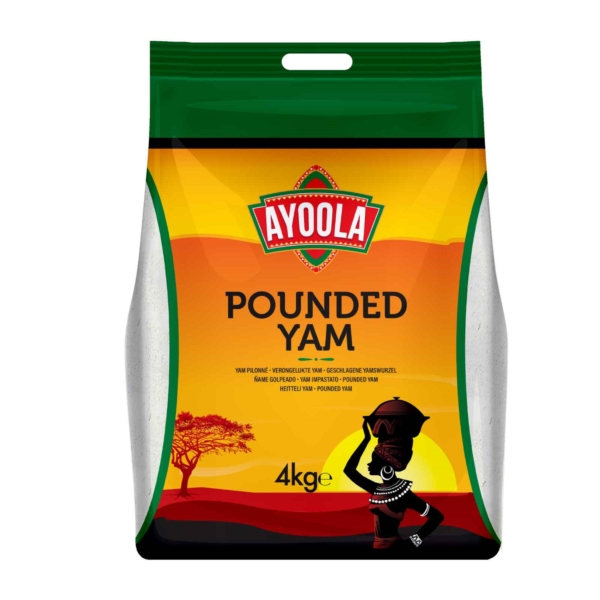
Competition from established brands like Ayoola exists, but the market is not saturated.
There’s real room for quality entrants, especially those willing to focus on niche communities, invest in branding, or offer private labeling for diaspora entrepreneurs who want to launch their own brand.
A Quick Word on the Bigger Picture
There’s something worth stepping back to appreciate here.
Nigeria has the raw material. It has the farmers. It has the processing know-how.
And it has a diaspora that is literally searching for this product every week in grocery stores across multiple continents.
The gap isn’t about resources. It’s mostly about execution; who’s willing to do the paperwork, build the relationships, maintain the quality, and ship consistently.
That gap is where the opportunity lives.
