
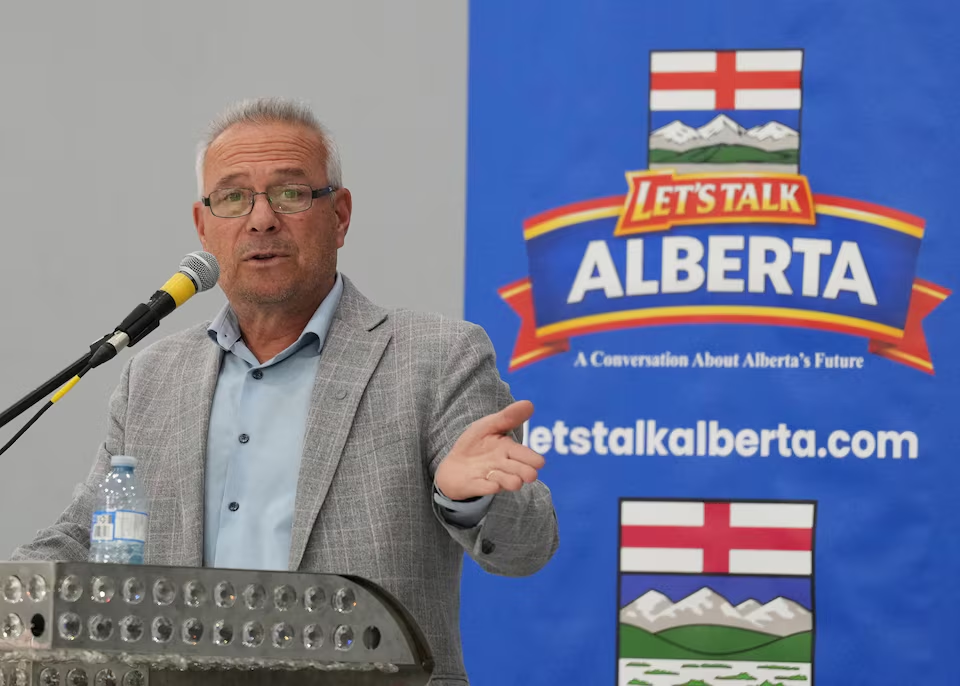
Canada is facing one of the most dramatic political showdowns in its modern history. Voters across Alberta are stepping into voting booths to answer a question that once sounded like political science fiction: should the oil-rich western province start walking out the door?
Talk of breaking away is no longer just chatter in rural coffee shops or angry debates on social media. It is now printed directly on official government ballots. On October 19, 2026, Albertans are taking part in a historic provincial referendum, and the final question asks whether the province should start the legal process required to hold a binding vote on separating from Canada.
The idea of Canada breaking apart has sent shockwaves from Edmonton all the way to Parliament Hill in Ottawa. Prime Minister Mark Carney has stepped into the ring, pleading for unity and warning that dividing the country makes everyone weaker. Meanwhile, provincial leaders, grassroots independence groups, Indigenous chiefs, and everyday citizens are locked in a fierce debate over Alberta’s money, identity, and future.
If you are trying to make sense of what is happening, you are not alone. Let us break down exactly what this referendum is, why people are so upset, what the law actually says, and what an independent Alberta would mean for everyday life.
What Is on the Ballot?
This vote is not a small, quiet event. In fact, it is the largest single exercise in direct democracy in Canadian history.
The $0 Secret To Launching Your Entire Online Empire
Why pay hundreds every month for separate software? Build funnels, send emails, and make sales with Systeme.io completely free.
Get Started For $0Free Forever • No Credit Card Needed • Beginner-Friendly
Voters in Alberta are facing a stack of 10 different color-coded ballots. Nine of those questions ask about hot-button provincial matters like immigration control, access to local healthcare, public education, social care, and tighter rules for voter identification.
The headline act sits at the very bottom of the pile. Question 10 asks voters whether Alberta should stay a Canadian province or begin the legal process needed to hold a future, legally binding referendum on separation.
The current vote itself does not instantly declare Alberta an independent country overnight. Instead, it works like a giant starter pistol. If a majority of voters choose “leave,” it formally commands the provincial government to trigger legal steps and negotiations aimed at eventually holding an official, binding exit vote.
According to Elections Alberta, every single ballot will be counted by hand, with the question on separation scheduled to be counted first so the country gets an answer as quickly as possible.
Why Are So Many Albertans Frustrated with Canada?
To understand why anyone wants to split, you have to understand a feeling known as western alienation. This is not a new mood. It has been simmering under the surface in Western Canada for more than a century.
Alberta sits on the fourth-largest proven crude oil reserve on planet Earth. Its energy sector, farming, and cattle industries generate hundreds of billions of dollars every year. For decades, many Albertans have felt that they do all the heavy lifting for the national economy, only to get bossed around by federal politicians in Ottawa who live thousands of kilometers away.
The biggest complaint usually comes down to money and control.
The Equalization Argument
Canada has a federal system called equalization. It is designed to take tax revenue collected across the country and distribute payments to provinces with weaker economies, ensuring all Canadians get comparable public services like hospitals and schools.
Because Alberta has had a booming economy for decades, its taxpayers have sent billions of dollars more to the federal government than the province gets back in federal spending. Many local residents feel like an economic workhorse that gets treated like an afterthought. They see their tax dollars funding public transit, daycares, and services in other provinces while federal regulations make it harder to build oil pipelines or expand energy projects at home.
Federal Regulations and Energy Frustrations
Over the last decade, federal climate policies, carbon pricing, and caps on emissions have created huge friction between Alberta and Ottawa. Local energy workers often feel that national environmental targets target their jobs directly.
When politicians in eastern Canada talk about phasing out fossil fuels, workers in Calgary, Red Deer, and Fort McMurray take it personally. They feel the federal government wants to take Alberta’s tax dollars while shutting down the very industry that produces them. That deep frustration has given separatist groups fresh fuel to recruit followers.
Who Wants to Leave, and Who Wants to Stay?
Despite all the noise, the province is not united on this issue. In fact, Albertans are deeply divided.
Reliable opinion polls, tracked by outlets like CBC News and CTV News, show that roughly 70 percent of Albertans still want to remain part of Canada. Only about 20 to 25 percent support outright separation.
So why is a referendum happening if most people want to stay?
Political analysts point out two key groups driving the numbers:
Send, Spend & Hold Money Worldwide Without Hidden Fees
Transfer money internationally at the real exchange rate and hold 40+ currencies in one account.
Open a Wise AccountMid-market rate • Fast transfers • 40+ currencies
- Hardcore Separatists: This group makes up about 20 percent of the province. They believe Alberta will never get fair treatment within Canada and that full independence is the only way to protect its economy, culture, and wealth.
- Protest Voters: This group represents about 10 to 15 percent of the population. They do not necessarily want their own passport or border wall, but they are willing to vote “yes” just to scare Ottawa into offering Alberta a better deal.
Where people live also plays a huge role. Support for independence tends to be much higher in rural farming towns and oil-field communities. In large urban centers like Calgary and Edmonton, where the majority of the province lives, support for separation drops off sharply.
Danielle Smith’s Dangerous Political Balancing Act
The person standing right in the middle of this political storm is Alberta Premier Danielle Smith.
Her party, the United Conservative Party, has members on both sides of the fence. Some of her strongest political supporters are staunch separatists who backed her leadership campaign. At the same time, she knows that blowing up the province’s relationship with Canada could trigger economic chaos and alienate moderate voters in suburban ridings.
Smith announced the referendum question by saying it was time to let Albertans have their say on the matter and settle the debate once and for all. Interestingly, she publicly announced that she cast her own advance ballot in favor of staying in Canada.
Even so, critics argue that putting the question on a ballot gives fringe ideas too much legitimacy. Separatist advocates, on the other hand, view the vote as their golden chance to get their message into every living room in the province.
Ottawa Fights Back: Mark Carney’s Plea for Unity
The federal government is not sitting on the sidelines. Prime Minister Mark Carney, who grew up in Edmonton, has taken a firm stand against separation.
During Canadian Thanksgiving, Carney released an impassioned national address making the case for keeping the country whole. He pointed out that Canada faces major global challenges, including global economic instability, international security risks, and rising trade disputes with key partners like the United States.
In his address, reported by The Associated Press, Carney argued that splitting Canada apart would be like tearing down your own house during a winter storm. He reminded Albertans that their parents and grandparents helped build the country, insisting that Canada is stronger together and that the nation’s shared future is worth fighting for.
Behind the scenes, federal leaders know that an Alberta exit would be a catastrophe for the Canadian federation, stripping away a massive chunk of the country’s tax base, geography, and energy power.
The Massive Legal Wall: Why Secession Is Incredibly Hard
Let us imagine for a moment that the “leave” side wins the referendum. Could Alberta simply declare independence and walk away next month?
The $0 Secret To Launching Your Entire Online Empire
Why pay hundreds every month for separate software? Build funnels, send emails, and make sales with Systeme.io completely free.
Get Started For $0Free Forever • No Credit Card Needed • Beginner-Friendly
The short answer is no. Under Canadian law, breaking up the country is an enormous legal and constitutional mountain.
Canada has already lived through separatist battles with Quebec, which held dramatic referendums in 1980 and 1995. After Quebec came within less than one percentage point of voting to leave in 1995, Canada created strict legal rules to govern any future attempt by a province to secede.
The 1998 Supreme Court Decision
In 1998, the Supreme Court of Canada issued a historic ruling known as the Quebec Secession Reference. The highest court declared that no Canadian province has the legal right to separate unilaterally.
A province cannot just pack its bags and go. The court ruled that if a province votes to leave with a clear majority on a clear question, it only creates an obligation for both sides to sit down and negotiate.
The Clarity Act of 2000
Following that court ruling, the federal parliament passed the Clarity Act.
This law states that the House of Commons in Ottawa gets to decide whether a referendum question was clear enough and whether the voter turnout and margin produced a clear majority. If Ottawa decides the question was confusing or the margin was too thin, it is not legally required to negotiate separation at all.
Even if negotiations did happen, any final separation would require amending the Canadian Constitution. That means obtaining approval from the federal parliament and multiple other provinces, many of which would fight tooth and nail against terms favorable to an exiting Alberta.
The Indigenous Veto: The Treaties That Pre-Date Alberta
Perhaps the single biggest obstacle to an independent Alberta is not Ottawa. It is the Indigenous First Nations whose territories cover the entire province.
Long before the province of Alberta was created in 1905, Indigenous nations signed historic agreements known as Treaty 6, Treaty 7, and Treaty 8. Crucially, those treaties were signed directly with the British Crown and the Government of Canada, not with the provincial government of Alberta.
First Nations leaders have made their position unmistakably clear: their lands are not Alberta’s to take out of Canada.
The Assembly of Treaty Chiefs, which represents First Nations across the province, has strongly opposed the separation movement. Chiefs have pointed out that separating Alberta from Canada would be a direct violation of their sacred treaty rights.
In fact, an Alberta court already ruled earlier this year that provincial authorities made an error by allowing separatists to collect referendum signatures without consulting Indigenous communities whose legal and constitutional rights would be impacted.
Without the consent of First Nations, an independent Alberta would find its map carved up by massive legal disputes over almost every square kilometer of land, forest, and oil field.
The Harsh Realities: What an Independent Alberta Would Face
Separatist groups love to paint a picture of an independent Alberta as an ultra-wealthy northern Switzerland, low on taxes and free from federal red tape.
Reality paints a much harder picture. Running a brand-new nation comes with complicated problems that slogans cannot fix.
The Landlocked Trap
Alberta does not touch an ocean. Every barrel of oil, bushel of wheat, and cut of beef that leaves the province has to travel through British Columbia, the United States, or other Canadian provinces to reach world markets.
Right now, Alberta enjoys guaranteed access to Canadian ports and trade corridors under federal law. If Alberta left Canada, it would instantly become a landlocked foreign nation. It would have to negotiate cross-border transit rights with a Canada it just abandoned and a United States that always puts American interests first. If British Columbia or Washington State decided to block a pipeline or charge heavy transit fees, an independent Alberta would have very little leverage to fight back.
Currency and Debt Headaches
What money would people use?
Alberta could try to keep using the Canadian dollar informally, but it would have zero say in Canada’s interest rates or banking regulations. If it decided to launch its own currency, like an “Alberta Dollar,” it would face huge volatility tied directly to global oil prices. Whenever oil prices crashed, the new currency would plummet, making groceries, electronics, and imported cars far more expensive for regular people.
Then comes the national debt. Canada carries over a trillion dollars in federal debt. In any separation deal, Alberta would be required to take on its share, which could amount to tens of billions of dollars overnight.
Passports, Borders, and Trade
Leaving Canada also means leaving Canada’s trade agreements. An independent Alberta would have to negotiate its own spot in global trade deals like the USMCA with the United States and Mexico.
Day-to-day life would change too. Families crossing into neighboring Saskatchewan or driving to the Rocky Mountains in British Columbia could face customs checkpoints, passport requirements, and commercial tariffs. Highly trained workers, doctors, and students might lose their automatic right to live and work across the rest of Canada.
Frequently Asked Questions
Is Alberta voting to leave Canada tomorrow?
No. The referendum on October 19 is a non-binding consultation vote. Question 10 asks whether the provincial government should start the legal process required to hold a future, legally binding vote on independence.
Does Premier Danielle Smith want Alberta to separate?
Danielle Smith authorized the vote to address pressure from conservative and separatist factions in her party, but she stated publicly that she voted “remain” on her own ballot. She maintains that she wants a stronger deal for Alberta inside Canada rather than an immediate exit.
What happens if the majority votes “Yes”?
If a majority votes “Yes” on Question 10, the provincial government has promised to introduce legislation setting up the framework for a binding separation referendum and start formal talks with Ottawa. However, Canada’s federal government would still have to decide whether the question meets the requirements of the federal Clarity Act.
Can Canada legally stop Alberta from separating?
Yes. The Supreme Court of Canada ruled in 1998 that no province can unilaterally break away. Separation would require negotiating constitutional amendments with the federal government and other provinces, as well as honoring First Nations treaty agreements.
Can First Nations block separation?
First Nations hold constitutional and treaty rights that pre-date the province of Alberta. Because their historic treaties are with the Crown, Indigenous leaders insist Alberta cannot take their traditional lands out of Canada without their consent, creating an almost impossible legal roadblock for separatists.
What Happens Next
The Alberta referendum is less about walking away tomorrow and more about a high-stakes game of political chicken.
For many voters, marking “leave” on the ballot is a scream of frustration designed to force Ottawa to take western concerns seriously. For true separatists, it is the first real step toward building an independent nation on the prairies. For the rest of Canada, it is a wake-up call that the bonds holding the country together are under serious strain.
Once the hand count begins and the unofficial numbers start pouring in, Canada will know whether it is looking at a loud wake-up call or the opening chapter of a messy constitutional breakup
