
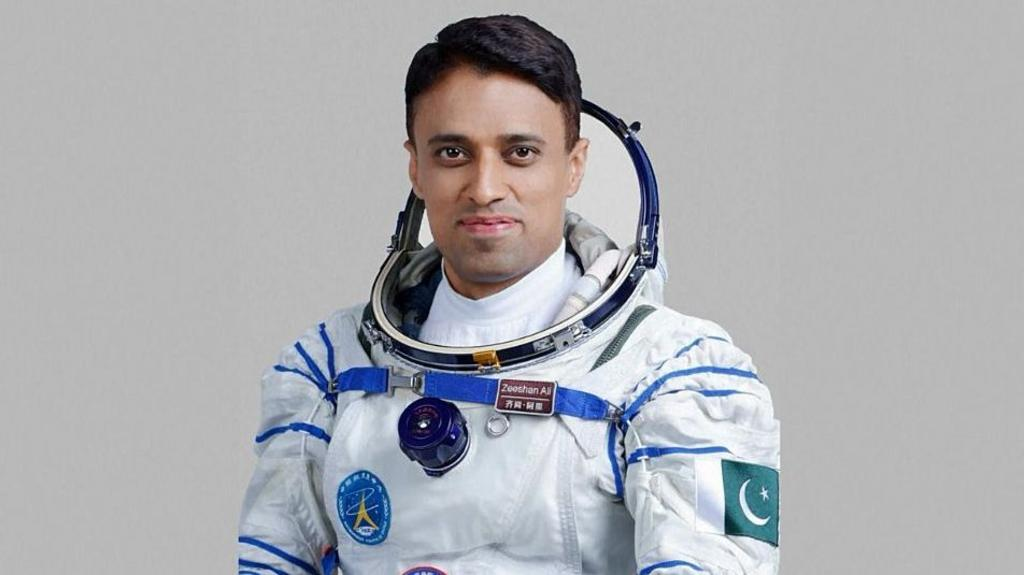
On Wednesday, November 25, 2026, history was made in the skies above northwestern China. At exactly 8:18 a.m. Beijing time, a massive Long March-2F rocket roared to life at the Jiuquan Satellite Launch Center in the Gobi Desert, carrying the Shenzhou-24 spacecraft into orbit.
Inside that capsule sat three astronauts, and one of them was carrying the hopes of an entire nation on his shoulders. For the very first time, a Pakistani astronaut has entered Earth’s orbit, and for the very first time, China has welcomed a foreign crew member aboard its Tiangong space station.
Just ten minutes after liftoff, the spacecraft separated cleanly from the rocket and settled into its planned path around Earth. Officials from the China Manned Space Agency quickly declared the launch a complete success, confirming that all three crew members were safe and in great spirits.
This is much bigger than a routine rocket launch. It signals a major shift in how countries work together beyond Earth, and it proves that space exploration is no longer a club reserved for just two or three superpowers.
What Makes the Shenzhou-24 Mission Such a Big Deal?
For decades, space travel followed a very predictable script. The United States, Russia, and their European partners ran the International Space Station, while China built its own separate space program from the ground up.
The $0 Secret To Launching Your Entire Online Empire
Why pay hundreds every month for separate software? Build funnels, send emails, and make sales with Systeme.io completely free.
Get Started For $0Free Forever • No Credit Card Needed • Beginner-Friendly
China finished building the three-module core of its Tiangong space station back in November 2022. Since then, only Chinese astronauts, known as taikonauts, have lived and worked inside it.
Shenzhou-24 changes that forever. This flight is the first joint crewed space mission involving Chinese and international astronauts in the history of China’s human spaceflight program.
It also comes at a critical moment for global space exploration. With NASA preparing to retire the aging International Space Station around 2031, Tiangong is positioning itself as a major new hub for international science in low Earth orbit. While Washington and its allies are pouring billions into lunar habitats—like when NASA dropped 10 billion dollars to build humanity’s first moon base—Beijing is opening its orbital doors to developing nations that want a seat at the table.
Who Is Muhammad Zeeshan Ali and How Did He Make History?
The man at the center of this historic flight is 40-year-old Muhammad Zeeshan Ali, a veteran fighter pilot with the Pakistan Air Force. Representing Pakistan’s national space agency, SUPARCO, Ali is flying on Shenzhou-24 as a payload specialist.
Some people might remember that Pakistani adventurer Namira Salim briefly touched the edge of space on a commercial Virgin Galactic suborbital flight in October 2023. That was an exciting moment, too, yet a suborbital hop only lasts a few minutes before falling back to Earth.
Muhammad Zeeshan Ali is doing something completely different. He is the first Pakistani citizen in history to reach full Earth orbit, live aboard an active space station, and conduct official government scientific research in microgravity.
Before stepping onto the launchpad, Ali shared an emotional message that quickly went viral across South Asia. Speaking to reporters at the crew ceremony, he said he was carrying the name of Pakistan on his shoulder along with the dreams of 250 million people.
He also had a special message for young students watching from home. He told every child looking up at the night sky to remember that he was up there carrying their dreams with him.
How Did a Pakistani Pilot Prepare for a Chinese Space Mission?
Getting a seat on a rocket does not happen overnight. The journey behind Shenzhou-24 started in February 2025, when China and Pakistan signed a landmark bilateral space cooperation agreement.
Following that deal, Pakistan launched a nationwide search to find candidates who could handle the physical and mental demands of spaceflight. Doctors and engineers tested applicants for heart health, psychological toughness, and their ability to survive extreme g-forces without passing out.
Two finalists made the cut: Muhammad Zeeshan Ali and fellow candidate Khurram Daud. In April 2026, both men traveled to Beijing to begin seven months of intense, nonstop training at the Astronaut Center of China.
Training for space is grueling on its own, yet Ali and Daud had an extra challenge to conquer. Every control panel, emergency manual, and mission command inside the Shenzhou capsule and the Tiangong station is written and spoken in Mandarin.
Ali spent months mastering technical Mandarin alongside survival drills, zero-gravity pool simulations, and spacecraft docking procedures. By the time launch week arrived, he was speaking Mandarin fluently in press interviews and joking comfortably with his Chinese crewmates.
Who Are the Other Astronauts Flying on Shenzhou-24?
Ali is not flying into orbit alone. He is joined by two highly skilled Chinese astronauts who are leading the mission and staying aboard the station long after his short visit wraps up.
Who Is Mission Commander Tang Hongbo?
Leading the crew is 51-year-old Tang Hongbo, one of China’s most experienced space veterans. With the launch of Shenzhou-24, Tang just set a record of his own by becoming the first astronaut to visit the Tiangong space station three separate times.
Send, Spend & Hold Money Worldwide Without Hidden Fees
Transfer money internationally at the real exchange rate and hold 40+ currencies in one account.
Open a Wise AccountMid-market rate • Fast transfers • 40+ currencies
Tang first flew to Tiangong in June 2021 aboard Shenzhou-12, where he was part of the very first crew to live inside the newly launched core module. He returned in 2023 as commander of Shenzhou-17 for a six-month stay. Having a steady hand like Tang in the commander’s seat gave both Beijing and Islamabad huge confidence for this first international flight.
Who Is Flight Engineer Wu Yi?
Rounding out the three-person launch crew is 39-year-old Wu Yi, who serves as the mission’s flight engineer. Just like Ali, Wu is making his very first trip to space.
Wu is responsible for monitoring spacecraft systems, assisting with automated docking maneuvers, and managing station hardware throughout their six-month stay. Together, Tang and Wu will remain on Tiangong until May 2027.
What Happens Once Shenzhou-24 Reaches the Tiangong Space Station?
After blasting off from the Gobi Desert, the Shenzhou-24 capsule took roughly three hours to catch up with Tiangong and dock with the forward port of the Tianhe core module.
Waiting to greet them inside the station is the Shenzhou-23 crew, led by commander Zhu Yangzhu. In an interesting twist, Zhu is actually staying behind on Tiangong when his crewmates head home, making him the first Chinese astronaut scheduled to spend a full continuous year in orbit. That kind of endurance puts China right in step with other long-duration missions we have covered, such as when astronauts spent 240 days floating in outer space before splashing down.
For Muhammad Zeeshan Ali, life aboard Tiangong will be a whirlwind sprint. Because he is a visiting payload specialist rather than a permanent station crew member, his stay in orbit lasts about one week.
When his seven days of research are complete, Ali will climb aboard the docked Shenzhou-23 return capsule alongside the outgoing Shenzhou-23 astronauts and parachute back to Earth.
What Science Experiments Will the Crew Run in Orbit?
Space travel costs millions of dollars per seat, so astronauts do not fly up there just to look out the window. Every hour on Tiangong is packed with scientific work designed to solve real problems back on Earth.
Across the full six-month Shenzhou-24 mission, the crew will run more than 90 scientific experiments and technology tests. These projects cover space medicine, microgravity fluid physics, combustion science, and advanced manufacturing.
During his week in orbit, Ali will personally operate four specialized joint experiments developed by Chinese and Pakistani researchers. These studies focus on biology, crop resilience, and advanced materials.
The $0 Secret To Launching Your Entire Online Empire
Why pay hundreds every month for separate software? Build funnels, send emails, and make sales with Systeme.io completely free.
Get Started For $0Free Forever • No Credit Card Needed • Beginner-Friendly
Testing how seeds and crops behave in microgravity might sound like pure science fiction, yet it has huge practical value for a farming nation like Pakistan. Exposure to cosmic radiation and zero gravity can trigger unique genetic adaptations in plant seeds, helping scientists breed crops back on Earth that survive extreme heat, drought, and floods.
Why Is China Opening Its Space Station to Other Countries?
If you follow global news, you know that space has become a major arena for international diplomacy and soft power. For years, U.S. law—specifically a rule known as the Wolf Amendment—has banned NASA from collaborating directly with China’s space agency.
Rather than letting that block its progress, Beijing built its own rockets, its own space station, and its own deep-space probes. Look at how fast China’s space ambitions have grown over the past few years:
- Beijing is actively pushing forward with plans to bring Mars rocks back to Earth by 2031, potentially beating NASA to one of science’s biggest prizes.
- Chinese engineers recently used forgotten space tech to map out an efficient path to Jupiter.
- Private Chinese aerospace companies are also booming, including a startup that raised millions to build giant robot arms for orbiting satellites.
Now, China is using Tiangong as a diplomatic bridge. By offering training and flight seats to friendly nations, China builds deep scientific and political alliances without firing a single shot.
2026 also happens to be the 75th anniversary of diplomatic relations between China and Pakistan. Sending a Pakistani pilot into orbit is the ultimate anniversary gift, showing the world how close the partnership between Beijing and Islamabad has become.
And Pakistan is likely just the beginning. Officials at the United Nations Office for Outer Space Affairs have already partnered with China to select international experiments for Tiangong, meaning astronauts from Europe, the Middle East, Africa, and Latin America could soon follow in Ali’s footsteps.
How Are People in Pakistan and Around the World Reacting?
Back in Pakistan, the launch triggered a wave of celebration that cut right across politics and daily life. Families woke up before dawn to watch the 5:18 a.m. Pakistan Standard Time liftoff live on television and social media.
Pakistani Prime Minister Shehbaz Sharif praised the launch as a historic milestone for the country, calling it the journey of 240 million Pakistanis rather than just one man. Planning Minister Ahsan Iqbal echoed that pride, thanking Beijing for helping Pakistan take a giant leap into human spaceflight.
Across social media platforms, hashtags celebrating Zeeshan Ali and SUPARCO trended for hours. Teachers shared clips of the rocket launch in classrooms, and young students talked about becoming aerospace engineers and astronauts.
That emotional spark is something money cannot buy. When people see someone who looks like them, speaks their language, and wears their flag on a spacesuit, suddenly a career in science feels completely within reach.
What Does This Mean for the Future of Global Space Exploration?
The launch of Shenzhou-24 proves that we have officially entered a multipolar space age. Countries no longer have to rely solely on Washington or Moscow if they want to send people or satellites into orbit.
Just look at how other countries are shifting their space partnerships around the world. Even traditional allies are exploring new paths, such as when Canada and France teamed up on space launches to reduce their dependence on American rockets. Meanwhile, private billionaires are reshaping orbit on their own terms, from efforts to mine a 20-quadrillion-dollar treasure on the Moon to satellite networks changing how phones connect globally.
At the same time, competition in orbit is heating up fast. With the U.S. Space Force confirming armed satellites in Earth orbit, peaceful scientific cooperation like the Shenzhou-24 mission stands out as a refreshing reminder of what nations can accomplish when they work together.
For Muhammad Zeeshan Ali, this one-week flight is just the opening chapter. Before boarding the rocket, he noted that this mission is not a finish line, expressing hope that China and Pakistan will eventually send joint crews to the Moon, Mars, and beyond.
What Are the Most Frequently Asked Questions About Shenzhou-24?
Who is the Pakistani astronaut on the Shenzhou-24 mission?
The Pakistani astronaut aboard Shenzhou-24 is 40-year-old Muhammad Zeeshan Ali. He is a Pakistan Air Force pilot and payload specialist representing SUPARCO, Pakistan’s national space agency.
When did China launch Shenzhou-24?
China launched the Shenzhou-24 spacecraft on Wednesday, November 25, 2026, at 8:18 a.m. Beijing time (00:18 GMT / 5:18 a.m. Pakistan time) from the Jiuquan Satellite Launch Center in the Gobi Desert.
How long will Muhammad Zeeshan Ali stay in space?
Muhammad Zeeshan Ali will spend roughly one week aboard China’s Tiangong space station conducting scientific experiments. He will then return to Earth aboard the Shenzhou-23 spacecraft, while his two Chinese crewmates stay on Tiangong for six months.
Is Muhammad Zeeshan Ali the first Pakistani in space?
He is the first Pakistani national to enter Earth’s orbit and live aboard an orbital space station. Earlier, in October 2023, Pakistani adventurer Namira Salim completed a brief suborbital space tourism flight aboard Virgin Galactic, making Ali the first orbital astronaut in Pakistan’s history.
What will the Shenzhou-24 crew do on the Tiangong space station?
The crew will carry out more than 90 scientific experiments and technology tests over six months. During his week on the station, Ali will operate four joint China-Pakistan experiments focusing on biology, agricultural crops, and advanced materials.
What Should We Watch for Next in Space?
Over the next several days, all eyes will be on Tiangong as Muhammad Zeeshan Ali completes his orbital experiments and prepares for his fiery ride home inside the Shenzhou-23 capsule. Once he lands safely back on Earth, Pakistan will officially join the small, elite group of nations with an orbital astronaut to call their own.
More importantly, Shenzhou-24 has cracked open a door that will never close again. As China invites more international astronauts to train in Beijing and fly to Tiangong, the next person floating above our planet could come from almost anywhere in the world.
