
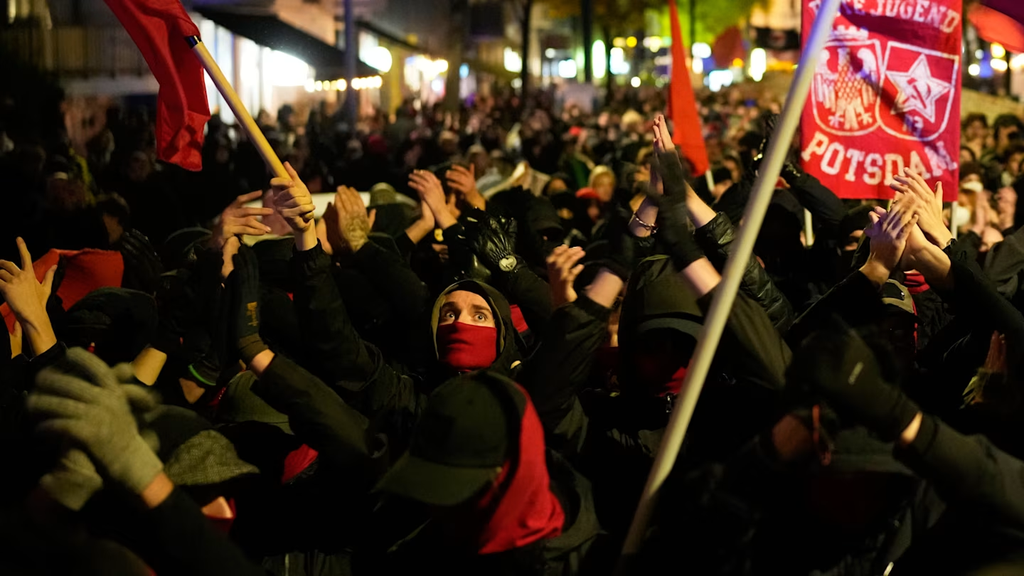
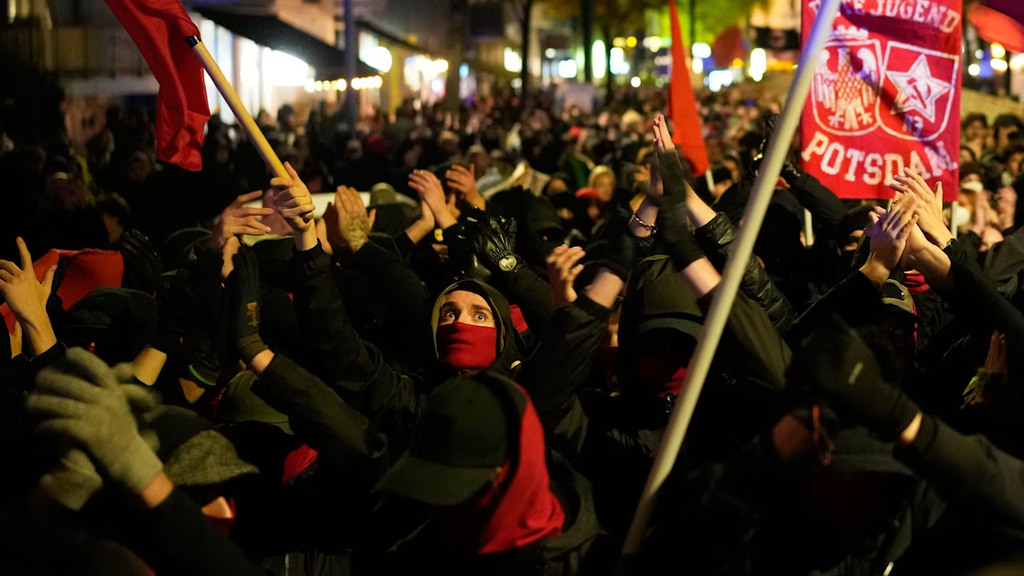
Halloween weekend across Germany did not go according to plan. Tens of thousands of young demonstrators rallied across more than thirty cities under the banner of “Gen Z regelt” (roughly translated as “Gen Z takes charge” or “Gen Z sorts it out”). What started as a loud, creative demonstration against soaring living costs, decaying schools, and mandatory military service spiraled into chaos as night fell.
In Frankfurt’s city center, thick plumes of smoke rose above luxury shopping streets. Molotov cocktails and heavy fireworks flew toward police officers. Windows were smashed in designer boutiques, a sneaker outlet, and even a gun shop, prompting emergency tactical deployments and water cannons. Similar tensions flared in Berlin, Cologne, and Hamburg, sending shockwaves across Europe’s largest economy.
Here is what really happened on the ground, why millions of young people feel pushed to the edge, and what this explosive moment means for Europe moving forward.
How a Peaceful Youth March Turned into Nighttime Chaos
During the daylight hours of October 31, the atmosphere felt vibrant and determined. Thousands of students, apprentices, and young workers gathered carrying banners demanding cheaper rent, climate action, and real funding for education. Chants echoed through central plazas in Berlin, Munich, Frankfurt, and Leipzig. Organizers explicitly called for non-violent resistance, urging participants to look out for one another and keep the gatherings strictly peaceful.
The shift happened rapidly once dusk settled.
The $0 Secret To Launching Your Entire Online Empire
Why pay hundreds every month for separate software? Build funnels, send emails, and make sales with Systeme.io completely free.
Get Started For $0Free Forever • No Credit Card Needed • Beginner-Friendly
In Frankfurt, Germany’s bustling financial capital, small splinter crowds refused police orders to disperse after authorized rallies concluded. Masked individuals clashed with lines of riot officers, setting fire to street furniture and trash bins. Riot police deployed tear gas, pepper spray, and water cannons as petrol bombs and heavy fireworks were hurled from behind makeshift barricades.
Frankfurt police issued urgent public alerts on social media warning bystanders to stay clear of the downtown core. Across the shopping promenade Zeil, rioters smashed storefront display cases. Multiple stores were looted, including high-end perfume boutiques, trainer shops, and an arms retailer where authorities arrested a suspect after seizing two stolen firearms. Several police officers sustained injuries, and dozens of people were taken into custody across Frankfurt, Berlin, and Hamburg.
For detailed updates on global affairs, visit Reuters for international reporting or track live local coverage via Deutsche Welle.
The Boiling Point: What Drove Gen Z to the Streets?
The destruction caught public attention, but it did not erupt out of thin air. The young protesters have spent months voicing profound frustration over systemic problems they feel politicians are ignoring.
The movement centers around five core grievances that are squeezing the youngest generation of Europeans:
1. The Crippling Cost of Living and Housing
Germany’s youth are navigating a brutal economic squeeze. Rent prices in university cities like Berlin, Munich, and Cologne have skyrocketed to unprecedented levels. Many young workers and university students report spending over 50 percent of their monthly income simply on small shared-apartment rooms. At the same time, basic food items, energy bills, and transit passes continue to eat away at starting salaries. For teenagers and early twentysomethings, financial independence feels practically out of reach.
2. Crumbling Schools and Public Service Cuts
A major rally cry during the protests focused on deep austerity measures hitting social welfare, schools, and mental health services. Protesters pointed out that while defense budgets receive massive cash injections, school buildings are falling apart. Leaking roofs, unheated classrooms in winter, broken restrooms, and severe teacher shortages have plagued state schools across the country. Students described arriving at lectures in buildings that look abandoned, while youth addiction clinics and counseling centers face closure due to lack of municipal funds.
3. Resistance Against Mandatory Military Service
National security discussions in Berlin have triggered intense debate about reintroducing compulsory military screening or peacetime draft mechanisms. Spokespersons for the Gen Z protests made their stance unmistakably clear: they do not want to be forced into uniform for geopolitical conflicts they had no role in starting. Demonstrators chanted slogans demanding diplomacy, social support, and peace over mandatory enlistment.
4. Climate Inaction and Broken Promises
Europe has experienced back-to-back years of extreme weather, heatwaves, and seasonal flooding. Many in Gen Z feel that long-term environmental protection is constantly pushed to the back burner whenever short-term political pressures arise. For them, climate action is not an optional hobby—it is survival.
5. Increased Digital Surveillance and Shrinking Freedoms
German youth have grown up valuing strong civil liberties and privacy. Legislative moves toward broader state surveillance, expanded police stop-and-search powers, and tighter digital tracking have caused deep unease among activists who feel democratic spaces are narrowing.
The “French Connection”: Fears of Spreading Unrest
German state officials expressed deep concern about the sudden escalation of violence. The interior minister of Hesse, Roman Poseck, addressed the media directly, warning that Germany must not slide into the widespread street unrest recently seen across France.
In recent months, youth and student protests in Paris, Lyon, and Marseille saw widespread street clashes, barricades, and commercial property damage. German authorities warned that extremist elements—including far-left groups and autonomous agitators—sought to hijack genuine youth grievances to provoke violent confrontations with the state.
Security teams had anticipated potential friction. High-end boutiques along Berlin’s famous Kurfürstendamm and downtown department stores in Frankfurt boarded up large display windows with plywood 24 hours prior to the Halloween events. Still, the ferocity of the late-night clashes caught many neighborhood shop owners by surprise.
To connect directly with our reporting desk, head over to the WhatsBuzzn Contact Page.
Who is Behind “Gen Z Regelt”?
The movement known as Gen Z regelt burst onto social channels like TikTok and Instagram just a few months ago. Using short-form videos, punchy graphics, and direct appeals to young people of all backgrounds, the collective organized local working groups across 34 German cities.
Send, Spend & Hold Money Worldwide Without Hidden Fees
Transfer money internationally at the real exchange rate and hold 40+ currencies in one account.
Open a Wise AccountMid-market rate • Fast transfers • 40+ currencies
The group explicitly identifies as non-partisan. Their core message states: “Our shared problems matter more than what divides us. We criticize decisions, no matter which political party is behind them”.
However, organizing an open-door movement has presented major challenges:
- Radical splinter factions: Dispersed leadership makes it nearly impossible for grassroots organizers to stop outside rioters or aggressive groups from showing up after dark.
- Turnout disagreements: While organizers anticipated up to 180,000 attendees across the nation, official police estimates put the turnout closer to 20,000 to 30,000 in major hubs.
- Student union divisions: Germany’s national umbrella union for high school students (BSK) chose to distance itself from the October 31 demonstrations, pointing toward its own structured day of action planned for late November.
Even with growing pains and internal debates, one thing is unmistakable: the organizers managed to mobilize thousands of people who had never previously attended a street demonstration.
What Happens Next?
This weekend was not a one-off event. The collective behind the movement has already declared another massive nationwide day of action scheduled for Saturday, November 14, 2026.
Federal and municipal politicians are facing fierce pressure to respond. Conservative and centrist leaders are calling for harsh legal consequences for looters, tighter crowd controls, and an outright crackdown on street vandalism. At the same time, youth advocates and educational leaders warn that simply deploying riot police will not solve the crisis.
If governments continue to cut education budgets, ignore rising housing rents, and push military requirements onto a generation that feels left out of political discussions, frustration will only build higher.
Frequently Asked Questions (FAQs)
What triggered the Gen Z protests in Germany?
The protests were organized over rising living costs, rent inflation, severe budget cuts to schools and healthcare, opposition to compulsory military service, and frustration with government climate policies.
Where did the most violent clashes happen?
The heaviest unrest occurred in the financial center of Frankfurt, where police used water cannons and pepper spray after demonstrators threw stones, fireworks, and Molotov cocktails. Clashes, barricade fires, and arrests also took place in Berlin, Hamburg, and Cologne.
Were businesses looted during the rallies?
Yes. Several businesses in central Frankfurt had their windows smashed, including shoe stores, perfume shops, and a hunting and firearms store. Police confirmed arrests and recovered stolen weapons on site.
Was the entire demonstration violent?
No. Organizers and police confirmed that the daytime rallies across more than 30 cities were overwhelmingly peaceful, artistic, and lawful. The violence erupted late at night when smaller aggressive groups and autonomous agitators refused to leave the downtown areas.
The $0 Secret To Launching Your Entire Online Empire
Why pay hundreds every month for separate software? Build funnels, send emails, and make sales with Systeme.io completely free.
Get Started For $0Free Forever • No Credit Card Needed • Beginner-Friendly
Are there more youth protests planned in Germany?
Yes. The organizers have already called for another large-scale nationwide mobilization on Saturday, November 14, 2026, while school associations have organized separate rallies later in the month.
The events across Germany are a wake-up call for leaders throughout Europe. When younger generations feel they have no financial runway, no voice in legislative decisions, and no relief from economic pressure, peaceful frustration can quickly boil over into open defiance. The coming weeks will reveal whether government officials listen to the core concerns of their youth or double down on security crackdowns.
