
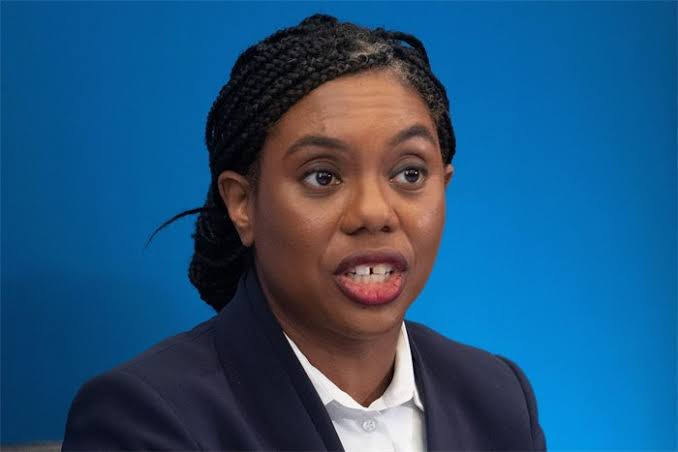
Ten years after Britain voted to leave the European Union, the fight over Europe is roaring back to life. Conservative Party leader Kemi Badenoch stepped onto the stage in central London and delivered a blunt warning to the country’s top business bosses. Her message was simple and direct: rejoining the European Union will not fix Britain’s economic problems.
Speaking at the annual conference of the Confederation of British Industry (CBI), Badenoch addressed more than 650 business leaders and policymakers. Her speech came just days after Prime Minister Andy Burnham signed a major new agreement with EU leaders in Brussels.
For millions of people dealing with high bills, sluggish wages, and uncertain job markets, the big question is clear. Does Britain need closer ties with Europe to grow again, or does the country need a completely different approach at home?
What Exactly Did Kemi Badenoch Say at the CBI Conference?
Kemi Badenoch did not hold back when she took the microphone at the Queen Elizabeth II Centre in London. She told the room of executives that Britain is facing deep economic trouble, and looking toward Brussels for a rescue plan is the wrong move.
“Something bad is happening in our economy and rejoining the EU is not going to fix it,” Badenoch said during her keynote speech. She immediately added a crucial point that caught many listeners off guard: “Nor will staying outside the EU automatically fix it either.”
The $0 Secret To Launching Your Entire Online Empire
Why pay hundreds every month for separate software? Build funnels, send emails, and make sales with Systeme.io completely free.
Get Started For $0Free Forever • No Credit Card Needed • Beginner-Friendly
By saying both paths carry no automatic magic wand, Badenoch tried to reframe the entire national conversation. She argued that Britain cannot simply sign a treaty with European neighbors and expect growth to magically appear. Instead, she insisted that the country needs bold changes to how its own economy works.
Badenoch also warned that reopening the Brexit debate is dangerous for business confidence. She said the last thing the country needs is another five years of bitter arguments, political division, and distraction.
Even more starkly, the Conservative leader warned that living standards are under serious pressure. She suggested that unless Prime Minister Andy Burnham’s government finds a way to lift household incomes and boost growth, Britain could even face French-style street protests.
Why Is the Brexit Debate Heating Up Again Right Now?
To understand why Badenoch made such a forceful speech, you have to look at what happened in Brussels just three days earlier. On November 20, 2026, Prime Minister Andy Burnham met with European leaders for a high-stakes UK-EU summit.
At that summit, Burnham signed a broad package of agreements designed to reset relations between Britain and the 27-nation bloc. According to the official UK government announcement, the new deal removes most border checks on food and plant products, links the UK and EU carbon trading markets, and creates a new Youth Experience Scheme for people aged 18 to 31.
Burnham called the agreement a “win-win” for both sides. He argued that the status quo after Brexit was not working and that reducing trade barriers would cut red tape for British businesses and help keep supermarket prices down.
However, Burnham also sparked intense political debate by saying he would like to see Britain rejoin the EU in his lifetime. Even though he later clarified in Parliament that rejoining without a referendum would be “unthinkable” and is not current government policy, critics seized on his comments right away.
Badenoch accused the Prime Minister of dragging Britain backward on control of its own laws, money, and borders. She pointed out that Labour won the last general election under Keir Starmer on a clear promise not to reopen the EU relationship. In her view, Burnham has broken that pledge and opened the door to years of endless constitutional arguments.
What Is Kemi Badenoch’s Plan for an Economic Revolution?
Rather than negotiating new rules with Brussels, Badenoch told business leaders that Britain needs what she called an “economic revolution” at home. In her full speech to the CBI, she laid out a five-point business plan built around helping companies grow, invest, and hire workers without heavy government interference.
Her central argument is straightforward. Governments do not create wealth on their own. Private businesses, entrepreneurs, and risk-takers create wealth, and ministers should stop treating companies like a cash cow to be taxed heavily.
How Would Lower Taxes and Cheaper Energy Help British Businesses?
One of the biggest complaints from British factories, shops, and tech firms is the high cost of doing business. Energy bills in the UK remain stubbornly expensive compared to several international competitors, and taxes on businesses have climbed in recent years.
Badenoch argued that cutting energy prices, lowering taxes, and stripping away unnecessary regulations would give companies immediate breathing room. When businesses keep more of their earnings and pay less for electricity and paperwork, they can afford to buy new equipment, open new locations, and raise staff pay.
She also called for more flexible labour markets. Supporters of this view say that making it easier and less costly to hire staff encourages small and medium-sized companies to take chances on new workers. Critics, however, worry that rolling back workplace rules could weaken job security for ordinary employees.
Why Does She Think the US and China Are Leaving Britain Behind?
Another major theme of Badenoch’s speech was looking at the bigger global picture. She acknowledged that Europe will always be an important trading partner for Britain, especially on shared security and standing against Russian aggression.
Still, she delivered a striking line to the conference: “Europe will always remain an important market, but it is not the market of the future.”
Send, Spend & Hold Money Worldwide Without Hidden Fees
Transfer money internationally at the real exchange rate and hold 40+ currencies in one account.
Open a Wise AccountMid-market rate • Fast transfers • 40+ currencies
Badenoch pointed out that the United States and China are currently racing ahead to build powerful, disruptive new technologies. From artificial intelligence to advanced manufacturing, those two superpowers are shaping how the global economy will work over the next several decades.
She warned that if Britain spends all its political energy arguing about European trade rules, it will be left behind in that global tech race. Instead, she urged the country to rely on its own strengths, including world-class universities, respected courts, a global language, and brilliant innovators.
How Are Prime Minister Andy Burnham and Other Leaders Responding?
Badenoch’s speech did not go unchallenged. Politicians across the spectrum, along with business groups and trade unions, quickly weighed in with very different views on what Britain needs most.
What Does Prime Minister Andy Burnham Say About the New EU Deal?
Prime Minister Andy Burnham and his Labour team strongly rejected Badenoch’s criticism. A Labour Party spokesperson accused the Conservative leader of having her “fingers in her ears” when it comes to listening to British companies.
Labour argued that the previous Conservative government’s Brexit deal created costly red tape that hurt exporters and pushed up food prices. According to UK Treasury estimates cited by the government, the new November 2026 reset agreement could add up to 0.5 percent to Britain’s gross domestic product by 2040. That equals roughly 17 billion pounds a year for the British economy.
Supporters of the deal point to very practical wins. Scrapping export health certificates that cost up to 200 pounds per shipment makes it much cheaper for British farmers and food producers to sell fresh produce, burgers, sausages, and seafood into Europe. Linking carbon markets also protects around 6.5 billion pounds worth of British steel and aluminium exports from extra EU border taxes.
Burnham insists that fixing obvious trade friction with Britain’s closest and largest trading neighbor is pure common sense, not an attempt to undo the 2016 referendum.
What Do Other Political Parties and Business Groups Think?
Other party leaders at the CBI conference pushed the debate even further in opposite directions.
Green Party leader Zack Polanski told business leaders that he wants Britain to fully rejoin the European Union. He argued that from a business, cultural, and national security standpoint, Britain is far better off inside the bloc rather than standing on the sidelines.
Liberal Democrat leader Sir Ed Davey also backed closer European ties, describing Burnham’s new agreement as mere “tweaks to a failed deal” and urging the government to go much further.
The $0 Secret To Launching Your Entire Online Empire
Why pay hundreds every month for separate software? Build funnels, send emails, and make sales with Systeme.io completely free.
Get Started For $0Free Forever • No Credit Card Needed • Beginner-Friendly
On the other side of the political aisle, Reform UK leader Nigel Farage attacked Burnham’s Brussels summit from the opposite angle. Farage argued that closer alignment with Brussels drags Britain backward and hands power back to European regulators.
Meanwhile, inside the CBI conference hall itself, many business owners welcomed Labour’s effort to cut border paperwork with Europe. For years, manufacturers and retailers have asked politicians to make cross-channel trade smoother. At the same time, trade unions warned that any money companies save from reduced red tape must be passed on to working families through fair wages and lower prices, rather than simply boosting corporate profits.
Will Closer Ties With Brussels Really Solve Britain’s Money Problems?
Stepping back from the daily political point-scoring, many independent economists say there is a grain of truth on both sides of this argument.
Professor Anand Menon, director of the research group UK in a Changing Europe, noted that British governments have not always been fully honest with the public about the real economic trade-offs of leaving the EU. Trade barriers with a next-door neighbor naturally create extra costs, and lowering those barriers helps.
At the same time, economic experts widely agree that Britain’s financial challenges did not start in 2016, and they would not vanish overnight even if the UK rejoined the EU tomorrow.
Britain has struggled with weak productivity growth since the 2008 global financial crisis. The country faces an aging population, heavy pressure on the National Health Service, high government debt costs, and a shortage of affordable housing in major cities.
Even inside the European Union, major economies like Germany and France are dealing with their own slow growth, high energy prices, and tough competition from American and Asian tech giants. That reality gives weight to Badenoch’s claim that membership in the bloc is not a guaranteed cure-all.
For everyday families, the debate comes down to practical results. People want to know if their weekly grocery shop will get cheaper, if small businesses on their high street will stay open, and if young people will have good career opportunities at home and abroad.
What Are the Most Frequently Asked Questions About the UK-EU Debate?
Is the UK Actually Rejoining the European Union Soon?
No, Britain is not rejoining the European Union anytime soon. Prime Minister Andy Burnham has explicitly ruled out rejoining the EU, the single market, or the customs union during the current parliament, which runs until the next general election expected in 2029. He also stated that attempting to rejoin without holding another public referendum would be unthinkable.
What Does the New November 2026 UK-EU Reset Deal Include?
The reset deal agreed in Brussels on November 20, 2026 focuses on specific areas of cooperation rather than full membership. It removes most border checks and costly health certificates on food and agricultural trade, links the UK and EU carbon emissions trading systems to protect steel and industrial exports, increases joint action against people-smuggling gangs, and sets up a capped Youth Experience Scheme allowing young adults aged 18 to 31 to live, work, and study across borders for up to three years.
Why Does Kemi Badenoch Oppose Closer EU Alignment?
Kemi Badenoch opposes closer regulatory alignment because she believes following EU rules limits Britain’s freedom to set its own laws, cut business red tape, and adapt quickly to fast-moving global industries. She argues that Britain should focus on lowering domestic taxes, reducing energy bills, and competing in emerging technology sectors alongside the United States and China.
How Could This Debate Affect Everyday People in Britain?
In the short term, the new UK-EU agreements could help ease price pressures on imported food and create new travel and work visas for young adults. In the longer term, the direction Britain chooses will shape tax rates, energy bills, workplace rules, and how attractive the country is for international companies looking to create jobs.
Where Does Britain Go From Here?
Kemi Badenoch’s speech at the CBI conference has drawn a clear dividing line in British politics. On one side, Prime Minister Andy Burnham argues that rebuilding practical trade ties with European neighbors puts billions of pounds back into the economy and lowers everyday costs. On the other side, Badenoch insists that true prosperity can only come from an economic revolution at home—cutting taxes, lowering energy bills, and backing British innovators to take on the world.
Neither path is quick or easy, and British voters will be watching closely to see which approach actually puts more money in their pockets over the next few years.
What do you think about Kemi Badenoch’s warning? Should Britain focus on domestic tax and energy reforms, or is rebuilding closer ties with Europe the smarter move for growth?
