
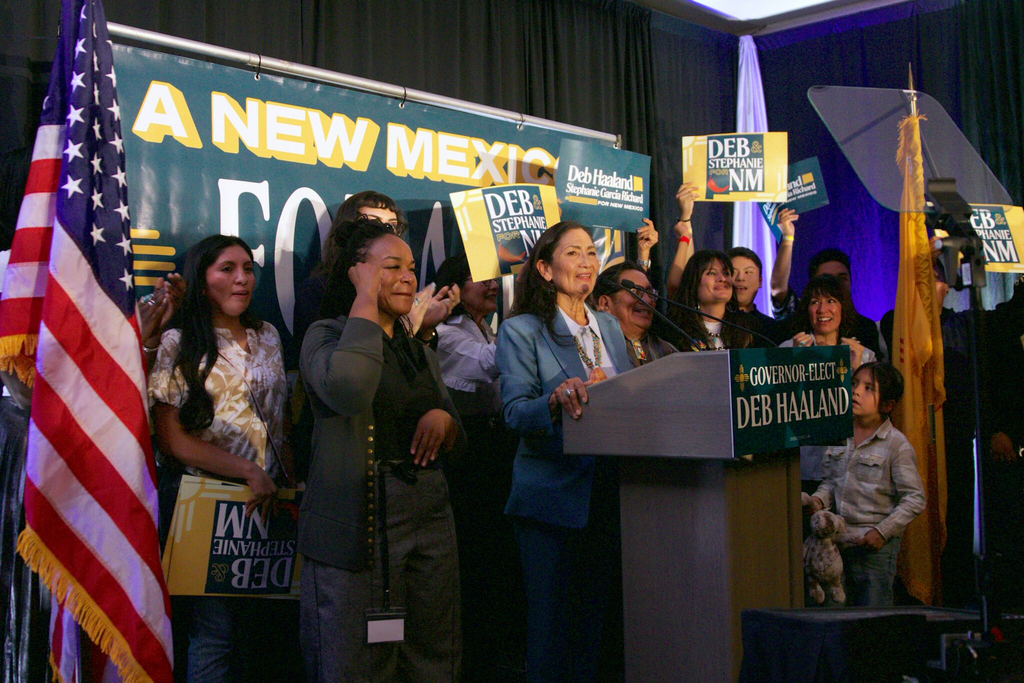
Deb Haaland has officially won the New Mexico governor’s race, making history as the first Native American woman ever elected to lead a United States state.
The Associated Press called the contest after the former Interior Secretary built an insurmountable lead over Republican candidate Gregg Hull, the former mayor of Rio Rancho. When the final ballots were tallied, Haaland secured over 57% of the statewide vote, capturing more than 412,000 votes to Hull’s 308,000. The convincing 14-point margin demonstrated deep, cross-coalition support across urban centers, rural valleys, and tribal communities alike.
Crowds erupted into cheers at the Laguna Pueblo’s Route 66 Casino and Hotel as Haaland stepped up to the microphone. The room was packed with supporters wearing traditional ribbon skirts, silver and turquoise jewelry, and campaign shirts reading “Deb for New Mexico.” For many in attendance, the moment felt surreal. Native Americans have inhabited the Southwest for thousands of years, yet until this election, no Indigenous woman had ever held a state’s highest executive office in the country’s two-and-a-half-century history.
Haaland addressed the room with the steady calm that has defined her career. She spoke directly to young people across tribal reservations and small towns, reminding them that their dreams are valid and achievable. She shared how her own journey—from working on her sobriety and raising a child on food stamps to serving in Congress and the presidential cabinet—proved that real change happens when regular people refuse to give up.
She will be formally sworn in on January 1, 2027, as the 33rd governor of New Mexico, succeeding term-limited Democratic Governor Michelle Lujan Grisham.
The $0 Secret To Launching Your Entire Online Empire
Why pay hundreds every month for separate software? Build funnels, send emails, and make sales with Systeme.io completely free.
Get Started For $0Free Forever • No Credit Card Needed • Beginner-Friendly
The Historic Milestone: Breaking a 250-Year Barrier in American Politics
This election represents a watershed moment not only for New Mexico, but for the entire nation. Across all 50 states, only four Native American men have ever served as governors, and never once had an Indigenous woman held the title. Haaland’s victory effectively knocks down one of the oldest political barriers in the United States.
Native Americans make up roughly 12% of New Mexico’s total population, representing 23 distinct federally recognized tribes, including 19 Pueblos, three Apache nations, and the Navajo Nation. Despite that deep presence, Indigenous communities have historically faced substantial barriers to voting, from extreme travel distances to polling places to limited ballot drop-off access on tribal land.
Haaland’s win is seen as the culmination of decades of grassroots organizing by Native activists, elders, and young community organizers who pushed relentlessly for voting access and political representation. Her win comes alongside broader nationwide shakeups, where voters reshaped statehouses and national politics, much like how Democrats mounted historic midterm momentum across key battleground districts.
National political observers note that the symbolism of an Indigenous woman running the state government from Santa Fe—the oldest capital city in the United States—cannot be overstated. For generations, state and federal policies treated Indigenous nations as an afterthought. Now, an enrolled tribal member will sit at the head of state government, signing legislation, setting the state budget, and commanding the New Mexico National Guard.
How the Race Was Won: Numbers, Coalitions, and Voter Turnout
Haaland’s decisive victory came down to building a broad, multi-racial coalition that bridged the divide between progressive urban voters and traditional rural working families.
According to election tracking from The Associated Press, Haaland dominated populous Bernalillo County, which includes Albuquerque, by winning nearly 63% of the vote. She ran up massive margins in Santa Fe and northern New Mexico counties like Taos and Rio Arriba, which have long been democratic strongholds.
Her opponent, Republican Gregg Hull, ran a campaign focused on economic growth, public safety, and business deregulation. Hull hoped to capitalize on concerns regarding inflation and the cost of living. He performed well in conservative strongholds across the state’s oil-rich southeast region, including Lea and Eddy counties in the Permian Basin.
However, Hull could not cut into Haaland’s commanding lead in suburban Albuquerque or overcome the historic voter turnout across tribal precincts. On the Navajo Nation and in Pueblo communities such as Laguna, Zuni, and Jemez, voter turnout surpassed previous midterm marks, with Haaland capturing over 80% of the vote in several key tribal precincts.
Haaland also benefited from shifting voter dynamics across Hispanic communities in the Southwest. While Republicans made gains in certain border communities in recent years, Haaland’s team invested heavily in local Spanish-language outreach, bilingual town halls, and community-led rallies. This strategy mirrored broader trends where Latino voters shifted back to Democrats across several competitive races.
From Single Mom on Food Stamps to the Governor’s Mansion: The Deb Haaland Story
Haaland’s political path has never looked like a standard politician’s resume. She is a 35th-generation New Mexican and an enrolled member of the Pueblo of Laguna. Her mother, Mary Toya, was an educator and a Navy veteran. Her father, Major J.D. “Dutch” Haaland, was a decorated 30-year combat veteran in the Marine Corps.
Because her parents moved frequently between military bases, Haaland attended 13 different public schools before graduating from high school in Albuquerque. As a young adult, life threw heavy challenges her way. She became a single mother, raised her daughter Somáh on limited means, and frequently relied on food stamps just to feed her family.
She spent years working toward personal sobriety, an experience she talks about openly and without shame. To make ends meet, she ran a small business making and selling traditional Pueblo salsa.
Determined to build a better life, she enrolled at the University of New Mexico as an adult student, earning her bachelor’s degree in English when she was 34. She later pushed through law school, graduating from the University of New Mexico School of Law in 2006.
Before ever running for office herself, she spent years as a volunteer organizer. She drove an old car from pueblo to pueblo along dirt roads, registering people to vote and listening to their concerns. That grassroots persistence earned her respect within the state party, leading to her election as chair of the Democratic Party of New Mexico in 2015.
Her rise to national prominence happened rapidly:
Send, Spend & Hold Money Worldwide Without Hidden Fees
Transfer money internationally at the real exchange rate and hold 40+ currencies in one account.
Open a Wise AccountMid-market rate • Fast transfers • 40+ currencies
- In 2018, she won New Mexico’s 1st Congressional District, becoming one of the first two Native American women elected to the United States Congress alongside Sharice Davids of Kansas.
- While in the House of Representatives, she advocated for environmental justice, renewable energy development, and missing Indigenous women and children.
- In 2021, President Joe Biden nominated her to lead the Department of the Interior, making her the first Native American cabinet secretary in American history.
- At Interior, she oversaw 500 million acres of public lands, modernized tribal consultation rules, and launched the Federal Indian Boarding School Initiative to investigate historical abuses against Indigenous children.
Now, she returns to New Mexico as governor, bringing a lived experience that few executive leaders in modern American history possess.
What Governor-Elect Haaland Plans to Do in Santa Fe
Taking the oath of office in Santa Fe is only the first step. Haaland inherits a state with immense natural beauty and massive potential, but also severe systemic hurdles that have persisted for generations.
During her campaign, Haaland laid out a comprehensive policy agenda centered on three core priorities:
1. Natural Resources, Energy, and Water Rights
New Mexico is currently the second-largest crude oil-producing state in the nation, thanks to booming output in the Permian Basin. This energy production fills state coffers with billions in tax revenue, funding schools, healthcare, and infrastructure.
Haaland has made it clear that she will not halt the state’s economic engine overnight, but she is committed to diversifying the economy. Her plan calls for investing state surplus funds into solar, wind, and geothermal energy projects.
Water security remains an equally urgent priority. With severe drought threatening the Rio Grande basin, Haaland plans to implement modern conservation standards and ensure small farmers, ranchers, and tribal communities have protected water rights.
2. Education, Child Welfare, and Poverty
New Mexico has consistently ranked near the bottom of national rankings for childhood well-being and public school performance.
Haaland has pledged to expand the state’s landmark universal early childhood education system. Her platform includes raising teacher salaries, expanding bilingual education programs, and providing direct grants to tribal schools that have historically been underfunded. Because she lived in poverty as a single mother, she often reminds voters that investing in early childcare is the single most effective way to help working parents hold good jobs.
3. Public Safety and Healthcare in Rural Communities
Access to healthcare is a daily challenge for families living outside Albuquerque and Santa Fe. Haaland plans to expand mobile health clinics, increase funding for rural emergency rooms, and address the shortage of doctors and nurses in southern and northwestern counties.
On public safety, Haaland has promised to treat the fentanyl crisis as a public health emergency. She advocates combining stronger law enforcement against drug trafficking organizations with community-based treatment centers and harm-reduction programs.
The $0 Secret To Launching Your Entire Online Empire
Why pay hundreds every month for separate software? Build funnels, send emails, and make sales with Systeme.io completely free.
Get Started For $0Free Forever • No Credit Card Needed • Beginner-Friendly
Her platform also prioritizes funding for the Missing and Murdered Indigenous Persons (MMIP) task force, ensuring that state law enforcement collaborates with tribal police departments without bureaucratic red tape.
The Bigger Picture: Midterm Shockwaves and the National Political Map
Haaland’s victory carries implications that stretch far beyond the borders of New Mexico. In a year when national politics felt turbulent, her decisive win offers a clear playbook for how state leaders can maintain broad appeal.
Across the United States, voters sent nuanced signals. In many suburban and rural areas, economic anxiety was the central debate, leading to tough moments for incumbents. That tension was evident throughout the election season, especially as national party strategists analyzed why Republicans faced widespread panic heading into the midterm elections.
At the same time, Haaland avoided political culture wars and focused relentlessly on kitchen-table fundamentals: high grocery bills, housing affordability, water access, and public schools. That disciplined approach allowed her to outperform standard Democratic margins in several swing precincts.
Her comfortable win added to an election night full of surprises, which quickly became the dominant topic across cable news and late-night television, including moments where talk show hosts celebrated major midterm upsets that reshaped state and national politics.
For Democrats, Haaland proves that candidates with authentic, unconventional life stories can break through voter fatigue. For Native Americans across Indian Country, her win is proof that tribal leaders belong at every level of government decision-making.
Key Takeaways from New Mexico’s Landmark Election
Here are the main lessons from this historic contest:
- Authentic Life Stories Build Trust: Haaland did not run away from her past struggles with poverty, single motherhood, or recovery. Voters responded to her honesty because it mirrored the everyday struggles of working families across New Mexico.
- Coalition Building Wins Elections: Relying solely on urban progressive centers is not enough to win by double digits. Haaland won by pairing city votes with record turnout across tribal lands and rural Hispanic communities.
- Representation Continues to Expand: Following her tenure as Interior Secretary, Haaland’s election as governor confirms that Indigenous leaders are stepping into top executive governance across the country.
- Pragmatic Energy Policy Matters: Voters want clean air and climate solutions, but they also care about the jobs and state revenue created by natural resources. Balancing both will be the central test of Haaland’s administration.
Frequently Asked Questions About Deb Haaland’s Historic Win
Who is Deb Haaland?
Deb Haaland is an American politician, attorney, and enrolled member of the Pueblo of Laguna who was elected governor of New Mexico in the November 2026 midterm election. She previously served as the 54th United States Secretary of the Interior from 2021 to 2025 and represented New Mexico’s 1st Congressional District in the U.S. House of Representatives from 2019 to 2021.
What did Deb Haaland achieve in the 2026 election?
Haaland made history as the first Native American woman ever elected governor of any state in the United States.
What was the final election result between Deb Haaland and Gregg Hull?
Haaland won the election with approximately 57.2% of the vote (412,834 votes), defeating Republican nominee Gregg Hull, who received 42.8% of the vote (308,315 votes).
When will Deb Haaland take office as governor of New Mexico?
Deb Haaland will be sworn into office on January 1, 2027, becoming the 33rd governor of New Mexico.
Which tribe does Deb Haaland belong to?
Haaland is an enrolled member of the Pueblo of Laguna, a federally recognized tribe located in west-central New Mexico. She identifies as a 35th-generation New Mexican.
Who was her opponent in the gubernatorial race?
Her opponent was Republican candidate Gregg Hull, a businessman and former mayor of Rio Rancho, New Mexico.
What was Deb Haaland’s role before running for governor?
Before running for governor of New Mexico, Haaland served as the U.S. Secretary of the Interior under the Biden administration, managing approximately 500 million acres of federal public lands and the Bureau of Indian Affairs.
New Mexico’s election of Deb Haaland marks a defining turning point in American political history. Her path from a single mother applying for assistance to the highest executive office in the state shows that persistence, community roots, and steady leadership still resonate with voters. When she takes the oath of office in the Roundhouse in Santa Fe this coming January, she will carry with her the aspirations of hundreds of tribal nations and millions of New Mexicans who are ready to see what this new chapter brings.
