
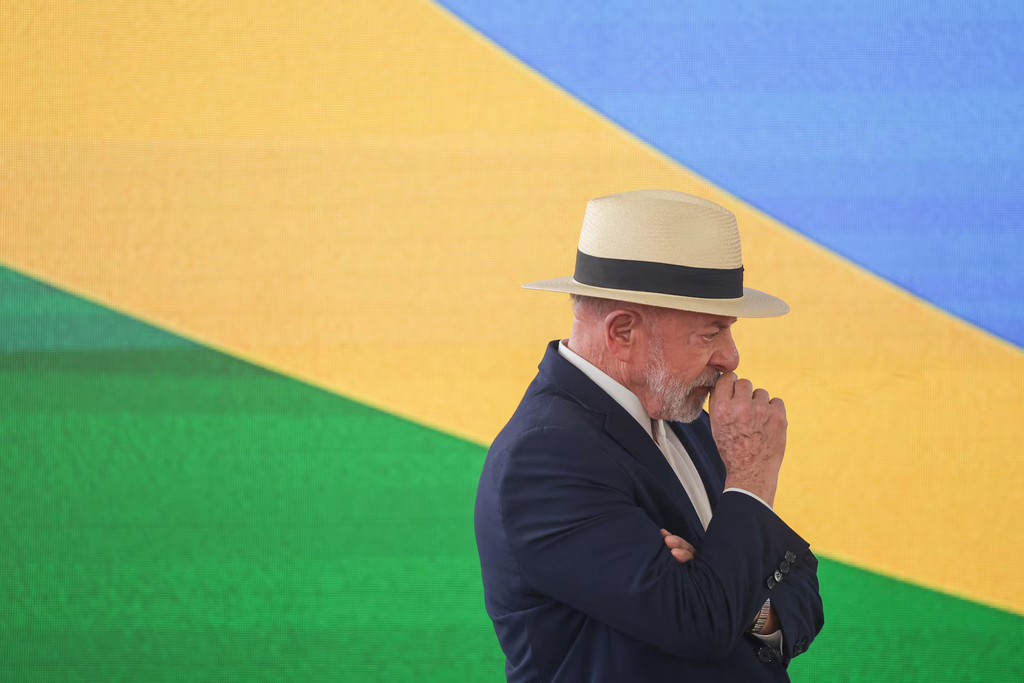
Donald Trump sparked another major international controversy this week after claiming Brazil’s presidential runoff election looked corrupt and fraudulent. Speaking to reporters on Monday as he departed Washington for a midterm campaign rally, Trump claimed without offering proof that the contest was tainted.
The dramatic statement came right after Brazilian leftist incumbent Luiz Inácio Lula da Silva secured a hard-fought victory against right-wing candidate Senator Flávio Bolsonaro. While Flávio Bolsonaro immediately protested the vote count and talked about taking the contest to court, his own political group made a sudden move that caught political observers off guard. The leadership of the Liberal Party officially stepped forward to recognize Lula’s victory, shutting down talk of an overturned election before the dust could even settle.
This clash between Trump’s accusations and the reality on the ground in Brasília has set off fiery debates across both hemispheres. It touches on democratic stability, diplomatic ties between Washington and South America’s largest nation, and the growing divide over how elections are accepted across modern democracies.
What Donald Trump Said About the Brazil Election
The comments from the former U.S. president were delivered in his trademark blunt style. As he prepared to board his plane for upcoming campaign events, reporters questioned him about the high-stakes runoff in South America.
Trump did not hesitate to question the integrity of the vote. He told reporters that the election looked terrible to him and claimed it seemed like another rigged race. He maintained that he was not officially picking sides, but he repeatedly called the outcome corrupt and awful.
The $0 Secret To Launching Your Entire Online Empire
Why pay hundreds every month for separate software? Build funnels, send emails, and make sales with Systeme.io completely free.
Get Started For $0Free Forever • No Credit Card Needed • Beginner-Friendly
The remarks reflect a political playbook that audiences in the United States know well. Trump has frequently questioned electoral systems, both domestically and across allied nations, whenever conservative allies suffer narrow defeats. His comments quickly made global headlines, especially as Trump ramps up public appearances ahead of critical domestic votes. You can read more about how Donald Trump promises a full campaign blitz for midterms and insists Republicans have a winning message to see how his public rhetoric shapes his current political strategy.
Despite Trump’s pointed remarks, international observers and election authorities affirmed that Brazil’s voting system performed properly. Independent observers deployed across Brazilian states found no credible evidence of tampering or institutional fraud.
Inside the Numbers: How Lula Won a Hard-Fought Fourth Term
The runoff election in Brazil was one of the tightest and most fiercely contested political races in modern Latin American history. Lula da Silva, a veteran trade unionist who first became president more than two decades ago, mobilized millions of working-class voters to secure an unprecedented fourth term in office.
According to official tally numbers released by Brazil’s Superior Electoral Court, Lula pulled in approximately 64.2 million votes, representing roughly 51.8 percent of the total ballots cast. His challenger, Senator Flávio Bolsonaro, gathered 59.8 million votes, finishing at about 48.2 percent.
The contest demonstrated the deep polarization dividing Brazilian society. Lula drew massive support from the country’s northeastern states and major urban centers, rallying low-income families, environmental advocates, and civic coalitions who favored social welfare expansion and protection of the Amazon rainforest.
In contrast, Flávio Bolsonaro dominated the agribusiness-heavy central-west region and wealthy southern hubs. His campaign centered on conservative family values, market deregulation, and a strong pushback against political corruption.
When the final results flickered onto electronic screens across Brazil, tens of thousands of red-clad supporters poured onto Avenida Paulista in São Paulo to celebrate. In his victory speech, Lula struck an uncompromising tone, declaring that Brazil had defended its democratic institutions and that the nation does not accept being treated as anyone’s backyard.
Why Flávio Bolsonaro Refused to Concede Right Away
Even though election authorities quickly declared Lula the winner, Senator Flávio Bolsonaro refused to give up the fight on Sunday night.
Flávio Bolsonaro is the eldest son of former President Jair Bolsonaro, who lost a razor-thin presidential election to Lula back in 2022. For weeks leading up to the runoff, the younger Bolsonaro had warned his supporters that Brazil’s judicial authorities were tilted against his campaign.
When the vote ended, Flávio seized on an administrative ruling made by Brazil’s Supreme Court on election day. Because of heavy turnout and logistical bottlenecks in several regions, the high court had authorized election booths in select municipalities to extend voting by two additional hours.
Flávio Bolsonaro pointed to this extension as proof of irregularity. He alleged that keeping polling stations open past the regular closing time altered the outcome of the race. He announced to reporters in Brasília that his legal team would explore formal petitions to annul the runoff results.
Political tensions spiked across the capital immediately following those remarks. Many Brazilians remembered the turmoil of January 2023, when supporters of Jair Bolsonaro stormed government buildings in Brasília after refusing to accept the 2022 election results. Fears began spreading that Flávio’s refusal to concede might spark another cycle of street protests, roadblocks, and institutional paralysis.
The Plot Twist: The Liberal Party Accepts Lula’s Win
Just as tensions reached a boiling point, the leadership of Flávio Bolsonaro’s own party took matters into its own hands.
On Monday afternoon, the Liberal Party (known locally as the Partido Liberal or PL) released an official statement that pulled the rug out from under the annulment claims. The statement was signed directly by party chairman Valdemar Costa Neto.
Instead of backing Flávio Bolsonaro’s calls to contest the election, the party leadership formally acknowledged the runoff outcome and recognized Lula as the legitimate winner.
Send, Spend & Hold Money Worldwide Without Hidden Fees
Transfer money internationally at the real exchange rate and hold 40+ currencies in one account.
Open a Wise AccountMid-market rate • Fast transfers • 40+ currencies
Why did the party make this sudden pivot? Brazilian political analysts point to practical political realities:
- Securing Congressional Power: The Liberal Party holds the largest single voting bloc in the Brazilian National Congress. Prolonging an election dispute with zero legal backing would jeopardize their ability to negotiate committee assignments, budget allocations, and legislative power.
- Avoiding Criminal Liability: Brazilian courts and prosecutors have taken a strict stance against unsubstantiated attacks on the electoral system. Party leaders knew that backing baseless claims of vote fraud could expose the party to hefty fines or legal sanctions.
- Protecting Long-Term Interests: Pragmatic party bosses recognized that maintaining credibility with mainstream voters and business leaders matters far more than pursuing an unwinnable legal battle.
By signing the concession statement, Valdemar Costa Neto effectively isolated Flávio Bolsonaro from his own institutional base. Without party funding and formal party backing, any legal challenge brought before the electoral courts was dead on arrival.
Why Trump’s Remarks Matter on the Global Stage
When a former American president weighs in on another country’s election, the entire world pays attention. Donald Trump’s intervention was not just an offhand remark; it carried deep diplomatic and strategic implications.
First, Trump’s commentary highlighted his personal affinity for the Bolsonaro family. During Jair Bolsonaro’s presidency from 2019 to 2022, Washington and Brasília shared an unusually close alignment on trade, foreign affairs, and political ideology. Flávio Bolsonaro had visited the United States multiple times, building relationships with American conservative strategists and figures in Trump’s circle.
Second, Trump’s comments revealed how election skepticism has become a cross-border political strategy. By describing international contests as rigged without evidence, political leaders can rally their grassroots followers and keep their supporters engaged. This mirrors recurring disputes over mail-in ballots, voter identification, and court rulings in the United States, as detailed in our breakdown of the Supreme Court showdown on mail-in voting limits and the midterm elections.
Third, the comments created an awkward diplomatic situation. The current U.S. government quickly congratulated Lula on his democratic win. International leaders from Latin America, Europe, and Asia also sent formal congratulatory messages. Trump’s counter-narrative exposed the sharp differences between current diplomatic policy and the rhetoric of American conservative leaders.
For readers following political developments in the United States, Trump’s unpredictable moves remain a central talking point. In fact, many party strategists closely track how these statements impact voters at home. You can read our report on why Republicans are closely evaluating public reactions to Donald Trump as congressional races heat up.
How Brazil’s Electronic Voting System Works
One of the biggest reasons claims of a rigged election struggle to gain traction in Brazil is the design of the country’s voting system. Unlike many countries that rely on paper ballots or mixed hybrid models, Brazil has run entirely on electronic voting machines since 2000.
Here is a clear look at how the system operates:
- Independent Machines: The electronic ballot boxes, known as urnas eletrônicas, are fully offline. They are never connected to the internet, local Wi-Fi, or any external network, which makes remote digital hacking practically impossible.
- Biometric Verification: Voters verify their identity at polling stations using fingerprint scans, photo identification, and official voter registration cards.
- Public Ballot Receipts: At the exact moment voting concludes, each voting box prints out a physical tally sheet called a boletim de urna. Copies are posted publicly on the door of the polling room so poll workers, party delegates, and everyday citizens can inspect the numbers.
- Independent Audits: Political parties, universities, the federal public prosecutor’s office, and international observer groups have access to review the source code and audit machine tallies before, during, and after voting day.
Because physical printouts are verified across thousands of voting sites before central numbers are transmitted via dedicated encrypted telephone lines, altering results without getting caught is virtually impossible. That is why credible international news organizations like Reuters and the Associated Press consistently report that Brazil’s voting technology ranks among the most thoroughly tested and transparent in the democratic world.
The $0 Secret To Launching Your Entire Online Empire
Why pay hundreds every month for separate software? Build funnels, send emails, and make sales with Systeme.io completely free.
Get Started For $0Free Forever • No Credit Card Needed • Beginner-Friendly
Geopolitics: What Lula’s Win Means for South America and the World
Lula’s re-election represents a major shift in the political balance of Latin America. Over the past two years, conservative and center-right candidates had won several high-profile elections across the continent. Lula’s victory stopped that trend in its tracks.
As the leader of Latin America’s largest economy and dominant military power, Lula brings a distinct foreign policy worldview to the table:
Independent Foreign Policy
Lula has consistently advocated for a multipolar global order. Under his leadership, Brazil plays an active leadership role within the BRICS alliance alongside nations like India, China, and South Africa. Lula has made it clear that Brazil will not take orders from Washington, Beijing, or Brussels. His administration intends to balance relations with both the West and emerging superpowers.
Trade and Natural Resources
Brazil sits on enormous reserves of critical minerals, rare earths, agricultural commodities, and crude oil. How Brazil manages these resources has direct consequences for global supply chains. For example, international disputes over energy supplies and commodity agreements—such as the debates covered in our report on Donald Trump’s regional foreign policy shifts across South America—show just how quickly Latin American politics can disrupt global commerce.
Climate and the Amazon Rainforest
Environmental protection was a central plank of Lula’s campaign platform. During the Bolsonaro family’s time in power, deforestation rates in the Amazon basin reached multi-year highs. Lula has committed to restoring strict environmental enforcement, cracking down on illegal wildcat gold mining, and working alongside international partners to protect biodiversity.
The Road Ahead: The Big Challenges Facing Lula’s Administration
Winning an election is tough, but governing a divided nation can be even tougher. Even though Lula came out on top, his path forward will not be simple.
Flávio Bolsonaro still won nearly half of the voting population. Millions of Brazilians remain skeptical of Lula’s Workers’ Party, remembering the sprawling corruption investigations that rocked the country during the 2010s.
Furthermore, the National Congress in Brasília leans heavily conservative. Lula will have to negotiate every major reform, budget proposal, and cabinet appointment with centrist and right-of-center lawmakers. Valdemar Costa Neto and the Liberal Party may have recognized Lula’s win, but they did not do so out of loyalty—they did it to position themselves as powerful dealmakers who can extract political concessions.
Lula will have to address high living costs, stubborn inflation, and sluggish industrial growth if he wants to keep public support strong. If his coalition fails to deliver tangible improvements to everyday citizens, conservative opposition figures will be ready to push back hard in future local and congressional races.
Frequently Asked Questions
Did Donald Trump provide any evidence that the Brazil election was rigged?
No. Donald Trump did not present any documents, voting data, or specific examples to support his claim. He made the remarks informally while speaking with reporters on an airport tarmac before heading to a political rally. Official Brazilian election authorities, legal bodies, and foreign observer missions confirmed that the voting process was fair, secure, and properly conducted.
Why did Flávio Bolsonaro’s party accept the result if he wanted to contest it?
The Liberal Party leadership recognized that an attempt to overturn the election had no legal standing. Continuing to fight an unwinnable battle would expose the party to legal penalties and harm its influence in the National Congress, where it holds the largest number of seats. Accepting the results allowed the party to protect its legislative power and prepare for future negotiations.
What was the dispute regarding voting hours?
On election day, Brazil’s Supreme Court permitted specific polling locations in certain areas to remain open for an extra two hours due to long lines and administrative delays. Flávio Bolsonaro claimed this decision was unlawful and gave his opponent an unfair advantage. However, electoral authorities clarified that allowing registered voters who were already waiting in line to cast their ballots is standard legal procedure.
What is the relationship between Donald Trump and the Bolsonaro family?
Donald Trump has maintained a close political alliance with the Bolsonaro family for many years. Former President Jair Bolsonaro was often referred to by international media as the Tropical Trump because of his similar communication style, conservative policies, and anti-establishment rhetoric. His son, Senator Flávio Bolsonaro, has made frequent visits to the United States to build connections with conservative groups.
How does Brazil’s election system prevent fraud?
Brazil uses electronic voting machines that operate completely offline without internet connectivity. Each machine prints a physical record of the totals as soon as voting ends, which is posted publicly at the precinct before data is sent through encrypted private networks. The hardware and software undergo public security testing and audits involving political parties, universities, and independent monitors.
The fast-moving events in Brasília demonstrate how quickly democratic institutions can resolve political standoffs when party leaders choose institutional stability over prolonged conflict. While Donald Trump’s accusations made major waves in international headlines, the rapid concession by the Liberal Party grounded the dispute and kept the country moving forward.
Brazil now enters a critical transition period as President Luiz Inácio Lula da Silva prepares to govern a closely divided country. As both South America and the United States navigate election seasons and high-stakes policy debates, political observers across the globe will keep a watchful eye on how these leadership dynamics unfold.
