
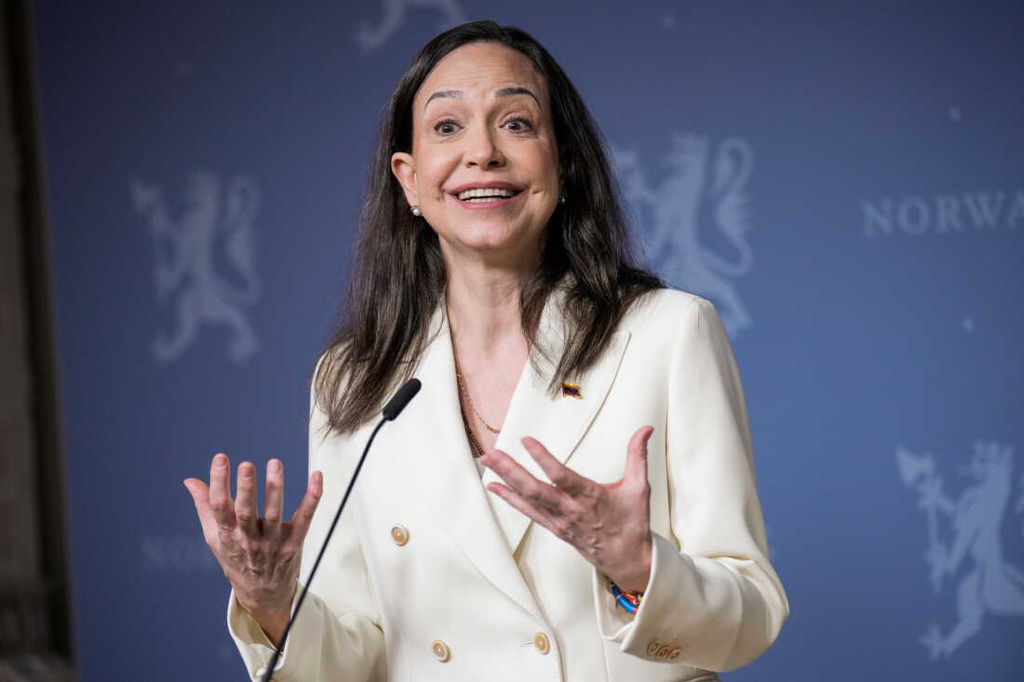
A short message posted on social media on Sunday morning sent shockwaves through Latin America and the halls of power in Washington. It contained only five Spanish words: “Estoy aquí. Con ustedes.” Translated into English, it simply said, “I am here. With you.”
Those five words came from María Corina Machado, the fiery leader of the Venezuelan opposition and a Nobel Peace Prize laureate. After spending more than ten months outside the country in forced exile, she slipped past border controls and re-entered Venezuelan territory.
Minutes after her post went live, her close ally and former presidential candidate Edmundo González Urrutia confirmed the news to the world. He announced that their leader was back on home soil and promised that he would join her very soon.
For millions of Venezuelans who have spent years praying for political change, the announcement felt like lightning striking on a clear day. For the current interim administration in Caracas and foreign diplomats trying to manage Venezuela’s oil wealth, her return throws every carefully made plan completely up in the air.
The Journey That Started on a Midnight Speedboat
To understand why her return is such a massive deal, we have to look back at how she left.
The $0 Secret To Launching Your Entire Online Empire
Why pay hundreds every month for separate software? Build funnels, send emails, and make sales with Systeme.io completely free.
Get Started For $0Free Forever • No Credit Card Needed • Beginner-Friendly
Late in 2025, María Corina Machado was in hiding inside Venezuela, hunted by security forces loyal to the regime. When the Nobel Committee awarded her the Nobel Peace Prize for her tireless fight for democratic freedoms, she faced an agonizing choice: stay trapped underground or risk a dangerous escape to accept the prize on the global stage.
She chose to move. Under the cover of total darkness, Machado was smuggled aboard a speedboat across open water. She dodged coastal patrols, made it to safety, and eventually landed in Oslo, Norway. When she walked onto the stage in Oslo, greeted by her adult children whom she had not seen in two years, the moment moved people across the globe.
She used that platform to remind world leaders of the daily suffering in Venezuela. She spoke about political prisoners, broken hospitals, hyperinflation, and the millions of families torn apart as people fled the country looking for food and work.
Yet Machado was crystal clear from day one: leaving Venezuela was never supposed to be permanent. She repeatedly told reporters and supporters that she was a daughter of Venezuela and would return to finish the work of bringing democracy home.
Who Is María Corina Machado, and Why Does the Government Fear Her?
People often call María Corina Machado the “Iron Lady” of Venezuela. She is an industrial engineer by training, a mother, and a long-time political reformer who refused to back down even when former strongman Hugo Chávez and his successor Nicolás Maduro tried to silence her.
Over the last two decades, Machado faced travel bans, physical assaults, death threats, and government orders barring her from running for public office. When the opposition organized a historic primary election to choose a single unity candidate, Machado won with an astonishing landslide of over 90 percent of the vote.
The government banned her from the presidential ballot anyway. Instead of walking away or telling her supporters to boycott the process, she made a brilliant political move. She backed Edmundo González Urrutia, a calm, retired diplomat who carried her banner into the race.
Machado traveled across Venezuela by car, standing in the back of pickup trucks, holding up portraits of González, and drawing crowds of tens of thousands in town after town. She organized poll watchers across every precinct and helped build an independent verification system that collected actual paper receipts from voting machines.
When the official election council claimed victory for the regime without publishing precinct-level records, Machado’s team posted the physical voting tallies online for the entire world to inspect. The international community, independent observers, and regional neighbors quickly pointed out that the evidence showed González had won the vote by a huge margin.
That fearless organizing made her the undisputed moral and political voice of the Venezuelan opposition. It also made her the biggest threat to the ruling elite.
The Wild Twist: What Happened in Caracas While She Was Away?
While Machado was outside the country rallying support in early 2026, an earth-shattering event flipped the entire crisis on its head.
In January 2026, the United States carried out a swift military operation in Caracas that captured President Nicolás Maduro. U.S. forces flew Maduro directly to New York to face long-standing federal charges involving drug trafficking and torture.
Many people around the world assumed that with Maduro gone, Machado and González would be invited to take immediate control of the government and guide the nation into fresh, free elections. But global politics rarely moves in a straight line.
Instead of backing Machado, the Trump administration in Washington chose to cut a deal with Maduro’s vice president and top deputy, Delcy Rodríguez. Rodríguez was sworn in as Venezuela’s interim president.
The decision stunned millions of everyday citizens who had marched and bled for the opposition. Washington’s primary goal was to secure economic stability and keep Venezuelan crude pumping into international energy markets. Rodríguez agreed to sign a major oil accord that gave the United States highly favorable energy terms.
Send, Spend & Hold Money Worldwide Without Hidden Fees
Transfer money internationally at the real exchange rate and hold 40+ currencies in one account.
Open a Wise AccountMid-market rate • Fast transfers • 40+ currencies
Under the original transition understanding, Rodríguez was supposed to lead an interim government for roughly 90 days to maintain basic public services before organizing open democratic elections.
Those 90 days came and went. Months passed. The interim government settled into the presidential palace, oil exports flowed, but no official date for a free election was ever set.
Seven Failed Attempts: The Secret Road Back
Machado refused to sit on the sidelines while her country’s democratic dreams were traded away. Her close political advisers revealed that over the past few months, she attempted to enter Venezuela seven different times.
Each of those earlier attempts ran into heavy roadblocks. Security checkpoints, strict intelligence monitoring, and diplomatic pushback kept her locked outside the borders.
Her inner circle began laying the groundwork for a breakthrough late in the summer. In August, Omar González, one of Machado’s most trusted confidants, slipped back into Venezuela after three years of exile. He described his arrival as a “prelude” to Machado’s eventual homecoming.
Machado did not give up. Operating with strict operational security, she moved across international boundaries without tipping off state intelligence. According to news accounts from regional outlets, she traveled through Colombia and crossed into Venezuela on foot or through unmonitored border tracks.
By the time Caracas officials realized she had moved, Machado was already standing deep inside the country.
Tears, Faith, and Chants of Liberty: The Scenes on the Ground
The public first saw proof of her arrival at a church in Barquisimeto, the bustling capital of Lara state, roughly 220 miles west of Caracas.
Machado walked into the Sanctuary of the Divine Shepherdess, an iconic spiritual center for Venezuelans. Worshippers who had come for regular Sunday morning prayers suddenly stopped in their tracks.
Footage circulating from churchgoers showed women gasping and placing their hands over their faces in pure disbelief. One woman broke down in tears and called the arrival an absolute miracle. People rushed forward to hug her, crying out her name. A man in the sanctuary shouted at the top of his lungs, “Long live freedom, damn it!”
The $0 Secret To Launching Your Entire Online Empire
Why pay hundreds every month for separate software? Build funnels, send emails, and make sales with Systeme.io completely free.
Get Started For $0Free Forever • No Credit Card Needed • Beginner-Friendly
Machado, dressed simply in a white shirt and blue jeans, hugged supporters, wiped away tears, and bowed her head in prayer.
From Lara state, she joined a growing convoy of cars and motorcycles heading east along the national highways toward the capital, Caracas. As word spread across messaging apps, families poured out of their homes.
By the time the convoy reached Yaracuy and the town of Guacara, thousands of people had gathered at highway overpasses and toll plazas. They waved Venezuelan tricolor flags and chanted “Liberty!” over and over.
Machado leaned through the sunroof of her vehicle, smiling, shaking outstretched hands, and leading the crowd in singing the national anthem. One emotional father ran along the side of her moving car with tears streaming down his face, shouting, “The future of my children is in your hands. Please!”
The raw emotion on display proved something critical: despite months of exile, Machado’s connection to everyday citizens has not faded one bit.
Washington’s Reaction: What Donald Trump Said
Journalists immediately pressed U.S. President Donald Trump for his thoughts on Machado’s daring return.
Speaking to reporters on Sunday, President Trump offered a candid and somewhat surprising reaction.
“I don’t know anything about it, but I think she’s a very nice woman,” Trump said. “She gave me her Nobel Prize. So how can I say anything else? And I hope she’s safe. She’s a very nice woman. But we’re doing really well in Venezuela.”
Trump had previously questioned whether Machado had the internal strength to hold together a fragile country, choosing instead to do business with Delcy Rodríguez’s interim setup to secure energy deals.
Public reporting from international outlets like the PBS NewsHour report on Venezuela and coverage from Al Jazeera’s dispatch on Machado points out a major friction point. The United States wants steady oil supplies and calm streets. But Venezuelan citizens want a genuine democracy where their votes actually pick their president.
Machado’s presence back on home soil forces both the White House and the interim government to face that reality head-on.
The Pressure Facing Delcy Rodríguez and the Interim Government
Interim President Delcy Rodríguez now finds herself in a tight political spot.
When Rodríguez addressed the United Nations General Assembly earlier this year, she pledged to the international community that Venezuela was working on a peaceful democratic transition and would hold fresh elections. Yet months have slipped past without any official calendar, voter roll updates, or new electoral board appointments.
If the interim government moves to arrest Machado, it risks provoking massive street demonstrations across the country and triggering outrage from international human rights bodies.
On the other hand, if the government allows Machado to move freely, hold rallies, and speak to the press, her popular support will rapidly expose the lack of democratic legitimacy behind the current interim administration.
Machado is not asking for special treatment. Her demand has remained rock solid: schedule the elections, let the people choose, and hand over power to the rightful winners.
What This Means for Everyday Families
It is easy to get caught up in high-level geopolitics, oil barrels, and international diplomacy. But the heart of this story belongs to ordinary people.
Almost every family in Venezuela has an empty chair at their dinner table. More than seven million citizens have left the country over the past decade to escape economic collapse. Parents are separated from their children. Grandparents only know their grandchildren through video calls on shaky internet connections.
When people poured into the streets to cheer Machado’s motorcade on Sunday, they were not just celebrating a famous politician. They were expressing an intense longing for normalcy.
They want a Venezuela where a monthly paycheck can buy a full basket of groceries. They want working tap water and steady electricity. Most of all, they want their loved ones to pack their bags and come home.
Machado’s return gives those families tangible hope that the long political nightmare might finally be approaching its final chapter.
Frequently Asked Questions
Why did María Corina Machado leave Venezuela in late 2025?
Machado had been living in hiding to escape government persecution after leading the opposition movement through the disputed 2024 presidential election. In December 2025, she left Venezuela secretly aboard a speedboat under the cover of night so she could travel to Oslo, Norway, to accept the Nobel Peace Prize and draw global attention to Venezuela’s crisis.
How did María Corina Machado get back into Venezuela?
Machado entered Venezuela without using official airport checkpoints, following seven previously unsuccessful attempts to cross back into the country. She traveled discreetly through neighboring Colombia, crossed the border on Sunday, October 25, 2026, and made her first public appearance at a church in the city of Barquisimeto in Lara state.
Who is currently running Venezuela after the removal of Nicolás Maduro?
Maduro’s former vice president, Delcy Rodríguez, is serving as the interim president. After U.S. forces captured Maduro in January 2026 and flew him to New York on federal criminal charges, the Trump administration backed Rodríguez to stabilize the country and keep oil supplies moving.
What is the United States’ position on Machado’s return?
U.S. President Donald Trump remarked that he hopes Machado remains safe and described her as a “very nice woman,” while emphasizing that U.S. economic and energy arrangements in Venezuela are performing well. Washington has prioritized economic stabilization and energy pacts with the interim government, but Machado’s return increases pressure on U.S. officials to demand free and fair elections.
Will Venezuela hold new presidential elections soon?
An official election date has not yet been announced. Interim President Delcy Rodríguez promised the United Nations that elections would take place, but her administration has delayed setting a date. Machado and her coalition are demanding that a clear election calendar be published immediately so citizens can vote in an open, competitive race.
The Road Ahead
Machado’s sudden appearance in Venezuela marks the start of a critical new phase in Latin American politics. She has proven that she is willing to face enormous personal danger to stand shoulder-to-shoulder with her people on their own soil.
The days ahead will test everyone involved. The interim administration in Miraflores Palace must decide whether to negotiate or dig in its heels. The White House will have to balance its commercial energy interests with its stated commitment to democratic values.
Most importantly, the millions of Venezuelans who have refused to surrender their hope now have their leader back in their streets, marching right alongside them.
We will be watching this story very closely as it unfolds across the country. You can reach out to our editorial desk directly on our WhatsBuzzn Contact Page with your news tips, feedback, and thoughts on the situation.
Join our growing community and follow our latest updates across our social channels on Instagram, Facebook, and X.
Exiled Opposition Leader María Corina Machado Returns to Venezuela
This video shows the emotional scenes and public reaction as opposition leader María Corina Machado made her surprise return to Venezuelan soil.
