
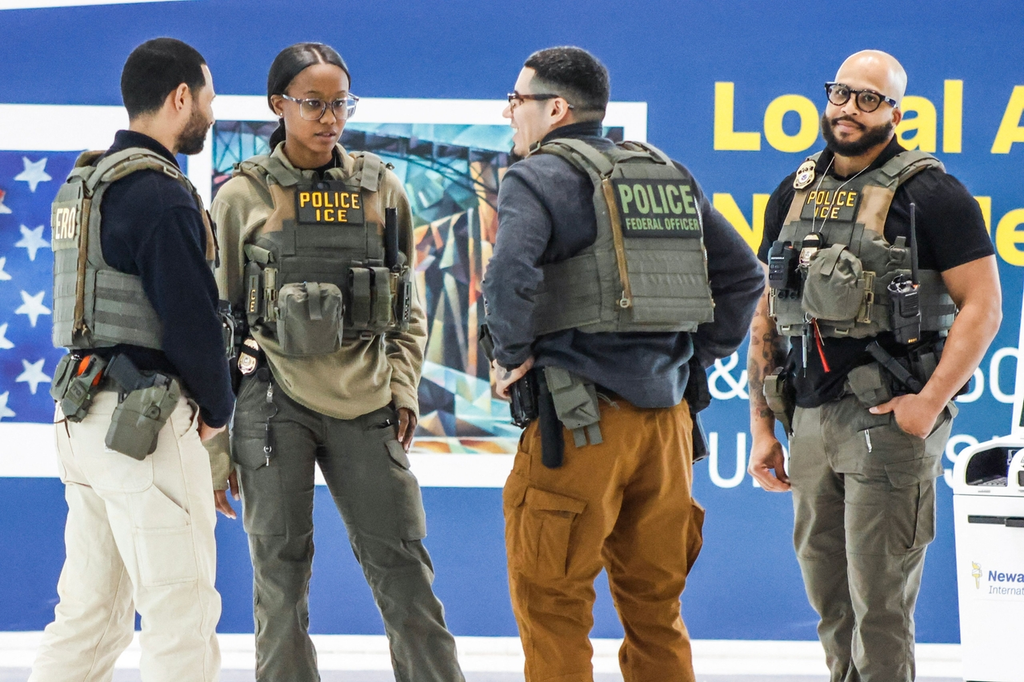
Armed federal agents in uniform are walking through residential neighborhoods, climbing porch steps, and knocking on front doors in multiple states. Their goal is to question everyday residents about their citizenship status and find out whether they have registered to vote or cast ballots in previous elections.
This sudden door-to-door operation comes just weeks before critical midterm elections. The sight of armed officers showing up unannounced at private homes has sparked deep concern among community leaders, voting advocates, and ordinary families across the country.
For many people, hearing a sudden knock and seeing armed badges outside their peephole feels like something out of a movie. Yet this is playing out in real neighborhoods right now. Here is a clear breakdown of what is happening, why it started, what investigators found, and what your basic rights are if someone knocks on your door.
What Just Happened? The Investigation That Broke the Story
The details of this nationwide effort came to light through an investigative report by CBS News. Reporters uncovered that agents from Homeland Security Investigations, known as HSI, have been dispatched to visit private residences across several states. HSI is the primary investigative branch of the Department of Homeland Security.
Agents carry clipboards and folders containing documents explicitly labeled “Target List”. They approach houses, identify themselves as federal officers, and ask residents direct questions about where they were born, their current immigration paperwork, and their voting history.
The $0 Secret To Launching Your Entire Online Empire
Why pay hundreds every month for separate software? Build funnels, send emails, and make sales with Systeme.io completely free.
Get Started For $0Free Forever • No Credit Card Needed • Beginner-Friendly
The Department of Homeland Security confirmed the initiative. An official agency spokesperson stated that the department, working alongside the Department of Justice, is laser-focused on prosecuting noncitizens who attempt to vote and protecting the integrity of American ballots. The spokesperson added that anyone living in the country lawfully who follows the rules has nothing to worry about.
Even so, critics and legal watchdogs argue that dispatching armed agents directly to people’s living rooms creates an environment of fear that could keep legal voters away from the ballot box.
Where Did This Door-to-Door Operation Come From?
The roots of this initiative trace back to directives issued earlier this year. Federal immigration authorities were instructed to place a heavy priority on uncovering election fraud and locating noncitizens who might appear on state voter rolls.
Political leaders pushing for this crackdown claimed that as many as 250,000 ineligible individuals could be registered across the country. However, official court records tell a very different story. Only about 156 people nationwide have actually faced formal charges related to voter fraud under this initiative.
To put that in perspective, the United States has more than 220 million registered voters. Documented cases of noncitizens attempting to cast ballots remain remarkably rare across every major study conducted over the last several decades.
Despite the tiny number of proven cases, federal authorities accelerated their ground operations leading into the election cycle. Field offices were told to move fast, leading directly to the in-person home visits we are seeing today.
The “Target List”: How Are Names Selected?
Many people are asking a simple question: How did federal agents decide whose house to visit?
The process relies on big government databases. Federal workers take state voter registration records and run them against immigration and naturalization databases maintained by U.S. Citizenship and Immigration Services, commonly called USCIS.
On paper, computer matching sounds simple and scientific. In practice, data matching between old, mismatched government systems is notoriously messy.
The Whistleblower Revelations
In September, an internal whistleblower from USCIS came forward with troubling information about how these lists are created.
According to the whistleblower, staff members were instructed to review tens of thousands of voter files under strict daily quotas. Workers had to review roughly 40 names per day. That gave them only about 12 minutes per person to pull records, compare names, and make a call on someone’s citizenship status.
Twelve minutes is barely enough time to verify a single document, let alone untangle complicated name changes, clerical typos, or naturalization certificates.
A Track Record of False Positives
When names are processed that quickly, mistakes happen frequently.
A clear example occurred recently in Nevada. Federal officials initially claimed they had uncovered nearly 16,000 noncitizens registered to vote across the state. State election officials reviewed the files and demanded evidence. In the end, the federal government could not provide evidence of a single illegally registered voter from that entire list.
Many of the names turned out to be American citizens who shared a common name with an immigrant, people who had become naturalized citizens years ago, or people who had simple clerical errors entered by county clerks.
Send, Spend & Hold Money Worldwide Without Hidden Fees
Transfer money internationally at the real exchange rate and hold 40+ currencies in one account.
Open a Wise AccountMid-market rate • Fast transfers • 40+ currencies
When flawed lists become target sheets for armed agents in the field, innocent citizens end up with officers knocking on their doors.
Recent Arrests and the Real-World Impact on Families
The door-to-door visits have already produced arrests, raising even more questions about the targets being chosen.
Earlier this week, federal officials announced that they arrested 11 individuals in the Los Angeles area, all of whom hold permanent legal residency through green cards.
One of the individuals taken into custody was a 72-year-old grandfather originally from Belize who has lived peacefully in the United States as a legal resident for decades. When questioned, he told investigators that he had never voted in an election and had no memory of ever signing up to register.
In many states, people are automatically offered voter registration forms when renewing a driver’s license at the motor vehicle department. If a clerk hands someone a form by mistake or checks an incorrect box, an immigrant can end up on a list without ever intending to commit a crime or ever casting a ballot.
Treating administrative confusion as a high-stakes criminal conspiracy has left entire neighborhoods on edge.
A Historic Departure for Federal Law Enforcement
Sending armed criminal investigators to check voter eligibility at private residences is not normal procedure in American politics.
Eric Balliet, a retired federal agent who spent 23 years working inside Homeland Security Investigations, publicly spoke out about how shocking this tactic is. Balliet noted that throughout his entire two-decade career under multiple presidential administrations, he never once saw or heard of special agents being sent to private homes to interrogate people about voting eligibility.
Traditionally, voter eligibility is managed locally by county registrars, secretaries of state, and local election boards. Routine list maintenance happens through official written mail notices, giving residents time to review their paperwork and respond.
Replacing standard mail notices with uniformed, armed federal agents at the doorstep is a drastic shift in how election laws are handled.
The $0 Secret To Launching Your Entire Online Empire
Why pay hundreds every month for separate software? Build funnels, send emails, and make sales with Systeme.io completely free.
Get Started For $0Free Forever • No Credit Card Needed • Beginner-Friendly
Why Voting Rights Groups Are Raising the Alarm
Civil rights organizations, including the American Civil Liberties Union and the Brennan Center for Justice, have condemned the door-to-door visits.
Their primary worry is the chilling effect this has on legal voters. When word spreads that armed federal agents are roaming neighborhoods asking about voter forms, people get scared.
This fear hits three groups hardest:
- Newly naturalized citizens: People who worked hard for years to earn their citizenship may worry that casting a ballot will somehow jeopardize their status or bring federal scrutiny to their families.
- Mixed-status households: Millions of American citizens live in homes where a spouse, parent, or sibling is a green card holder or undocumented. These citizens may decide not to register or vote simply to keep federal law enforcement away from their home.
- Racial minority communities: When target lists rely on common surnames, Hispanic and Asian communities frequently bear the brunt of database matching errors.
Voting rights advocates argue that this operation functions as a form of voter intimidation, whether intended or not. When eligible citizens stay home out of fear, democracy loses its voice.
What Are Your Legal Rights if Federal Agents Knock on Your Door?
If a federal agent, police officer, or investigator knocks on your door, you have clear rights protected by the United States Constitution. Staying calm and knowing what the law says can protect you and your family.
1. You Do Not Have to Open the Door
You are under no legal obligation to open your front door to law enforcement officers unless they possess a valid search or arrest warrant signed by a judge.
You can speak to officers through a closed door, through a screen, or through a video doorbell. You can politely ask: “Do you have a warrant signed by a judge?”
2. Understand the Difference Between Warrants
An administrative immigration warrant (often titled Form I-200 or Form I-205) is signed by an immigration supervisor, not an independent judge. An administrative warrant does not grant officers permission to enter your private home without your consent. Only a criminal search warrant signed by a court judge allows them inside without your permission.
If agents say they have a warrant, you can ask them to slide it under the door or hold it up to a window so you can read it.
3. You Have the Right to Remain Silent
Under the Fifth Amendment, you have the right to remain silent. You do not have to answer questions about where you were born, whether you are a citizen, how you registered to vote, or who you voted for in past elections.
You can state calmly: “I choose to remain silent. I want to speak to an attorney before answering any questions.”
4. Do Not Lie or Present Fake Documents
While you have the right to remain silent, you must never give false information or hand over fake paperwork to a federal agent. Lying to a federal officer is a felony. Remaining silent is your legal right; giving misleading statements is not.
5. You Can Record the Interaction
In almost every state, you have the constitutional right to take photos, record audio, or film video of law enforcement officers performing their duties in public view or at your front door, provided you do not physically obstruct them.
Having video footage creates an objective record of what took place.
How Does Noncitizen Voting Law Actually Work?
To understand why this issue generates so much controversy, it helps to understand the underlying law.
Under federal law (specifically 18 U.S. Code § 611), it is strictly illegal for any noncitizen to vote in federal elections, including races for the presidency, the U.S. Senate, and the U.S. House of Representatives.
The penalties for breaking this law are severe:
- Conviction can lead to substantial fines and up to a year in prison.
- More importantly for immigrants, an illegal vote almost always results in permanent deportation and a lifelong ban from ever returning to the United States or gaining citizenship.
Because the stakes are so high, very few noncitizens have any desire to risk their entire future in the country just to cast a single ballot.
State voter rolls are maintained independently by local election officials. Every person who registers must sign a legal document under penalty of perjury attesting that they are a citizen. Fraudulent registration is tracked through audits, signature verification, and regular list upkeep.
How to Check and Protect Your Own Voter Registration
With elections approaching, taking two minutes to check your voter status can prevent unwanted surprises on Election Day.
- Check your registration status online: Visit your official state secretary of state website or county election office portal. Confirm that your name, residential address, and party affiliation are listed correctly.
- Keep your address current: If you recently moved, update your registration right away so your polling location matches your current residence.
- Know your local rules: Some states allow same-day voter registration at polling places, while others require paperwork weeks before the vote. Look up your local deadlines early.
- Report intimidation: If you experience harassment, aggressive questioning, or inappropriate intimidation at your door or at a polling booth, report it to the nonpartisan Election Protection coalition at 866-OUR-VOTE (866-687-8683).
Frequently Asked Questions (FAQs)
Can federal agents force their way into my home to ask about my vote?
No. Federal agents cannot enter your private residence without your consent unless they carry a criminal search warrant signed by an independent judge. You have the legal right to keep your door closed.
Do I have to tell an agent who I voted for?
Never. In the United States, your ballot is completely secret. No law enforcement agent, government official, or employer can force you to disclose how you cast your vote.
What should I do if an officer asks for my immigration papers?
You can ask if you are being detained. If they say no, you can state that you wish to go about your day. If you are detained, you have the right to remain silent and request an attorney immediately.
Can a green card holder vote in local or school board elections?
A tiny handful of municipalities across the country allow noncitizens to vote exclusively in local municipal races, such as city council or school boards. However, noncitizens can never vote in federal or state elections anywhere in the country. Green card holders should always consult an immigration lawyer before taking part in any municipal vote, as doing so can create serious immigration complications.
How did my name get on a list if I have never broken any rules?
Government data matching frequently mixes up names. If you share a first and last name with someone else, or if an administrative worker checked the wrong box during a driver’s license renewal, your name might appear on an automated list by mistake.
Staying informed during high-stakes election cycles is the best way to protect your peace of mind and your community. If you have witnessed unexpected law enforcement activity in your area or want to share your perspective with our editorial desk, reach out directly to our team through our WhatsBuzzn Contact Page.
