
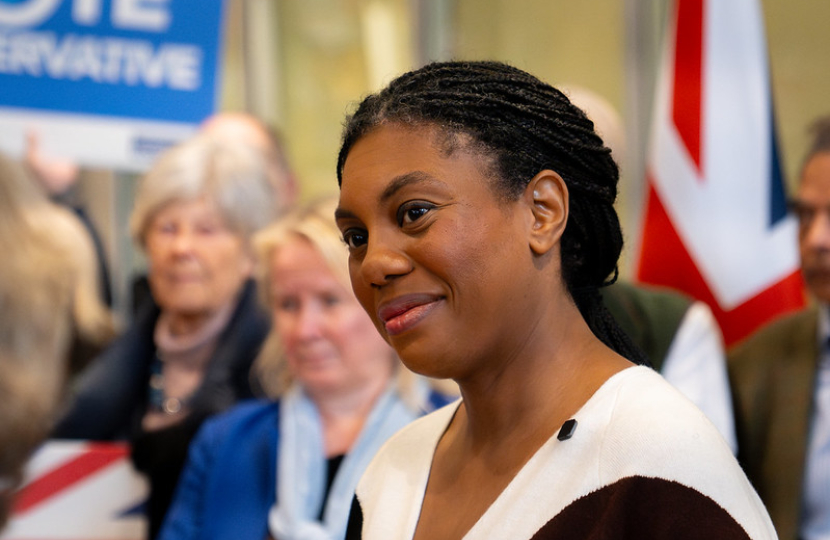
Conservative leader Kemi Badenoch has launched a fierce attack on the government, declaring that Labour will never have the courage to cut public spending when push comes to shove. Speaking directly to business leaders and political correspondents in central London, Badenoch warned that Chancellor John Healey is walking into his maiden Autumn Budget on October 28 with numbers that simply do not add up.
According to Badenoch, the government’s promises to reduce Britain’s deficit depend on massive, painful spending cuts pencilled in for the year 2029. Her argument is simple: Labour has already increased state spending by more than £100 billion over its first two and a half years in power. Believing that ministers will suddenly transform into ruthless budget slashers right before a general election is, in her words, total fantasy.
With Britain facing high borrowing costs, sticky inflation, and growing pressure on public services, the political stakes could not be higher. This is not just an argument between politicians in Westminster suites. The outcome of this clash determines how much tax comes out of your monthly paycheck, the interest rate on your mortgage, and the quality of local services in your community.
The Core Accusation: Why Badenoch Calls Labour’s Plans “Fictional”
At the heart of Badenoch’s speech is a direct challenge to the financial forecasts endorsed by the International Monetary Fund and official treasury watchers. While international bodies recently gave cautious praise to the UK’s medium-term deficit reduction targets, Badenoch insists they are looking at paper promises rather than political reality.
Labour’s official plan shows spending growth slowing down sharply toward the end of the current parliament. To make the deficit figures look respectable, government spreadsheets assume deep reductions in unprotected public departments several years down the line. Independent economists at the Institute for Fiscal Studies have already raised red flags about this timeline, warning that without detailed departmental plans, these projected savings risk being treated as a work of fiction.
The $0 Secret To Launching Your Entire Online Empire
Why pay hundreds every month for separate software? Build funnels, send emails, and make sales with Systeme.io completely free.
Get Started For $0Free Forever • No Credit Card Needed • Beginner-Friendly
Badenoch drove that point home with blunt language. She told the audience that ministers are using backloaded cuts as an accounting trick to buy credibility today, fully knowing an election will be called before those cuts ever take effect. As detailed in coverage of the speech from City A.M., she insisted that international investors and bond markets are not buying the story.
The opposition leader claimed that when the crunch point arrives, Labour backbenchers will rebel against spending restraint. Instead of shrinking the state, she argued, the government will choose to borrow more money, hike taxes on ordinary families, or rush to the country for an early election rather than deliver on the promised austerity.
John Healey vs Rachel Reeves: A New Chancellor, the Same Playbook?
The political backdrop to this showdown is the changing of the guard inside the Treasury. Following a rocky period marked by rising borrowing rates and voter anger over previous fiscal events, John Healey took the reins as Chancellor. Many political observers initially framed Healey’s appointment as an opportunity to calm market nerves and avoid the heavy drama of past budgets.
Badenoch directly pushed back against that narrative. While acknowledging that many voters viewed Healey’s arrival as a welcome relief after previous tax-heavy budgets, she argued that his upcoming fiscal statement could actually do far more long-term damage. The danger, she explained, comes from attempting a “nothing to see here” budget that ducks hard decisions.
In her view, pretending that Britain can maintain record-high spending without fixing structural waste is economic negligence. When governments try to maintain an unsustainable budget without making cuts, they end up raising stealth taxes on businesses and investors. That quietly chokes off private investment, drags down wages, and leaves ordinary workers carrying the bill.
This aggressive approach reflects the tactical shift Badenoch introduced after she shook up her shadow cabinet team to mount a much sharper, ideological challenge to the government’s economic agenda.
The Borrowing Trap: Taking Out Loans to Pay Interest
To explain why spending cuts cannot wait, Badenoch compared Britain’s national debt to a household maxing out credit cards. Britain’s government bond yields have hovered near 6 percent, pushing the state’s cost of borrowing to levels not sustained since the late 1990s.
When government bond yields rise this high, borrowing becomes extremely expensive. At current rates, every single pound the state borrows costs roughly two pounds to service over a twelve-year period. Badenoch argued that instead of paying down debt, the government is essentially taking out fresh loans just to cover the interest payments on existing debt.
No household or private business could survive that dynamic for long. When a country spends billions of pounds every single month just paying interest to bondholders, that money vanishes into thin air. It cannot be spent on building new hospitals, repairing local roads, hiring teachers, or cutting taxes.
This cycle of spiralling state borrowing is not unique to Britain. Around the world, advanced economies are grappling with the reality of what happens when trillions of dollars in public debt crowd out productive investment and put upward pressure on domestic interest rates.
Welfare vs Defence: The Big Spending Trade-Off
The most controversial section of Badenoch’s address was her proposal for where spending cuts should come from. She argued that the UK must urgently cut its welfare bill to fund national defence.
With international security growing increasingly unstable across Eastern Europe and the Middle East, calls have grown for Britain to lift defence spending to 3 percent of gross domestic product. Badenoch pointed out that lifting defence expenditure to this level would cost less than one-third of the total increase added to the welfare budget since Labour entered government.
She argued that Britain has allowed out-of-work sickness benefits to expand beyond reasonable limits. Rather than subsidising working-age people with mild conditions to remain outside the workforce, she urged the government to tighten eligibility rules and push people back into active employment. This builds directly on her earlier speeches warning that Britain has developed an unhealthy dependency on welfare.
Under her proposed “Golden Economic Rule,” the Conservative Party claims to have identified more than £70 billion in potential state savings. Under this rule, half of every pound saved through administrative and welfare reform would go toward reducing the national deficit, while the other half would fund targeted tax cuts for working people and small businesses.
The Warning on New Taxes: Banks, Landlords, and Jobs
Badenoch also issued a direct warning against floating new tax hikes ahead of the October 28 statement. Rumours across Westminster suggest that the Chancellor is exploring higher levies on major banks and commercial landlords to help balance the books without breaching manifesto pledges on headline income tax rates.
Send, Spend & Hold Money Worldwide Without Hidden Fees
Transfer money internationally at the real exchange rate and hold 40+ currencies in one account.
Open a Wise AccountMid-market rate • Fast transfers • 40+ currencies
Badenoch argued that targeting banks and property owners is a dangerous shortcut that backfires directly on ordinary citizens:
- Taxes on banks hit ordinary pensions: Major commercial banks are held heavily by British pension funds. Punishing financial institutions directly reduces the retirement nest eggs of millions of ordinary workers.
- Taxes on landlords raise private rents: When landlords face higher taxes and compliance costs, they either pass those costs onto tenants through higher monthly rent or sell their properties, reducing rental supply.
- Taxes on businesses kill entry-level jobs: Levies on employers make hiring new workers risky and expensive, hitting young people looking for their first career step.
Instead of hunting for new groups to tax, Badenoch argued for bold tax cuts. Her platform includes abolishing stamp duty on primary residences, cutting National Insurance for workers under the age of 25, reducing business rates on high-street shops, and scrapping inheritance tax on family homes. In her view, the path to prosperity lies in letting people keep more of their hard-earned money rather than feeding a growing state apparatus.
The View from Downing Street: How Labour Sees the Challenge
The government views the economic landscape through a completely different lens. Prime Minister Andy Burnham and Chancellor John Healey maintain that public spending is essential to repair what they call fourteen years of Conservative mismanagement.
From Labour’s perspective, public services were left on the brink of collapse. Hospital waiting lists reached record highs, school buildings required emergency concrete repairs, and prisons ran out of cells. Labour ministers argue that you cannot simply cut your way to prosperity when essential public infrastructure is crumbling.
Responding to Badenoch’s proposals, Labour figures pointed out that slashing welfare support during a persistent cost-of-living squeeze would push vulnerable families into outright poverty. Prime Minister Burnham has argued publicly that national security cannot come at the direct expense of social security.
Furthermore, Labour argues that its approach to public finances focuses on long-term structural reform. Rather than cutting support off overnight, the government says it wants to reform job centres, invest in preventative healthcare, and train workers so that people can move off benefits naturally into secure jobs.
This ideological split has defined the intense rivalry at the top of British politics, with both sides offering radically different answers to the same economic problems. The philosophical battle has been building steadily ever since Badenoch and Andy Burnham took opposing sides on the national stage.
The Looming Early Election Question
Badenoch made a notable political prediction during her London address: she argued that ministers are deliberately delaying hard budget decisions because Prime Minister Andy Burnham plans to call an early general election before the planned spending cuts ever fall due.
This is a classic political manoeuvre known in Westminster as “kicking the can down the road.” By scheduling deep departmental cuts for 2029, a government can present a clean financial forecast to the Office for Budget Responsibility today while avoiding the political pain of actually firing staff or closing programmes.
If an election happens before 2029, ministers never have to face the fallout from those spending cuts. They can campaign on having protected frontline services, leaving the next parliament to sort out the financial hangover. Badenoch recently hinted at this possibility when she warned Conservative activists about an early election shock.
The $0 Secret To Launching Your Entire Online Empire
Why pay hundreds every month for separate software? Build funnels, send emails, and make sales with Systeme.io completely free.
Get Started For $0Free Forever • No Credit Card Needed • Beginner-Friendly
At the same time, Badenoch faces intense pressure on her right flank. Nigel Farage’s party has continued to gain momentum across working-class constituencies, bolstered by record-breaking financial backing from private donors. To keep her party relevant and prevent voters from defecting, Badenoch must present a crystal-clear contrast to Labour’s tax-and-spend philosophy.
What This Spending Debate Means for Everyday People
It is easy to get lost in the sea of billions, percentages, and parliamentary insults. When you strip away the political theatre, this spending argument affects regular households in several practical ways.
Your Monthly Mortgage and Borrowing Costs
The single biggest reason this debate matters is the bond market. If international investors believe that the government’s Budget is based on made-up numbers, they demand higher interest rates to lend money to the UK.
When government bond rates go up, commercial banks immediately raise interest rates on fixed-rate mortgages, personal loans, and credit cards. A credible budget that keeps borrowing under control helps push mortgage rates down, saving homeowners hundreds of pounds each month.
Your Take-Home Pay
Taxes are already at an all-time high. While the Chancellor may avoid raising headline income tax rates, keeping tax thresholds frozen pulls more of your pay into higher tax brackets whenever you receive a raise.
If Badenoch is right that the government cannot cut spending, ministers will inevitably look for new revenue streams. That could mean higher capital gains taxes, adjustments to pension tax relief, or higher levies on goods and services.
Local Services and Council Tax
When central government squeezes departmental spending without enacting major structural reforms, local councils bear the brunt. Many local authorities across England and Wales are struggling with massive budget shortfalls.
If central grants fail to keep pace with inflation, local councils will continue raising council tax by the maximum allowed percentage each year while cutting back on road maintenance, library hours, and leisure centres.
Can Any Government Actually Cut Spending?
One question Badenoch’s critics are quick to ask is whether her own party could actually deliver £70 billion in spending cuts if they were in power today.
Cutting government spending sounds straightforward on paper, but every line item in the national budget has a passionate constituency fighting to protect it. Cutting overseas aid causes diplomatic friction. Trimming the civil service triggers union disputes. Restricting disability benefits leads to immediate moral and legal challenges in parliament.
During their fourteen years in government, Conservative prime ministers frequently promised to shrink the state, yet total government spending and overall taxation ended up higher in 2024 than when they took office in 2010.
Badenoch claims her leadership represents a clean break from that past. She argues that past Conservative administrations failed because they tried to govern like managers rather than standing firm on free-market principles. Whether the public believes her party has found the discipline that previous leaders lacked remains the ultimate hurdle for her comeback strategy.
Frequently Asked Questions (FAQs)
What did Kemi Badenoch mean by “fictional cuts”?
Badenoch argues that Labour’s plan to lower the deficit relies on sharp public spending cuts scheduled for 2029. Because those cuts are pushed so far into the future, right before the next general election, she claims the government has no real intention of ever carrying them out.
When is the next UK Budget?
The Chancellor delivers the Autumn Budget on Wednesday, October 28. It represents the government’s primary fiscal event of the season, outlining national tax policies, departmental spending limits, and updated economic growth forecasts.
Why does Badenoch want to cut welfare spending?
Badenoch argues that post-pandemic welfare spending has grown too fast, with thousands of working-age people leaving the labour force on sickness benefits. She wants to tighten qualification rules so that state resources can be redirected toward boosting national defence and funding tax cuts for workers.
What is the Conservative “Golden Economic Rule”?
Badenoch’s Golden Economic Rule states that for every pound the government saves by cutting state spending and bureaucracy, at least fifty pence must go directly toward lowering the national deficit, while the remainder is used to lower taxes for individuals and businesses.
How does government debt affect mortgage rates?
When a government borrows heavily, it must offer higher interest rates on its bonds to attract investors. Because commercial banks use those government bond rates as a baseline for pricing their own financial products, higher government borrowing costs directly push up fixed-rate mortgage costs for homebuyers.
What happens if the government does not cut spending?
If a government decides not to reduce spending while borrowing costs remain high, it must either raise taxes to cover the difference or borrow more money. Borrowing more can fuel inflation and increase the national debt, leaving less money for public services in future years.
The coming days will show whether Chancellor John Healey sticks to his current fiscal plan or adjusts course in response to mounting pressure from the opposition and financial markets. With both parties laying out entirely different visions for how Britain should manage its money, the decisions made on October 28 will set the economic direction of the country for years to come.
