
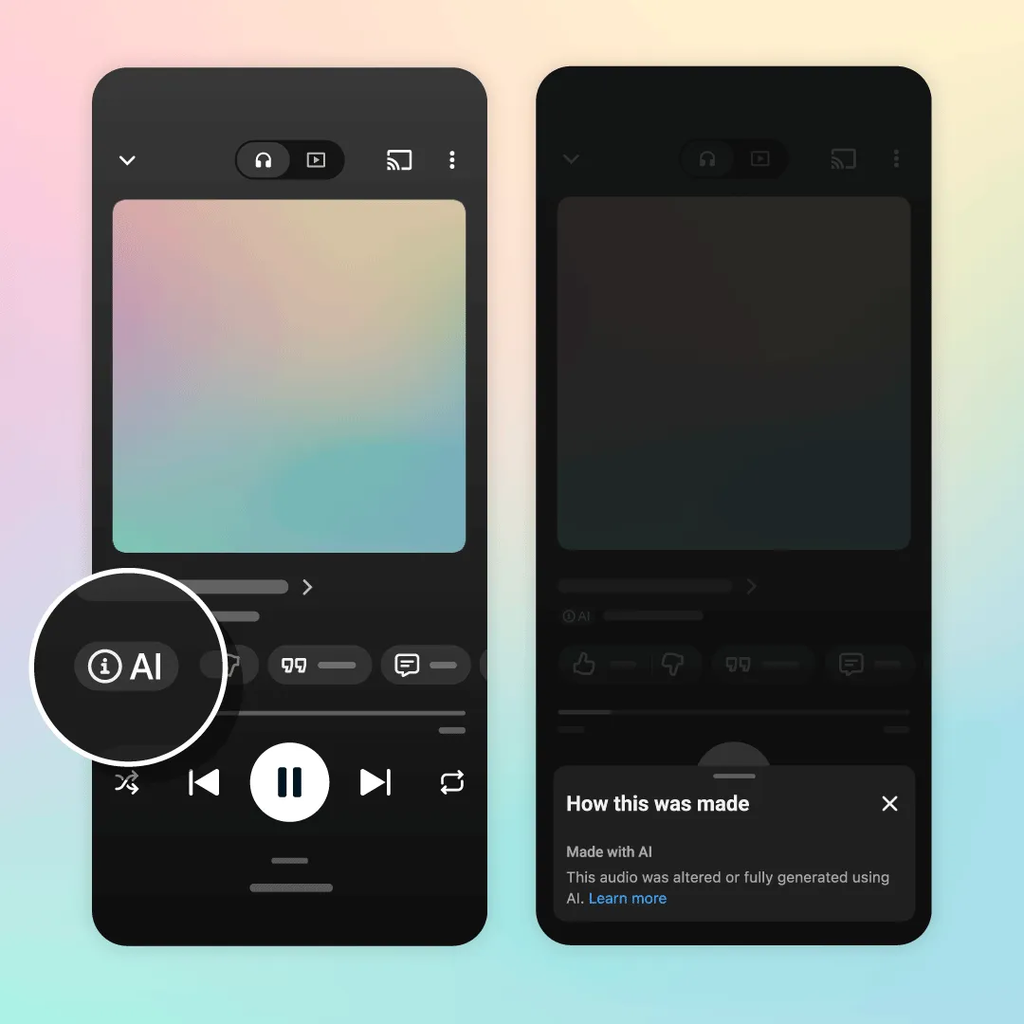
YouTube Music has rolled out visible disclosure labels directly onto song player screens to notify listeners whenever a track was made primarily with generative artificial intelligence.
If a song’s vocals or instrumentals were produced by typing prompts into a computer program rather than human musicians playing instruments in a recording booth, YouTube now tells you up front. The change arrived after months of complaints from listeners who stumbled across catchy songs online, only to realize the singer does not actually exist.
The move marks one of the most direct steps taken by a major streaming service to tackle the surge of synthetic tracks flooding digital libraries. Instead of hiding disclaimers deep inside audio metadata or buried under credit menus, the platform places an obvious tag right under the player controls. When you tap that tag, a menu opens to reveal how much artificial intelligence helped build the song you are streaming.
The update arrives at a time when digital music libraries are expanding at dizzying speeds. Anyone with an internet connection can now use software to generate dozens of full-length songs in minutes. While some fans love playing around with these novel tools, many listeners feel tricked when an emotional vocal run turns out to be pure algorithmic math. YouTube is betting that simple transparency can bring trust back to your daily music rotation.
How the New YouTube Music AI Tags Work on Your Screen
When you open the YouTube Music app on Android or iOS and hit play on an affected track, you will spot a clean, subtle label placed near the song details. Tapping this label brings up a brief information card explaining the track’s origins.
The $0 Secret To Launching Your Entire Online Empire
Why pay hundreds every month for separate software? Build funnels, send emails, and make sales with Systeme.io completely free.
Get Started For $0Free Forever • No Credit Card Needed • Beginner-Friendly
The prompt explains whether the music was created with generative software, giving curious fans instant answers without interrupting the flow of their listening session. YouTube is also rolling out this feature across the desktop web player, with plans to extend the exact same labeling system to music videos and background art tracks on the primary YouTube video application.
YouTube does not treat every song that touches a digital plugin as an artificial track. The platform focuses its warning tags on tracks where generative algorithms played the leading creative role. If a generative system wrote the lyrics, composed the underlying chord progression, and sang the lead vocals, that track gets flagged.
On the other hand, if a human singer recorded a vocal take in a home studio and used standard digital effects to clean up background hum or adjust pitch, they do not have to worry about getting hit with an AI badge. The goal is to highlight full algorithmic generation, not punish normal audio engineering.
The Three Tiers: How YouTube Classifies Music Production
To decide which songs get tagged and which do not, YouTube created three specific classifications for artists, record labels, and distributors. These guidelines help separate ordinary studio technology from automated audio generation:
- Fully Gen AI: This tag applies when an entire song comes directly from a computer prompt. If someone opens an AI music tool, types in a sentence asking for a melancholy indie ballad, and downloads the finished file, that file is fully artificial. The software produced the rhythm, the singing, the melodies, and the instrumentation from scratch.
- Partly Gen AI: This tier covers hybrid music production. For example, a human producer might play physical piano chords and write original verses, but use an AI audio tool to generate an artificial choir background or generate drum patterns. It also applies when songwriters use machine learning platforms to brainstorm melodies that they later re-record using live instruments in a studio.
- No Gen AI: This label belongs to traditional recordings made by human artists, even if they use modern software tools. Using Auto-Tune to tighten up a vocal run, running a clean-up filter to remove room echo, or using automated mastering plugins to balance audio frequencies does not count as generative creation. These utilities have been part of the recording industry for decades, and YouTube explicitly exempts them.
Record companies and independent musicians report these categories when uploading new music catalogs through standard digital distribution systems. When uploading through tools like YouTube Studio, creators now encounter options where they must declare the presence of synthetic media before their audio goes live.
What Happens When Someone Fails to Disclose?
A common question among artists and fans is whether uploaders can simply cheat the system by clicking the “No Gen AI” box. YouTube made it clear that self-reporting is only the first line of defense.
If an uploader refuses to disclose that their song was made with prompts, YouTube deploys internal audio detection algorithms to scan the upload. The company has spent years building Content ID to detect copyright violations, and it has adapted similar audio fingerprinting systems to look for artifacts common to synthetic audio engines. When the system detects heavy signs of machine generation that were hidden by the uploader, it can apply the tag automatically.
This automated safety net aligns closely with broader search and platform updates across parent company Alphabet. Over the past year, Google updated its systems to penalize low-quality automated content, pushing web publishers and video creators alike toward authentic, human-first work.
YouTube has also pushed for digital watermarking across its product suite. Tools like SynthID now embed invisible digital signatures inside audio files and images generated by Google models. In visual software, users have watched Google adjust how watermarks and labels appear on generated media, and bringing similar transparency directly into the music streaming interface is a logical next step.
Will These Labels Hurt an Artist’s Reach or Earnings?
Many independent creators worried that getting tagged with an AI badge would ruin their channel performance. The streaming industry has seen plenty of algorithm updates that silently tank impressions for certain categories of content, leaving artists uneasy about being honest.
YouTube addressed this directly: the new disclosure labels do not alter recommendation algorithms, and they do not strip a song of its ability to earn money.
A song tagged as generative AI can still land on personalized radio mixes, appear in autoplay queues, and generate revenue through advertisements and premium subscription payouts. YouTube’s leadership has repeatedly stated that its priority is listener awareness rather than punishment. The platform wants users to know what they are hearing, but it does not want to shut the door on creators experimenting with novel digital instruments.
This policy fits right alongside recent operational changes to the platform’s core mechanics. For instance, YouTube updated how it counts video plays from the first second, ensuring that genuine user interest matters more than arbitrary watch duration thresholds. Similarly, independent creators deciding between making money through AdSense versus brand sponsorships can rest easy knowing that an honest tag does not automatically turn off their monetization faucet.
YouTube is also running its own generative music experiments in parallel. Its proprietary Dream Track system allows approved creators to test voice conversion tools legally using licensed voices of participating artists. Because YouTube is actively trying to build sustainable commercial models around creative software, it has no incentive to ban synthetic songs from the ecosystem.
The Streaming Wars: How Rival Platforms Are Handling Synthetic Tracks
YouTube Music is not working in a vacuum. The entire audio streaming industry has been wrestling with an explosion of synthetic audio over the past two years, with each service testing different approaches to manage their catalogs:
Send, Spend & Hold Money Worldwide Without Hidden Fees
Transfer money internationally at the real exchange rate and hold 40+ currencies in one account.
Open a Wise AccountMid-market rate • Fast transfers • 40+ currencies
- Spotify: The Swedish audio giant has targeted ghost accounts and bulk uploaders. Spotify recently began tagging suspected synthetic accounts as AI Personas. It also regularly purges millions of low-effort ambient tracks designed purely to siphon fractions of a cent from royalty pools through automated listening bots.
- Apple Music: Apple announced plans to include dedicated “Made by AI” markers across song metadata screens. Apple has taken a cautious approach, working directly with major record labels to ensure that human session musicians and backing vocalists continue to receive proper attribution on digital liner notes.
- Tidal: Known for positioning itself as an artist-centric service, Tidal took an even stricter stance. Tidal plans to label generative releases while blocking completely synthetic tracks from drawing money out of the primary subscriber royalty pool, ensuring that subscription revenue flows exclusively to human musicians.
Social networks are moving along the same path. Video platforms have realized that users get frustrated when they cannot tell whether a personality on their feed is authentic. We saw this when Instagram introduced policies against fake human accounts and computer-generated personalities, requiring clear disclaimers for photorealistic generated figures. Music streaming is simply catching up to the standards already taking shape across social feeds.
Industry trade groups like the Recording Industry Association of America (RIAA), the International Federation of the Phonographic Industry (IFPI), and the Grammys have joined together to demand unified standards. They want every streaming service to adopt consistent markers so fans do not have to guess whether an album was written by an artist in a bedroom or cranked out by a server farm.
Why Fans and Musicians Have Been Asking for Transparency
To understand why these labels matter so much, you have to look at how chaotic music feeds have become.
For decades, discovering music felt intimate. You found an artist, connected with their story, read the album credits, and followed their career. Today, machine learning models can mimic almost any genre in seconds. If an account wants to create a convincing lo-fi hip-hop station or an acoustic pop track, it can produce an entire discography by lunch.
While algorithmic automation already powers everyday software features you use without thinking, music touches human emotion differently. When an emotional lyric brings tears to someone’s eyes, discovering that the singer never existed and never felt pain can leave a bad taste in their mouth.
Human achievement still holds massive cultural power. Millions of fans celebrate when an artist like Burna Boy racks up billions of YouTube views because those milestones represent sweat, touring, studio hustle, and genuine fan connection. Synthetic uploads can generate pleasing sounds, but they lack human vulnerability. The new labels protect that distinction.
Musicians also worry about economic survival. When hundreds of thousands of computer-generated songs flood streaming platforms every week, they crowd out independent artists who spent months writing melodies and saving money to rent studio space. Giving listeners a clear way to see what went into a song helps protect the value of human labor in an era where audio generation is essentially free.
What Independent Creators and Everyday Uploaders Should Do Next
If you make music, create digital background tracks, or produce user-generated creative content for brands and social platforms, these changes mean you need to update your upload habits.
Here is how you can navigate the new requirements cleanly:
- Audit your production workflow: Look closely at the tools in your digital audio workstation. If you use software instruments, virtual synthesizers, or pitch correction, your track falls under the “No Gen AI” designation. You do not need to flag normal software plugins.
- Be honest about stem generators: If you used a generative prompt to spit out a guitar solo, a vocal hook, or a backing sample, select the “Partly Gen AI” option when uploading through YouTube Studio or your music distributor. Being upfront prevents your channel from receiving metadata strikes or automated corrections down the road.
- Do not fear the label: Remember that having a tag on your song does not lower your video rank or disable monetization. Listeners who enjoy electronic, synthetic, or experimental music will still stream your tracks. Deceiving your audience hurts your credibility far more than an honest label ever could.
- Keep clean documentation: Keep your project files, raw vocal stems, and session arrangements saved. If YouTube’s automated detection bots ever mistake your real acoustic song for a synthetic track by mistake, having your original raw takes makes appealing the classification fast and painless.
Taking these steps keeps your account in good standing and lets your listeners know that you value their trust.
The $0 Secret To Launching Your Entire Online Empire
Why pay hundreds every month for separate software? Build funnels, send emails, and make sales with Systeme.io completely free.
Get Started For $0Free Forever • No Credit Card Needed • Beginner-Friendly
Frequently Asked Questions (FAQs)
Does having an AI label hurt a song’s view count or streaming reach?
No. YouTube has stated that disclosure labels do not alter recommendation algorithms. A tagged song can still be recommended on the home screen, included in automated radio stations, and added to user playlists without any algorithmic penalty.
Can listeners completely block AI music from playing on YouTube Music?
Not currently. At this stage, YouTube only displays labels so listeners can identify synthetic music on their own. While many listeners have asked for a toggle switch to hide all generated songs completely, YouTube has not introduced an outright filter button yet.
Does using Auto-Tune or pitch correction trigger the AI label?
No. Standard audio correction utilities, such as Auto-Tune, melody alignment, background noise removal, and automated mastering software, are classified under the “No Gen AI” tier. They do not trigger disclosure tags.
What happens if an artist hides their use of generative AI?
If an uploader marks a fully generated track as human-made, YouTube’s internal detection systems can identify the synthetic audio signatures and apply the label automatically. Continued false declarations can lead to account penalties or restrictions on YouTube Studio features.
Is YouTube Music trying to ban AI songs from the service?
No. YouTube actively supports the development of creative tools and works with generative models through initiatives like Dream Track. The company’s policy is focused on transparency for listeners, not banning software-assisted music.
The music landscape is shifting into an era where sound creation is more accessible than it has ever been. By giving listeners simple, honest markers directly on the player screen, YouTube Music is attempting to strike a fair balance between technological invention and respect for human artistry. Listeners get the clarity they deserve, artists maintain the integrity of their work, and the digital music ecosystem gains a much-needed layer of accountability.
