
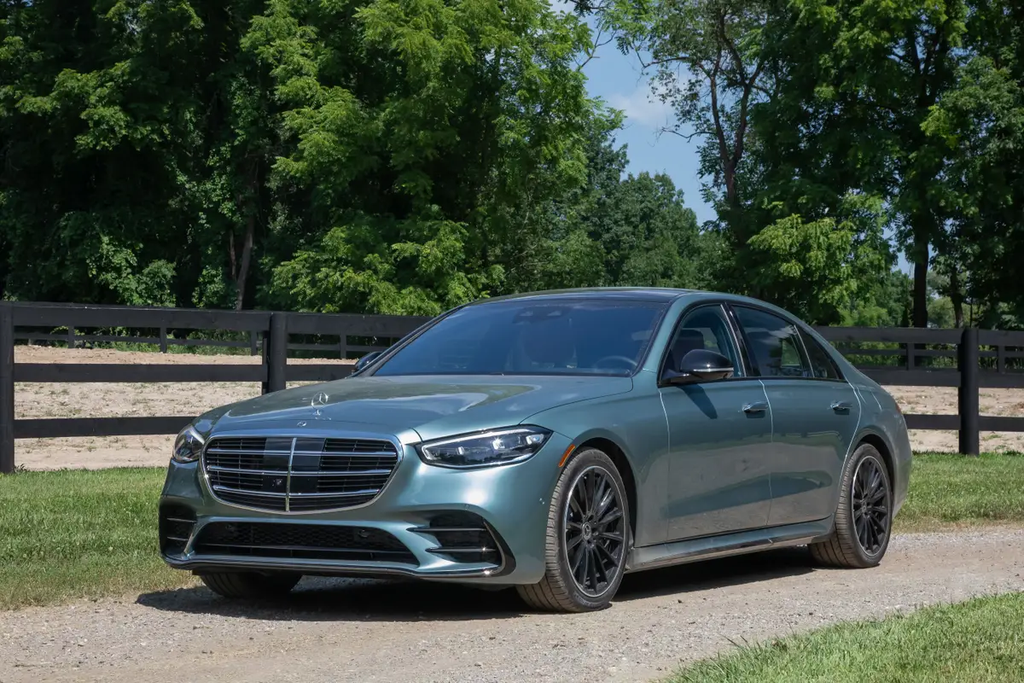
Mercedes-Benz has officially issued a major safety recall covering more than 30,000 of its flagship luxury sedans in the United States. If you drive a newer Mercedes-Benz S-Class, an ultra-luxury Maybach, or a high-performance AMG sedan, you need to pay close attention to your brake pedal.
Federal safety regulators at the National Highway Traffic Safety Administration (NHTSA) revealed that a defect in the front-axle brake hoses can cause brake fluid to leak out without any advance warning. When brake fluid leaks, hydraulic pressure drops, making it significantly harder to bring your car to a stop. In the worst-case scenario, stopping distances increase dramatically, sharply raising the chances of a serious crash.
This is not a tiny recall affecting a handful of niche prototypes. It hits the crown jewel of the German automaker’s lineup, covering vehicles built across several model years. Even more troubling is how this recall came to be: Mercedes originally thought the problem was limited to hot and humid climates, but real-world failures proved that theory wrong, forcing the company to expand the recall by nearly ten thousand vehicles.
Here is everything you need to know about the defect, which models are affected, how dangerous it really is, and what you must do right now to keep yourself safe on the road.
What Is Going on With the Brakes?
To understand why this recall matters, you have to look at how modern car brakes work. Your car does not stop through sheer muscle power. When you press down on the brake pedal, you push hydraulic fluid through sealed rubber and metal lines down to the brake calipers at each wheel. That hydraulic fluid creates immense pressure, clamping the brake pads onto the spinning discs to slow down the vehicle.
The $0 Secret To Launching Your Entire Online Empire
Why pay hundreds every month for separate software? Build funnels, send emails, and make sales with Systeme.io completely free.
Get Started For $0Free Forever • No Credit Card Needed • Beginner-Friendly
If that fluid leaks out, hydraulic pressure drops instantly.
According to safety filings submitted to the NHTSA under recall campaign 26V638, the front brake hoses on affected Mercedes models are suffering from material fatigue. Over time, heat from the engine bay and the brakes themselves, combined with the mechanical bending of the hoses as the front wheels turn and absorb bumps, causes the rubber hoses to wear out prematurely.
Eventually, tiny cracks develop, and brake fluid begins to escape.
When brake fluid leaks from the front hose, you lose pressure in that specific brake circuit. Modern luxury cars use dual-circuit braking systems so that if one line fails, the other can still slow the car down. That means your brakes will not vanish completely into thin air. However, losing half your hydraulic braking system means you will suddenly have to stomp the pedal much deeper into the floorboard, and your car will take far longer to come to a complete stop.
If that sudden loss of pressure happens on a crowded highway or as you approach an intersection, those extra feet of stopping distance can easily mean the difference between a close call and a devastating collision.
The Models Included in the Recall
This recall touches the absolute pinnacle of Mercedes-Benz luxury and engineering. These are vehicles that routinely retail between $115,000 and well over $200,000.
The recall covers a total of 30,078 vehicles across the 2022 through 2025 model years. Every vehicle in the recall was manufactured between February 2, 2021, and November 28, 2024.
The breakdown across the affected nameplates includes:
- Mercedes-Benz S 580 4MATIC (2022–2025): 16,881 units. This twin-turbo V8 executive cruiser represents the vast majority of the cars on the list.
- Mercedes-Benz S 500 4MATIC (2022–2025): 7,143 units. The inline-six flagship sedan that serves as the entry point to the modern S-Class lineup.
- Mercedes-Benz S 580 e 4MATIC (2023–2025): 2,277 units. The plug-in hybrid variant combining electrified efficiency with executive comfort.
- Mercedes-AMG S 63 E Performance (2023–2025): 1,760 units. The 791-horsepower performance beast built by AMG that packs blistering acceleration alongside heavyweight luxury.
- Mercedes-Maybach S 680 4MATIC (2022–2025): 1,070 units. The ultimate twelve-cylinder luxury limousine favored by business moguls and dignitaries.
- Mercedes-Maybach S 580 4MATIC (2022–2025): 947 units. The V8 edition of the extended-wheelbase Maybach.
Seeing high-end Maybach models caught up in a brake hardware defect might surprise many drivers, but shared platform architecture means shared parts. If you follow top-tier luxury releases, such as the refreshed Mercedes-Maybach GLS, you already know that Maybach and standard Benz models share numerous engineering foundations behind the scenes. When a front-suspension component or brake hose has a durability problem, it trickles across every badge built on that chassis.
Why the Recall Suddenly Expanded by Nearly 10,000 Cars
This is actually the second time Mercedes-Benz has had to address this specific brake line problem. The backstory of how the recall grew reveals a lot about how car companies investigate mechanical failures.
During an earlier campaign launched in 2025, Mercedes identified failing front brake hoses on certain S-Class models. At the time, the automaker believed the issue was restricted to vehicles operating in persistently hot, humid climates. The internal working theory was that high ambient heat combined with moisture degraded the rubber compound much faster than normal driving conditions would.
Based on that climate-focused hypothesis, Mercedes scoped out a limited recall, leaving out vehicles sold or registered in cooler regions.
That working explanation quickly fell apart.
Over the following months, field reports began trickling in from cooler international markets where high heat and intense humidity were non-existent. The brake hoses were still wearing out and leaking fluid. The evidence proved that climate was never the root cause. The issue was purely mechanical fatigue from standard vehicle operation over time.
By mid-2026, Mercedes launched an internal review of all global data. Between April, May, and August of 2026, the company recorded three separate failure reports on United States vehicles that were completely excluded from the original recall.
Send, Spend & Hold Money Worldwide Without Hidden Fees
Transfer money internationally at the real exchange rate and hold 40+ currencies in one account.
Open a Wise AccountMid-market rate • Fast transfers • 40+ currencies
On September 25, 2026, Mercedes leadership conceded that a safety risk could not be ruled out for any vehicle produced before a revised hose design entered assembly. They officially expanded the campaign to cover 30,078 total vehicles, roping in nearly 10,000 cars that had previously been deemed unaffected.
The Sneakiest Part: There Is Zero Warning Before It Leaks
One of the most alarming aspects of this defect is how silently it develops.
When you drive modern vehicles equipped with advanced driver-assist systems and digital dashboards, you expect the car to give you an early heads-up when something starts to degrade. In fact, drivers rely heavily on connected automotive tech for road awareness, from digital gauge clusters to navigation tools like Android Auto getting a live speedometer in Google Maps.
With these brake lines, however, there is zero advance warning.
You will not hear a squeal, you will not feel a slight vibration, and your car will not tell you that the hose is growing weak. The rubber simply fatigues over thousands of miles until a crack opens up.
The only warning you get happens after the brake fluid has already started leaking out of the hose. Once the fluid level inside the master cylinder drops past a critical threshold, a red warning message will illuminate on your digital instrument cluster stating that brake fluid is low.
If that red warning light pops on while you are cruising down the road, it is not a gentle reminder to schedule an oil change next month. It is an immediate mechanical emergency. Continuing to drive while brake fluid empties out will eventually compromise your stopping distance entirely.
Have There Been Any Accidents or Injuries?
The positive news so far is that Mercedes-Benz has reported no crashes, injuries, or property damage tied to this brake hose failure in the United States.
Even though the dual-circuit system prevents complete brake failure when a single hose bursts, the reduced stopping force is still classified by safety regulators as an unreasonable safety hazard. When you are piloting a heavy, two-and-a-half-ton luxury sedan at 70 miles per hour, needing an extra 50 or 100 feet to stop can result in a catastrophic impact.
Maintaining vehicle control and stopping reliability is vital on modern roads, especially in high-density areas where traffic authorities constantly push to crack down on reckless driving and speeding hazards. We see that local focus on vehicle safety highlighted everywhere from municipal crackdowns on illegal car racing in residential neighborhoods to national highway safety standards. Brakes are the most critical safety system on any automobile, and any defect that compromises them demands rapid attention.
The $0 Secret To Launching Your Entire Online Empire
Why pay hundreds every month for separate software? Build funnels, send emails, and make sales with Systeme.io completely free.
Get Started For $0Free Forever • No Credit Card Needed • Beginner-Friendly
What Is the Fix, and How Much Will It Cost?
The fix for this problem is completely free of charge to all owners.
Mercedes-Benz dealerships will inspect the front axle and replace both the left and right front brake hoses with newly redesigned, reinforced hoses that meet all durability specifications.
The replacement process involves:
- Removing the front wheels and disconnecting the worn factory brake hoses.
- Installing the new, modified hose assemblies on both sides of the front axle.
- Bleeding the brake lines to eliminate any air pockets and replacing the brake fluid with fresh hydraulic fluid.
- Testing system pressure to verify that both braking circuits hold firm under maximum pedal force.
Mercedes began alerting authorized dealership service departments in early October 2026 so that technicians could prepare for incoming repair orders. Official owner notification letters are scheduled to be sent out via first-class mail by November 27, 2026.
If you already had your front brake hoses replaced under the previous 2025 campaign, your vehicle should already have the updated components installed. However, if you are unsure whether your car was serviced or if you purchased your vehicle pre-owned, having a dealer verify the part numbers on your front axle is the safest move.
How to Check if Your S-Class Is Included Right Now
You do not need to wait until late November to receive an envelope in the mail before finding out if your car is at risk. You can check your car’s status in less than two minutes from your phone or computer.
Here is the exact step-by-step process:
Step 1: Locate Your 17-Character VIN
Your Vehicle Identification Number (VIN) is a unique 17-character sequence of letters and numbers. You can find it in several easy spots:
- On the driver’s side door jamb, stamped on the manufacturer label.
- Looking through the lower corner of the front windshield on the driver’s side dashboard.
- On your vehicle registration card or insurance policy document.
Step 2: Check the Federal Safety Database
Visit the official National Highway Traffic Safety Administration Recalls Portal. Type your 17-character VIN directly into the search bar. The tool will instantly show you whether your specific car has an open recall under campaign number 26V638.
Step 3: Check the Manufacturer Recall Database
You can also verify your car directly on the Mercedes-Benz USA Recall Lookup portal. This will show any open service campaigns, software updates, or hardware recalls tied directly to your chassis.
Step 4: Contact Your Local Mercedes-Benz Dealer
If your vehicle shows up as part of the recall, call your local dealership service department immediately. Give the service advisor your VIN and request an appointment for the front brake hose replacement. Dealers will perform the inspection and part swap at no expense to you.
Why Big Recalls Keep Hitting Ultra-Luxury Cars
When people spend well over six figures on an executive automobile, they often assume that sky-high price tags make cars immune to basic component failures. Yet recalls across the luxury and premium sectors are surprisingly common.
The modern auto industry is locked in a fierce technological race. From high-end European brands pushing hybrid V8s and opulent interiors to electric rivals like BYD dominating global EV sales against Tesla, every manufacturer is packing massive amounts of technology, weight, and power into modern platforms.
The current generation S-Class is heavier and more complex than any generation that came before it. Between rear-wheel steering, air suspension, hybrid battery packs, and immense horsepower, the stresses placed on steering linkages, suspension mounts, and hydraulic brake lines are far higher than in older, lighter vehicles.
When engineers design parts, they run extensive simulations, but real-world driving conditions over tens of thousands of miles will always reveal vulnerabilities that computer modeling missed. A rubber compound that passes lab durability tests might fail when subjected to thousands of heat cycles inside a cramped, twin-turbo V8 engine bay while negotiating rough roads.
Quality control is not about never making a mistake; it is about how quickly an automaker responds when a flaw appears. While Mercedes took an extra year to realize its climate theory was inaccurate, expanding the campaign to every affected vehicle ensures that drivers are not left stranded with compromised brakes.
What to Do if Your Red Brake Light Comes on While Driving
Experiencing a brake issue while behind the wheel can be stressful, but knowing how your car behaves will help you stay calm and avoid an accident.
If you are driving your S-Class and a red warning message suddenly pops up indicating low brake fluid:
- Do not ignore the warning: Treat the message as an active safety risk. Do not keep driving to run errands or finish a long commute.
- Test your pedal feel gently: When safe to do so, lightly apply the brakes to feel how the pedal responds. If the pedal travels noticeably deeper toward the floor, you know hydraulic pressure is compromised.
- Increase your following distance immediately: Give yourself at least three to four times your usual following space from the car ahead. If you need to stop, your car will take longer to come to a halt.
- Use firm, steady pressure: In a dual-circuit system, pushing hard on the pedal will still engage the working circuit. Do not pump the brakes rapidly like an old car without ABS; press firmly and steadily.
- Pull over safely and call roadside assistance: Find a safe shoulder, parking lot, or exit ramp. Once parked, turn off the vehicle and arrange for a flatbed tow to the nearest Mercedes-Benz dealership. Driving on an empty brake reservoir can introduce air into the ABS pump and cause total brake loss.
Frequently Asked Questions (FAQs)
Which Mercedes-Benz models are part of this brake recall?
The recall covers 30,078 vehicles from the 2022 to 2025 model years. This includes the Mercedes-Benz S 500 4MATIC, S 580 4MATIC, S 580 e 4MATIC plug-in hybrid, the high-performance Mercedes-AMG S 63 E Performance, and the ultra-luxury Mercedes-Maybach S 580 4MATIC and Maybach S 680 4MATIC sedans.
What is the exact mechanical defect causing the recall?
The front-axle brake hoses can experience material fatigue from heat and mechanical movement over time. This fatigue leads to cracks in the rubber hose, causing brake fluid to leak out. A leak results in reduced hydraulic pressure in one of the vehicle’s two braking circuits, leading to longer stopping distances and increased crash risk.
Will my brakes stop working completely if the hose leaks?
No. Modern Mercedes models use a dual-circuit braking system. If one circuit loses fluid, the second circuit still functions to slow the car down. However, you will feel the brake pedal travel much deeper toward the floor, and your car will require a substantially longer distance to stop.
Will my car warn me before the brake hose fails?
No. There is no warning sensor that predicts when the hose will crack. The only alert you receive occurs after fluid has already escaped, which triggers a red low brake fluid warning light on your digital dashboard display.
How much will the dealership repair cost me?
The repair is 100% free. Mercedes-Benz dealerships are required by federal law to inspect and replace both front-axle brake hoses with the redesigned parts at no cost to vehicle owners.
When will I get an official recall notice in the mail?
Owner notification letters are scheduled to be mailed out via first-class mail by November 27, 2026. However, you do not need to wait for the letter. You can check your VIN right now online and book an appointment with your local dealer.
If my car was already repaired in 2025, do I need to go back?
If your vehicle had both front brake hoses replaced under the previous 2025 recall campaign with the updated part design, your car is already fixed. The current expansion covers cars that were previously excluded from that original campaign. When in doubt, call your dealer with your VIN to confirm your service history.
Staying on top of factory safety recalls is one of the easiest ways to keep your vehicle running smoothly and safeguard everyone inside. Even in a flagship sedan loaded with world-class engineering, everyday components like rubber hoses still bear the brunt of road wear. Taking a couple of minutes to check your vehicle identification number and booking a free dealership fix ensures your car stops exactly when you need it to.
If you have questions about your vehicle, want to share an automotive story, or need to get in touch with our editorial team, reach out through our Contact Page.
You can also keep up with our latest breaking stories, tech updates, and viral features across our official social channels on Instagram, Facebook, and X. Stay safe, check your VIN, and make sure your luxury ride gets the care it needs.
