
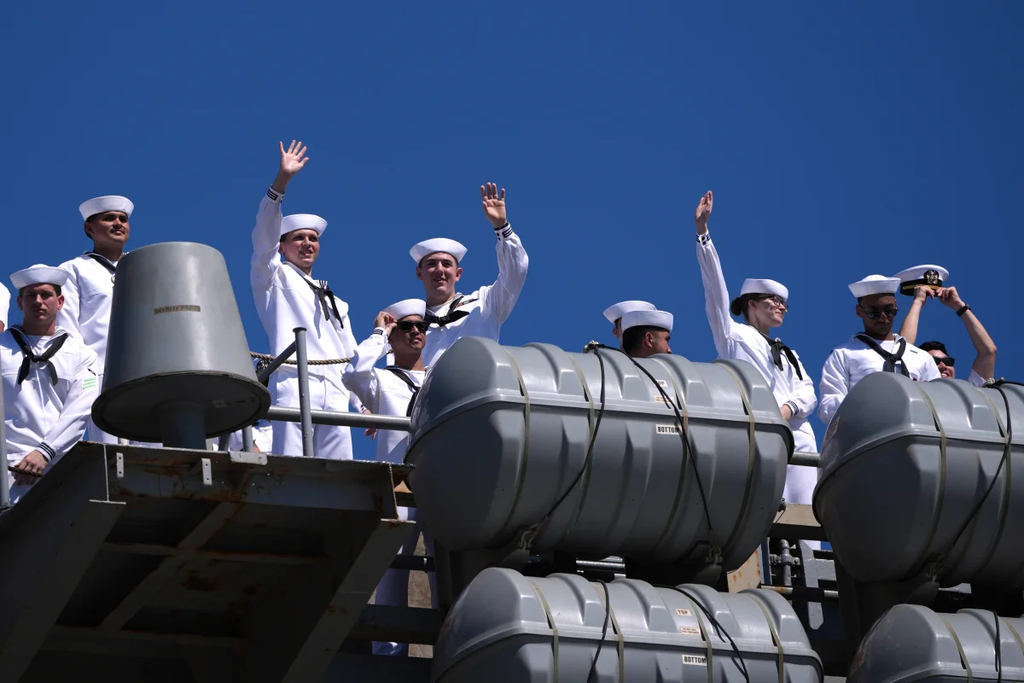
Tears, screams of joy, and a sea of waving signs transformed Naval Air Station North Island into a scene of pure emotion on Thursday, October 8, 2026. The massive Nimitz-class aircraft carrier USS Abraham Lincoln pulled into San Diego Bay after an arduous deployment that spanned more than ten months.
Thousands of family members stood on the pier under the California sun, holding banners and bouncing on their toes as the gray titan glided into harbor. For the roughly 6,000 sailors aboard the ship and its associated strike group, the dock landing represented the end of a long, grueling journey marked by extreme combat readiness, supply constraints, and an extraordinary 265 consecutive days at sea without a single port visit.
The homecoming brings a wave of intense relief to families who spent months waiting for news across thousands of miles. Yet, behind the triumphant cheers and reunion hugs lies a complex narrative. The deployment stretched crews to their limits, prompted internal Navy investigations, triggered intense debate in Washington, and tested the sheer physical and mental endurance of everyone on board.
Pier-Side Tears and Newborn Smiles: Heartwarming Family Reunions in San Diego
The moment the gangway touched down, emotional reunions unfolded across the pier. Among the most striking stories of the day was a group of 64 sailors who walked off the ship to meet their newborn babies for the very first time.
These fathers had watched their children’s births through grainy phone screens or delayed video messages while stationed thousands of miles away in combat zones. Holding these infants in their arms for the first time on California soil brought many hardened service members to tears.
The $0 Secret To Launching Your Entire Online Empire
Why pay hundreds every month for separate software? Build funnels, send emails, and make sales with Systeme.io completely free.
Get Started For $0Free Forever • No Credit Card Needed • Beginner-Friendly
Sailor Steven Rivas beamed as he held his seven-month-old daughter close to his chest. His voice trembled as he described the overwhelming feeling of pulling into San Diego Bay and seeing his family standing on the dock. He admitted that during the hardest stretches of the deployment, it was nearly impossible to grasp the reality that he would eventually make it back home.
Nearby, Kathy Monterrosa waited patiently while holding her six-month-old daughter, Sarahi, who wore a tiny blue-and-white sailor outfit. Monterrosa shared how difficult it was to navigate pregnancy and childbirth while her husband was deployed in high-risk waters. Hearing scattered reports about difficult conditions on the ship made the separation even more agonizing. Seeing her husband walk down the ramp was an overwhelming blessing after months of constant fear and prayer.
For younger crew members, the journey was an eye-opening trial of perseverance. Twenty-year-old sailor Abel Ramirez stepped onto land with a massive grin, relieved to finish his first major deployment. He spoke candidly about how long the ocean voyage felt, noting that at several points during the middle of the deployment, he wondered if he would ever leave the ship. Reconnecting with his parents, who drove all the way from Texas to welcome him, made every sacrifice worthwhile.
Young children held posters painted with glitter and bold letters reading “Welcome Home Dad” and “We Missed You.” Daughters spoke about missing their mothers for nearly an entire school year, missing birthdays, and relying on short, occasional phone calls to stay connected. The dock was packed with families holding onto each other, eager to reclaim lost time.
Inside the Record-Breaking 265 Days at Sea
The USS Abraham Lincoln’s deployment was anything but routine. Sent to the Middle East to support operations amid heightened regional instability and conflict involving Iran, the carrier spent the vast majority of its tour stationed in high-stress maritime environments.
What set this deployment apart in modern naval history was the sheer length of uninterrupted time spent underway. The ship logged 265 consecutive days at sea without making a single port call. In typical naval operations, aircraft carriers pull into international ports every few months to allow sailors to stretch their legs, sample fresh food, explore local cultures, and recharge away from the daily grind of shipboard duty.
Without those essential breaks, life aboard the Lincoln became a test of routine and grit. A supercarrier is essentially a floating steel city of 6,000 residents, but it is still an enclosed environment. Day after day, crew members worked 12-to-16-hour shifts under artificial lighting or on scorching hot flight decks, surrounded by the non-stop thunder of jet launches and landings.
The operational demands were unrelenting. Flight deck crews worked long hours launching combat sorties and surveillance missions. Engineers worked deep in the belly of the ship to keep massive turbines running smoothly. Communication teams maintained round-the-clock contact with command posts halfway across the globe.
It was not until early September, after spending more than nine uninterrupted months in hot zones, that the Lincoln finally pulled into a port in Thailand. For many sailors, that brief stop was their first opportunity in three-quarters of a year to feel dry land under their feet and eat something other than navy mess-hall rations. Soon after, the carrier began its long transit across the Pacific Ocean toward home in San Diego.
Behind Closed Doors: Supply Shortages, Mental Health, and Navy Scrutiny
As the deployment stretched far beyond its original timeline, reports began leaking to media outlets and lawmakers regarding deteriorating living conditions aboard the ship. The long months without supply stops created significant logistical hurdles for the strike group.
Family members back home voiced deep concern over mess hall offerings and basic ship amenities. Relatives reported that sailors were frequently eating packaged instant ramen and limited rations as fresh food stores dwindled. Ship commanders acknowledged that maintaining a massive vessel under constant operational load leads to inevitable mechanical problems, including temporary plumbing outages and clogged facilities across the floating city.
Beyond physical discomforts, the mental toll of the extended deployment became a major focal point for military leaders and lawmakers. Extended isolation, combined with combat stress and uncertainty over return dates, placed heavy psychological strain on young sailors.
During testimony before Congress, Navy officials confirmed that eight service members within the Lincoln’s strike group attempted suicide during the deployment. Tragically, the arduous nature of the mission was also linked to an incident where a sailor jumped overboard while at sea.
Military analysts noted that while the suicide attempt rate within the strike group was statistically comparable to wider Navy averages over similar timeframes, the concentration of stress on a single long-deployed carrier highlighted major vulnerabilities in operational planning. Defense experts and mental health advocates called for formal probes into crew conditions and stronger psychological support systems for long-term maritime operations.
Maintenance Challenges in a Combat Zone
Running a 100,000-ton nuclear-powered supercarrier without dockside maintenance for nearly a year creates enormous logistical strain.
Send, Spend & Hold Money Worldwide Without Hidden Fees
Transfer money internationally at the real exchange rate and hold 40+ currencies in one account.
Open a Wise AccountMid-market rate • Fast transfers • 40+ currencies
- System Wear and Tear: Essential plumbing, air conditioning, and water desalination systems operated continuously under extreme tropical heat without major overhaul opportunities.
- Supply Line Delays: Delivering fresh meat, vegetables, spare mechanical parts, and medical supplies to a carrier maneuvering in high-risk ocean zones required complex underway replenishment missions.
- First-Time Crew Shock: A majority of the sailors aboard were experiencing their very first naval deployment, meaning they had to adapt to extreme conditions without prior operational experience.
Defense Secretary Visit and Official Recognition
Just hours before the USS Abraham Lincoln entered San Diego Bay, Defense Secretary Pete Hegseth flew out to the carrier’s flight deck while it rested off the California coast. He addressed the gathered crew directly, seeking to honor their sacrifices and push back against public criticism surrounding the ship’s condition.
Hegseth presented the crew with the Presidential Unit Citation, which is the highest honor a military unit can receive, typically reserved for extraordinary heroism and achievement in combat operations. He noted that President Donald Trump had tracked the ship’s daily activities closely throughout the ten-month mission and expressed immense pride in their accomplishments.
During his flight deck speech, Hegseth directly addressed public reports concerning low morale and supply problems. He acknowledged that he was personally responsible for extending the ship’s deployment twice to cover critical operational gaps in the Middle East.
Hegseth criticized external reports that framed the Lincoln as a symbol of military dysfunction or failed planning. He argued that media coverage focused too heavily on challenges rather than celebrating the crew’s resilience and tactical success. He emphasized that the defining trait of the U.S. Navy is the ability to adapt, overcome severe hardship, and complete the mission regardless of the obstacles in their path.
Ship commander Capt. Daniel Keeler also spoke to reporters upon arrival, reaffirming that while managing a floating city of thousands of people comes with daily maintenance headaches, the crew performed remarkably well under pressure. He pointed out that four meals a day were consistently served and that safety protocols remained intact throughout the historic voyage.
Lessons Learned and What Lies Ahead for the Lincoln
The return of the USS Abraham Lincoln marks the end of one chapter and the start of a long recovery process for both the ship and its crew. Relief finally arrived in August when another aircraft carrier, the USS George Washington, rotated into the Middle East to take over operational duties.
Now that the Lincoln is safely docked at Naval Air Station North Island, the crew will transition into a extended stand-down period. Sailors will receive well-deserved leave to spend weeks reconnecting with loved ones, taking vacations, and settling back into shore life.
Meanwhile, the ship itself will undergo extensive maintenance and evaluation. Navy engineers will inspect every square inch of the vessel, repairing worn machinery, upgrading onboard systems, and restocking supplies to bring the carrier back to peak operational readiness.
The deployment of the Lincoln has sparked broader conversations within military leadership about carrier group availability and operational tempo. As global security demands continue to place heavy pressure on naval assets, finding a sustainable balance between mission requirements and sailor well-being remains a top priority for defense planners.
Frequently Asked Questions (FAQs)
How long was the USS Abraham Lincoln deployed?
The USS Abraham Lincoln was deployed for over ten months in total, making it one of the longest aircraft carrier deployments in recent naval history.
The $0 Secret To Launching Your Entire Online Empire
Why pay hundreds every month for separate software? Build funnels, send emails, and make sales with Systeme.io completely free.
Get Started For $0Free Forever • No Credit Card Needed • Beginner-Friendly
How many continuous days did the ship spend at sea without a port call?
The carrier spent 265 consecutive days at sea without making a single port visit, setting a modern record for uninterrupted underway operations.
Where was the USS Abraham Lincoln deployed?
The ship was primarily deployed to the Middle East to support military operations and maintain strategic presence during heightened conflicts involving regional threats.
What award was presented to the crew upon their return?
Defense Secretary Pete Hegseth presented the crew with the Presidential Unit Citation on behalf of President Donald Trump, honoring their performance during combat missions.
Which aircraft carrier replaced the USS Abraham Lincoln in the Middle East?
The USS George Washington relieved the USS Abraham Lincoln in August 2026, allowing the Lincoln to begin its journey home across the Pacific.
How many new fathers met their children for the first time during the homecoming?
Approximately 64 sailors aboard the ship met their newborn babies for the very first time upon docking in San Diego.
The return of the USS Abraham Lincoln is a powerful reminder of the deep human sacrifices behind every military deployment. Beyond the strategic defense goals and carrier movements, the true story belongs to the sailors who endured continuous months at sea and the families who waited faithfully for their safe return.
Staying updated on current events, global news, and human interest stories helps us understand the world around us. To learn more about our mission to bring you engaging news, explore our About Page. If you have questions, story suggestions, or general feedback, feel free to reach out directly through our Contact Page.
For real-time updates and trending stories delivered directly to your feed, connect with us on social media:
- Follow us on Instagram
- Like our page on Facebook
- Stay updated on X (formerly Twitter)
