
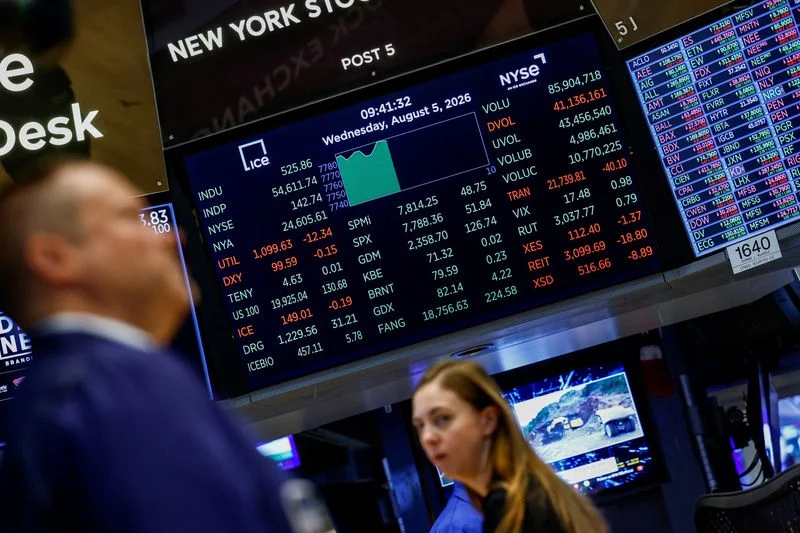
The benchmark U.S. 10-year Treasury yield recently spiked past 5.34%, hitting its highest level since 2002. At the same time, the 30-year Treasury yield surged past 5.65%, marking a multi-decade high that sent a clear shockwave through financial markets. When interest rates on government bonds shoot up this fast, investors everywhere take notice.
This dramatic move in the bond market has sparked intense debate among economic analysts and market strategists. Major global financial institutions, including investment analysts at Investing.com, are pointing out startling similarities between current market conditions and the famous late-1990s dotcom boom.
Back in 1999, high borrowing costs and soaring government bond yields eventually triggered a massive shakeout in overvalued technology stocks. Today, as massive investments flow into artificial intelligence, cloud infrastructure, and next-generation technology, rising bond yields are once again putting pressure on stock market valuations.
To understand what is happening, you do not need a degree in high finance. Below is a simple, straightforward breakdown of why Treasury yields are rising, how today compares to the dotcom era, and what this means for your money and the broader economy.
Understanding the 10-Year Treasury Yield in Plain English
Before jumping into the dotcom comparisons, it helps to understand what the 10-year Treasury yield actually is and why it controls so much of the global economy.
The $0 Secret To Launching Your Entire Online Empire
Why pay hundreds every month for separate software? Build funnels, send emails, and make sales with Systeme.io completely free.
Get Started For $0Free Forever • No Credit Card Needed • Beginner-Friendly
When the U.S. government needs to borrow money to fund its operations, build infrastructure, or service existing debt, it issues bonds. A 10-year Treasury bond is essentially an IOU from the government. When you buy one, you are lending money to the government for ten years, and in return, the government pays you a fixed annual interest rate known as the yield.
Because the U.S. government has never defaulted on its debt, Treasury bonds are considered one of the safest investments on planet Earth. When people talk about a “risk-free rate of return,” they are referring to government bond yields.
What causes bond yields to rise?
Bond yields move up and down based on market supply, demand, inflation expectations, and government policies. When investors expect inflation to remain high, or when they worry that the government is issuing too much debt, they demand higher interest payouts to lend their money.
When bond yields rise, borrowing becomes more expensive for everyone else. Mortgage rates go up, business loan rates increase, and credit card interest climbs. According to market data from Trading Economics, the 10-year Treasury yield has gained over 50 basis points in a matter of weeks, driven by persistent inflation concerns and heavy government borrowing.
How bond yields directly affect stock prices
Rising bond yields create a massive tug-of-war for investor capital. If a safe government bond pays you a guaranteed 5.3% interest every year with zero chance of losing your principal, you suddenly demand much higher returns from risky investments like stocks.
When yields were near zero a few years ago, investors had very few alternatives to put their cash to work, so money poured into high-growth tech companies. But when guaranteed bond returns shoot up to 24-year highs, expensive tech stocks look far less attractive by comparison.
When borrowing money becomes expensive, companies that rely on heavy borrowing to fund future growth face much higher costs. That directly squeezes company profit margins and lowers stock prices across the market.
Why Everyone Is Comparing Today to the 1999 Dotcom Era
The sudden rise in government bond yields has revived powerful memories of the late 1990s tech bubble. Looking closely at both eras reveals several striking parallels that have seasoned investors feeling a strong sense of deja vu.
Massive spending on transformative new technology
In 1999, companies spent hundreds of billions of dollars building out telecom infrastructure, laying fiber-optic cables, and establishing the groundwork for the modern internet. Investor excitement around the internet drove stock valuations to unprecedented heights.
Today, we are witnessing a nearly identical infrastructure rush centered around artificial intelligence. Global tech giants are pouring staggering amounts of capital into high-performance microchips, specialized hardware, and massive data centers. Across the globe, nations and corporations are committing massive resources, much like how South Korea unveiled a record budget to power the global AI revolution.
This huge capital expenditure mirrors the telecom boom of twenty-five years ago. Investors are placing massive bets on future productivity gains before many of these new AI services have fully proven their long-term profitability.
Sky-high stock market valuations
Another clear similarity is how expensive the stock market has become relative to corporate earnings. Wall Street measures this using valuation metrics like the Cyclically Adjusted Price-to-Earnings (CAPE) ratio.
Right now, market valuation measures for the S&P 500 have climbed to levels rarely seen outside of 1999. When stock prices are priced for perfection, even a tiny shift in economic conditions or interest rates can cause sudden price drops. Investors are realizing that tech stocks cannot keep surging forever if baseline borrowing costs stay this high.
Heavy backlash and rising costs for tech infrastructure
Just like during the dotcom era, expanding technological infrastructure requires vast amounts of electricity, land, and capital. Big tech companies face growing community pushback over resource consumption, such as local debates in Texas where Texas Republicans turned against massive data centers due to energy concerns.
When infrastructure development hits political or economic roadblocks, it raises operational costs for tech firms at the exact time that higher interest rates make borrowing more expensive.
Send, Spend & Hold Money Worldwide Without Hidden Fees
Transfer money internationally at the real exchange rate and hold 40+ currencies in one account.
Open a Wise AccountMid-market rate • Fast transfers • 40+ currencies
The Critical Differences Between 1999 and Today
While the similarities between today and 1999 are hard to ignore, important structural differences exist between the two time periods. Understanding these differences explains why the outcome might not be a total carbon copy of the dotcom crash.
U.S. government debt and massive budget deficits
One of the biggest differences between 1999 and today involves government finances. In 1999, the U.S. federal government was running a budget surplus and actually buying back long-term Treasury bonds. Long-term government bonds were relatively scarce, which helped keep long-term yields somewhat contained.
Today, the government is running massive fiscal deficits exceeding 6% of Gross Domestic Product (GDP). Rather than buying back debt, the U.S. Treasury is issuing trillions of dollars in new bonds every single year. Because there is a huge supply of government debt on the market, bond buyers can demand higher yields before agreeing to purchase them.
Real economic growth and labor market conditions
During the dotcom peak in 1999, the U.S. economy was expanding rapidly, with real annual GDP growth reaching nearly 4.8%. The Federal Reserve was actively raising interest rates to prevent an overheating economy from driving up consumer prices.
Today, economic growth is far more modest, hovering around 2.2%. Recent economic data shows mixed signals across employment and industrial sectors. For instance, reports on how U.S. job growth bounced back with a steady unemployment rate indicate a solid but slowing labor market rather than an overheated one. Similar trends show up internationally, such as when Nigeria’s GDP grew while factory production plunged, showing that global industrial output remains choppy.
Because economic growth is moderate, the Federal Reserve has less room to aggressively hike interest rates without risking a recession.
Corporate profitability and balance sheet strength
During the 1999 dotcom bubble, many publicly traded internet companies had no earnings, no clear business models, and virtually zero revenues. Stock prices surged purely on hype and website visitor metrics. When interest rates rose, unprofitable dotcom startups collapsed almost overnight.
Today’s market leaders are vastly different. The tech giants driving current market gains generate hundreds of billions of dollars in real annual revenue and hold massive cash reserves on their balance sheets. While elevated interest rates certainly compress tech valuations, major tech firms are far better equipped to survive high borrowing costs than the cash-strapped startups of 1999.
What Higher Yields Mean for Everyday People
It is easy to view Treasury yields and stock market indices as distant numbers that only affect Wall Street traders. However, a sustained climb in the 10-year Treasury yield impacts everyday personal finances in very direct ways.
Higher interest rates on home mortgages and personal loans
The 10-year Treasury yield serves as the primary benchmark for pricing 30-year fixed-rate mortgages in the United States and influences borrowing costs globally. As the yield climbs toward 5.35%, mortgage rates naturally follow suit.
The $0 Secret To Launching Your Entire Online Empire
Why pay hundreds every month for separate software? Build funnels, send emails, and make sales with Systeme.io completely free.
Get Started For $0Free Forever • No Credit Card Needed • Beginner-Friendly
Higher mortgage rates make buying a home significantly more expensive for first-time buyers and slow down overall real estate market activity. Car loans, personal lines of credit, and home equity loans also become more costly.
Rising cost of living and expensive technology
When capital costs rise for major corporations, those costs eventually get passed down to consumers in the form of higher prices for goods and services. High borrowing costs make it more expensive for tech hardware companies to manufacture cutting-edge devices, which contributes to higher retail price tags across the industry.
Consumers are already noticing premium pricing trends in consumer electronics, such as reports showing how Apple’s upcoming foldable iPhone could cost up to $2,000. Elevated interest rates make product development and manufacturing more expensive for consumer tech companies.
Better yields for savers and fixed-income investors
Rising bond yields are not bad news for everyone. For conservative savers and retirees who struggled for years with near-zero interest rates on savings accounts, higher bond yields offer a welcome return to income-generating opportunities.
High-yield savings accounts, certificates of deposit (CDs), and government bonds now offer reliable, low-risk annual returns above 5%. This allows risk-averse individuals to earn meaningful interest income without taking on high stock market risks.
How Smart Investors Navigate High Yields
When bond yields sit near multi-decade highs, sitting idle with an unexamined investment portfolio can be costly. Here are practical strategies financial experts suggest for navigating this environment.
Rebalancing stock and bond allocations
When risk-free Treasury bonds yield over 5%, holding a portfolio made up entirely of high-priced growth stocks becomes risky. Many investors choose to rebalance by shifting a portion of their capital into high-quality bonds or short-term Treasuries.
Diversifying across cash assets, fixed-income securities, and dividend-paying stocks helps protect your overall net worth against sudden tech sector volatility.
Focusing on cash flow and profitability
In a high-interest-rate world, companies that generate strong cash flow perform far better than companies that rely heavily on debt to survive. Investors are increasingly favoring mature, profitable businesses over speculative growth companies.
Evaluating company balance sheets and focusing on firms with low debt levels can help protect your investments during times of market turbulence. Similar principles apply across all asset classes, whether analyzing technology equities or evaluating major commercial ventures like the Dangote Refinery stock sale.
Looking at banking and consumer finance innovations
As interest rates remain high, traditional banking models continue to evolve. Digital banking platforms and fintech apps are gaining popularity by offering competitive interest rates on consumer deposits.
For example, seeing how FairMoney reached 30 million users by expanding digital banking options shows how fintech innovation continues to transform how everyday people store, save, and grow their money during changing economic times.
Frequently Asked Questions (FAQs)
What is the 10-year Treasury yield?
The 10-year Treasury yield is the annual interest rate the U.S. government pays to investors who lend it money for ten years. It serves as a benchmark for borrowing costs across the entire global economy.
Why does a rising 10-year Treasury yield hurt tech stocks?
When Treasury yields rise, investors can earn a high guaranteed return from safe government bonds. This makes risky, high-priced growth stocks less attractive. Additionally, higher yields raise borrowing costs for tech firms funding expensive expansion projects.
Is the stock market going to crash like it did in 1999?
While current stock valuations and massive tech investments resemble the dotcom boom, today’s leading tech companies are far more profitable than the unprofitable startups of 1999. However, high yields could cause tech stock prices to pull back or move sideways.
How does the 10-year Treasury yield affect my mortgage?
Mortgage lenders use the 10-year Treasury yield as a key benchmark when setting 30-year fixed mortgage rates. When the 10-year yield goes up, home loan interest rates almost always go up alongside it.
Where can I get safe returns when bond yields are high?
When Treasury yields are high, options like short-term Treasury bills, Certificates of Deposit (CDs), and high-yield savings accounts offer attractive interest rates with very low risk.
Navigating the Financial Road Ahead
The surge in the U.S. 10-year Treasury yield past 5.34% is a clear sign that the era of ultra-cheap money is firmly behind us. While the economic parallels to the 1999 dotcom era serve as a helpful reminder of how interest rates impact market valuations, today’s economy carries its own unique mix of massive government debt, AI innovation, and strong corporate balance sheets.
Staying informed about shifting market trends allows you to make smarter financial choices for your family, business, and personal savings goals. Keeping an eye on inflation trends, Federal Reserve announcements, and Treasury bond movements will help you navigate whatever market conditions come next.
To learn more about keeping up with trending economic and global news, check out our About Us page or reach out directly through our Contact Page.
Join our growing community on social media to stay updated on breaking news, lifestyle tips, and financial insights:
- Connect with us on Instagram
- Follow our updates on Facebook
- Join the conversation on X (Twitter)
