
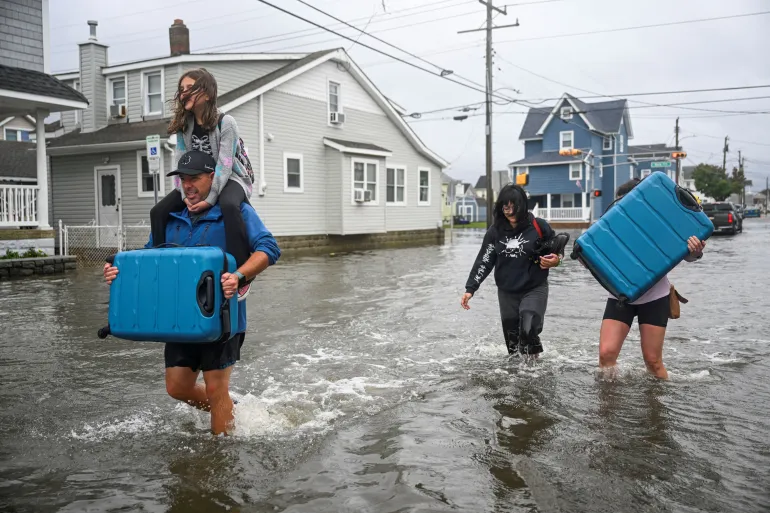
A ferocious, unseasonably early storm swept across the northeastern United States, bringing relentless rain, crushing winds, and ocean surges that completely overwhelmed coastal and urban communities. What started as an aggressive atmospheric shift rapidly intensified into a nightmare nor’easter, taking at least one life in New York City, knocking out power to over one hundred thousand homes and businesses, and leaving entire neighborhoods under feet of floodwater.
From the busy streets of Brooklyn to the quiet beach towns of New Jersey and the Outer Banks of North Carolina, millions of residents found themselves battling severe coastal erosion, trapped vehicles, canceled flights, and dark living rooms. Emergency crews across multiple states worked tirelessly through torrential downpours to rescue stranded citizens and clear downed power lines.
This violent weather event caught many off guard because of its timing. While nor’easters are common winter and late-fall occurrences in New England and the Mid-Atlantic, experiencing a storm of this magnitude so early in the autumn season created unprecedented challenges for local infrastructure and emergency responders.
The Tragic Fatality in Brooklyn: How a Falling Tree Turned Deadly
The most heartbreaking moment of the storm occurred in Brooklyn, New York, where the storm proved fatal. A 28-year-old employee of the New York City Housing Authority was killed on the job when a massive tree branch snapped under heavy wind gusts and crushed him.
As the storm pelted the city with heavy rain and wind gusts approaching high speeds, trees across the five boroughs were uprooted or stripped of large limbs. The saturated soil made roots loose, creating dangerous conditions for anyone walking or working outdoors. Emergency medical services rushed to the scene in Brooklyn, but the worker succumbed to severe traumatic injuries.
The $0 Secret To Launching Your Entire Online Empire
Why pay hundreds every month for separate software? Build funnels, send emails, and make sales with Systeme.io completely free.
Get Started For $0Free Forever • No Credit Card Needed • Beginner-Friendly
City officials immediately urged all residents to stay indoors and keep away from wooded areas and city parks. The tragedy highlighted the immense physical danger posed by falling debris during intense windstorms, especially in dense urban environments where large, mature trees overhang sidewalks and roadways.
This fatal event followed warnings from meteorologists, who had previously alerted city residents about dangerous weather patterns across the region. You can read more about how the city prepared in our previous reporting on New York City flash flood warnings.
Dark Neighborhoods: Mass Power Outages Hit Five States
As the nor’easter tore through the region, it battered electricity grids from Virginia all the way up to Massachusetts. Wind gusts snapped heavy tree limbs directly onto power lines, shattering utility poles and leaving tens of thousands of families sitting in the dark without heat or refrigeration.
At the peak of the storm, more than 119,000 customers lost power across New York, New Jersey, Massachusetts, Delaware, and Virginia. Utility companies dispatched hundreds of repair crews to fix damaged transformers and re-string fallen lines, but high winds and rising floodwaters slowed down repair efforts significantly.
In many suburban towns, fallen power lines lay hidden beneath deep puddles, creating severe electrocution hazards for pedestrians and drivers. Fire departments received hundreds of emergency calls reporting sparking wires, blown transformers, and small electrical fires started by falling branches.
By Sunday, power companies had managed to restore electricity to thousands of families, bringing the outage total down to around 73,000. However, utility officials warned that full restoration could take several days in hard-hit rural areas where roads remained blocked by fallen timber and high waters.
Streets Turned to Rivers: Kayaks on Long Island and Rescues in New Jersey
In coastal communities, the storm brought a terrifying combination of heavy inland rain and massive ocean tides driven by strong offshore winds. Water had nowhere to go, causing ocean water and rain runoff to fill coastal streets and invade local properties.
On Long Island, New York, flooding became so extreme in low-lying neighborhoods that local roads transformed into deep waterways. Local residents were spotted navigating their neighborhood streets using personal kayaks and small paddleboats to check on neighbors and assess property damage.
In coastal New Jersey, towns like Wildwood, Surf City, and Sea Bright suffered severe coastal flooding. In Sea Bright, emergency workers executed a dramatic water rescue after a woman and her dog became trapped inside their vehicle as water rapidly rose up to the windows on a main thoroughfare. Emergency crews used high-water rescue vehicles to pull the woman and her pet to safety just in time.
In Surf City, local business owners watched helplessly through security cameras as sea water poured inside local buildings. One marina owner reported that water was rising directly inside his display room—a rare occurrence that had not been seen since Hurricane Sandy battered the East Coast years ago. Boat owners throughout the marina woke up to frantic phone calls showing their watercraft blown off lifts and drifting loose into stormy waters.
Coastal Destruction and Stranded Communities in the Mid-Atlantic
Farther south along the coast, the storm created widespread destruction for beach towns and barrier islands. High waves combined with astronomical tides caused major beach erosion, chewing away millions of tons of sand and exposing property foundations to open ocean waves.
In Ocean City, Maryland, high waters pushed far beyond the beaches, flooding roads, parking lots, and coastal walkways. Residents reported canal waters rising fast enough to submerge backyards and overflow into ground-floor living spaces.
North Carolina’s Outer Banks experienced some of the worst isolation caused by the nor’easter. On Hatteras Island, a crucial highway was completely flooded and covered in thick sand ocean overwash, closing the only road connection to the mainland.
This sudden road closure disrupted everyday life and completely ruined weekend plans for many visitors. One wedding couple on Hatteras Island saw their long-planned wedding disrupted when almost all 45 invited guests became stranded on the mainland side of the road closure. Local island residents rallied around the couple, providing a new venue at a local campground, cabins for shelter, and a volunteer DJ so the ceremony could still happen despite the storm.
Local emergency managers worked alongside state transportation teams to set up emergency ferry service to deliver vital supplies to the roughly 5,000 year-round residents stranded on the island. Local officials reminded residents that they were not alone and that emergency teams were working continuously to clear sand and restore land access.
Send, Spend & Hold Money Worldwide Without Hidden Fees
Transfer money internationally at the real exchange rate and hold 40+ currencies in one account.
Open a Wise AccountMid-market rate • Fast transfers • 40+ currencies
Severe coastal storms like this serve as a stark reminder of how vulnerable low-lying coastal areas are to ocean surges. Similar emergency conditions occurred during the Cape Breton flooding crisis, proving how devastating slow-moving storm systems can be for coastal communities.
Travel Nightmares: Hundreds of Flights Grounded and Major Events Canceled
The nor’easter did not just damage homes and knock out power—it completely crippled air and ground transportation across the entire East Coast. High wind speeds, low visibility, and heavy rain forced major airlines to cancel or delay thousands of flights.
Data from air traffic tracking services revealed that over 425 flights were canceled outright, while more than 3,000 flights suffered severe delays across the country. Major airport hubs in New York, Boston, and Newark experienced the heaviest disruptions.
Tourist destinations like Nantucket and Martha’s Vineyard saw virtually all incoming and outgoing flights grounded for days, leaving hundreds of weekend travelers stranded at small regional terminals. High ferry suspensions made leaving these islands nearly impossible until seas calmed down.
Major outdoor gatherings and entertainment events were also forced to shut down due to safety concerns. Pop star Ed Sheeran was forced to cancel high-profile stadium performances scheduled in Massachusetts after venue officials determined that wind and rain conditions posed a major hazard to fans and production crews.
Why Scientists Are Surprised by This Early Autumn Nor’easter
While nor’easters are a familiar part of life in the northeastern states, meteorologists noted that the timing and sheer intensity of this particular storm were unusual.
Nor’easters typically form between October and April when cold arctic air masses clash with warm ocean currents off the East Coast. However, this storm developed earlier in the season than average, taking advantage of unusually warm ocean waters and a slow-moving jet stream pattern.
National Weather Service lead forecasters explained that because the storm moved so slowly, its impact was multiplied. Instead of passing over quickly, the system sat off the coast for days, continuously blowing ocean water onto land during multiple high-tide cycles. This slow movement caused compounding flood damage, preventing water from draining naturally back into the sea between tide cycles.
Climate researchers warn that as coastal waters remain warmer for longer periods into the autumn season, early-season storms may carry more moisture and higher wind energy, leading to stronger surges and heavier inland rainfall.
Safety Measures: How to Protect Yourself During Lingering Storm Flooding
Even after the main body of a nor’easter passes, lingering hazards can present serious dangers to local communities. High tides continue to push water back onto land, and weakened trees can fall hours after wind speeds die down.
The $0 Secret To Launching Your Entire Online Empire
Why pay hundreds every month for separate software? Build funnels, send emails, and make sales with Systeme.io completely free.
Get Started For $0Free Forever • No Credit Card Needed • Beginner-Friendly
Here are basic, essential safety rules every resident in an affected storm zone should follow:
Avoid Driving Through Standing Floodwaters
Never attempt to drive through flooded streets or water covering roadways. It is almost impossible to judge the depth of floodwater, and as little as twelve inches of moving water can float a vehicle or stall an engine, trapping you inside.
Stay Away from Fallen Power Lines
Always assume any downed wire on the ground is live and extremely dangerous. Standing water amplifies electrical currents, so keep at least thirty feet away from any fallen lines and report them immediately to emergency services or your local power utility.
Beware of Weakened Tree Limbs
Ground soil saturated by hours of heavy rain makes tree roots loose and unstable. Avoid walking or parking under large trees, and stay out of city parks until forestry teams inspect and clear loose branches.
Keep Emergency Supplies Handy
Make sure your home has working flashlights, fresh batteries, non-perishable food, and a clean supply of drinking water. Charge mobile phones and backup power banks before power cuts occur.
Frequently Asked Questions (FAQs)
What caused the powerful nor’easter in the northeastern US?
The storm was caused by a strong low-pressure system clashing with warmer coastal air off the Atlantic Coast. Its slow movement trapped moisture over the region and generated continuous onshore winds, leading to widespread rainfall and high tides.
Who was the person killed during the storm?
A 28-year-old employee of the New York City Housing Authority tragically lost his life in Brooklyn, New York, after a massive tree branch snapped due to strong winds and fell on him while he was working.
Which states were most affected by power cuts and flooding?
The hardest-hit states include New York, New Jersey, Massachusetts, Delaware, Virginia, and North Carolina. Over 119,000 households lost electricity across these regions at the height of the storm.
Why were flights and concerts canceled?
High wind gusts exceeding 50 miles per hour, poor visibility, and torrential rain made flying unsafe, leading to over 400 flight cancellations and thousands of delays. Outdoor events, including major concerts like Ed Sheeran’s shows in Massachusetts, were canceled for spectator safety.
Is the storm risk over for residents on the East Coast?
While the heavy rain has started to clear in some areas, lingering high tides, coastal ocean surges, and beach erosion remain serious threats for several days. Residents are advised to stay away from beaches and flooded streets until all official warnings are lifted.
Keeping up with fast-breaking news, weather emergencies, and global stories can feel overwhelming, but staying informed is the best way to keep your family safe and prepared.
To learn more about our mission and how we cover trending global stories, check out our About Page. If you have a news tip, feedback, or want to reach out to our team, visit our Contact Page.
You can also join our growing community on social media to get live updates on breaking news, viral trends, and deep dives into stories happening worldwide. Follow us on Instagram, connect with us on Facebook, and join the conversation on X (Twitter) today!
