
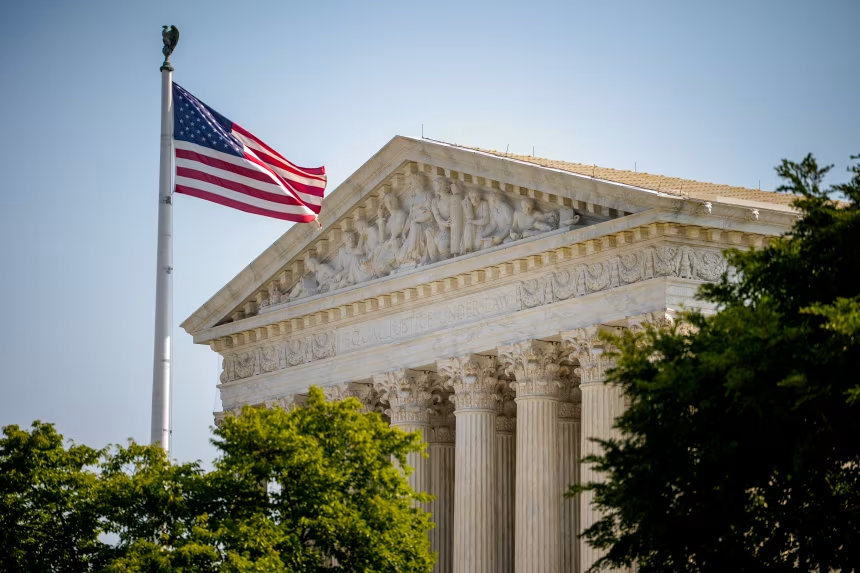
The United States Supreme Court has just handed down a major decision that will directly impact how states handle voter registrations ahead of the November midterm elections. In a 6-3 ruling on Friday, the justices lifted a lower court’s restrictions, allowing the federal government to move forward with a controversial database designed to check the citizenship status of registered voters.
If you are planning to head to the polls this November, this ruling is something you need to pay close attention to. The core of the issue revolves around a system known as the Systematic Alien Verification for Entitlements, or SAVE. Originally created decades ago, the system has recently been expanded, and its new capabilities have sparked a massive legal and political battle.
While proponents argue that these checks are a necessary step to secure elections, critics are raising alarms that the system is deeply flawed and could end up blocking eligible Americans from casting their ballots. The divide is sharp, the stakes are high, and the upcoming midterms are just weeks away.
What Exactly Did the Supreme Court Decide?
To understand the gravity of Friday’s ruling, we have to look at the numbers and the arguments inside the courtroom. The Supreme Court voted 6-3 along ideological lines. The conservative majority granted an emergency request from the Justice Department, effectively pausing a lower court order that had blocked the expanded use of the SAVE database.
This means state and local election officials now have the green light to use this federal tool to run bulk searches on their voter rolls. By cross-referencing state voter lists with federal immigration and Social Security records, states can flag individuals whose citizenship status cannot be immediately confirmed.
The $0 Secret To Launching Your Entire Online Empire
Why pay hundreds every month for separate software? Build funnels, send emails, and make sales with Systeme.io completely free.
Get Started For $0Free Forever • No Credit Card Needed • Beginner-Friendly
The three liberal justices strongly disagreed with the majority’s decision. Justice Ketanji Brown Jackson wrote a powerful dissent, which was joined by Justices Sonia Sotomayor and Elena Kagan. She argued that the government was overstepping its authority and that the potential damage to lawful voters was too great to ignore.
Justice Jackson made it clear that taking away someone’s right to vote, even accidentally, is a profound harm. She stated that burdening or disenfranchising lawful voters far outweighs any hypothetical harm the government might face by pausing the database checks. For more details on the political fallout of this decision, you can read the full breakdown from the New York Times.
Breaking Down the SAVE Database
You might be wondering what this database actually is and why it is causing such a stir. The Systematic Alien Verification for Entitlements program is not new. It was created by the Department of Homeland Security back in 1986. For most of its history, it was simply used to help government workers verify the immigration status of people applying for public benefits, like housing assistance or healthcare.
However, things changed significantly in 2025. The current administration expanded the database’s capabilities, allowing it to tap into sensitive information held by the Social Security Administration. Instead of checking one person at a time for a specific benefit, the revamped system allowed state officials to conduct massive, sweeping searches of their entire voter databases.
Election officials can now take thousands of names and run them through SAVE all at once. If the federal records do not explicitly confirm a person’s US citizenship, that person gets flagged. Once flagged, the burden shifts to the voter. Local authorities can contact the individual and demand that they provide physical proof of their citizenship before they are allowed to vote.
The Arguments Against the System
Voting rights organizations and privacy advocates are pushing back hard against this expanded system. Groups like the League of Women Voters and the Electronic Privacy Information Center have been at the forefront of the legal battle. Their primary concern is accuracy.
Databases are only as good as the information entered into them, and federal records are notoriously slow to update. Critics point out that the SAVE system often relies on outdated information. This creates a massive problem for naturalized citizens.
Imagine someone who moved to the United States years ago, received a green card, and eventually went through the long, rigorous process of becoming a naturalized US citizen. When they first interacted with the government, they were correctly categorized as a non-citizen. If their federal files were never updated after their naturalization ceremony, the SAVE database will still flag them as ineligible to vote.
This is not just a theoretical problem. In court filings, advocacy groups highlighted real-world errors. For example, an election official in Travis County, Texas, reported that a quarter of the people flagged by the system as non-citizens had actually already proven their US citizenship. In St. Louis County, Missouri, reports indicated that a staggering 81 percent of the system’s responses were incorrect.
These high error rates mean that thousands of lawful, eligible Americans could suddenly find their voter registrations canceled or suspended just weeks before they plan to vote.
The Government’s Defense of Voter Verification
On the other side of the courtroom, the administration and its supporters maintain that the expanded SAVE database is a vital tool for election integrity. The primary argument is that only US citizens have the legal right to vote in federal elections, and the government has a duty to enforce that rule.
Supporters of the database argue that state election officials need a reliable way to clean up their voter rolls. People move, people pass away, and sometimes non-citizens accidentally or intentionally register to vote. The administration insists that cross-referencing state lists with federal data is the most efficient way to catch these discrepancies.
From a legal standpoint, the government argued that federal law already allows the Department of Homeland Security to request and share citizenship data with other agencies. They viewed the lower court’s injunction as an unlawful overreach that prevented them from doing their jobs.
Following the Supreme Court’s decision, proponents celebrated the ruling as a victory for secure elections. They argue that requiring someone to show proof of citizenship is a minor inconvenience compared to the risk of illegitimate votes swaying a close election.
The Impact on the November Midterms
Timing is everything in politics, and the timing of this Supreme Court decision is crucial. We are just weeks away from the November midterm elections. Control of Congress is hanging by a thread, and both political parties are fighting tooth and nail for every single vote.
Send, Spend & Hold Money Worldwide Without Hidden Fees
Transfer money internationally at the real exchange rate and hold 40+ currencies in one account.
Open a Wise AccountMid-market rate • Fast transfers • 40+ currencies
Midterm elections historically have lower turnout than presidential elections. This means that even a small number of canceled voter registrations could tip the scales in a tightly contested district. If thousands of voters are flagged and forced to jump through administrative hoops to restore their voting rights, many simply will not have the time or resources to do so before election day.
Several states have already begun running their voter lists through the expanded SAVE system. If you live in a battleground state where the margins of victory are razor-thin, this process could play a decisive role in who wins and who loses.
The political atmosphere is already highly charged. The administration views this as a necessary step to maintain order, while opposition groups see it as a targeted effort to suppress the votes of naturalized citizens, who often lean toward the opposing party. This ruling guarantees that election administration and voting rights will remain front-and-center issues right up until the polls close.
The Legal Journey: How This Case Reached the Supreme Court
To truly grasp the significance of Friday’s ruling, it helps to look back at how this legal fight started. The journey to the Supreme Court was fast and chaotic, reflecting the urgent nature of election-year litigation.
The controversy began when the administration announced the modifications to the SAVE program. Almost immediately, voting rights groups filed lawsuits, arguing that the changes violated privacy laws and the National Voter Registration Act.
In June, a federal judge in Washington, D.C., named Sparkle Sooknanan, handed a major victory to the privacy groups. Judge Sooknanan ruled that the expanded system was assembled haphazardly. She found that the citizenship data was highly unreliable and that the government had knowingly trampled on the privacy rights of US citizens.
Her ruling effectively blocked the administration from using the expanded database. The government quickly appealed the decision. A federal appeals court looked at the case and decided to let the judge’s block remain in place while the lawsuit continued.
Frustrated by the delay, the Justice Department filed an emergency petition directly to the Supreme Court. They argued that they needed immediate access to the database to help states prepare for the upcoming midterms. The Supreme Court agreed to intervene, setting aside the lower court’s block and allowing the program to resume immediately.
Privacy Concerns and Data Sharing
Beyond the immediate impact on voting rights, this case has sparked a larger conversation about data privacy. We live in an era where massive amounts of personal information are stored on government servers. The idea that different federal agencies can share this data for bulk searches makes many privacy advocates very uncomfortable.
When you provide your Social Security number or immigration documents to the government, you typically expect that information to be used for a specific purpose. For example, you give your information to the Social Security Administration to manage your retirement benefits.
The $0 Secret To Launching Your Entire Online Empire
Why pay hundreds every month for separate software? Build funnels, send emails, and make sales with Systeme.io completely free.
Get Started For $0Free Forever • No Credit Card Needed • Beginner-Friendly
The expanded SAVE database changes the rules of the game. It takes data collected for one purpose and uses it for something completely different: law enforcement and voter verification. Critics argue that this creates a dangerous precedent. If the government can easily repurpose sensitive personal data to check voter rolls, what else might they use it for in the future?
The Electronic Privacy Information Center has been highly critical of this approach. They argue that massive databases are inherently prone to errors, and when those errors involve fundamental rights like voting, the consequences are disastrous. They emphasize that the government should not be allowed to conduct sweeping, automated checks without strict safeguards to protect innocent people from being wrongly targeted.
The 90-Day Rule and Voter Purges
While the Supreme Court handed the administration a victory, they did leave one important legal guardrail in place. Federal law includes a provision known as the 90-day rule under the National Voter Registration Act.
This rule strictly prohibits states from conducting broad, systematic removals of voters from the registration rolls within 90 days of a federal election. The idea behind this rule is simple: if a state makes a mistake and wrongly removes someone from the list, that person needs enough time to fix the error before election day. If massive purges happen at the last minute, eligible voters will show up to the polls only to find out they have been silently disqualified.
Because we are now within that 90-day window for the November midterms, states cannot use the SAVE database to automatically delete thousands of voters at once. However, the court clarified that states can still use the database to investigate individual voters. If a state flags a specific person through the system, they can ask that person for proof of citizenship.
This distinction is crucial. It prevents an absolute worst-case scenario where entire communities are wiped from the voter rolls overnight. However, it still allows for widespread, individualized challenges that could overwhelm local election offices and confuse voters.
What You Must Do Right Now to Protect Your Vote
Given the confusion and the potential for database errors, it is absolutely vital that you take your voting status into your own hands. You cannot simply assume that because you voted in the last election, you are safely registered for this one.
First, you need to check your voter registration status immediately. Every state has an online portal where you can verify your registration. Simply search for your state’s election office website, enter your name and date of birth, and confirm that your status is listed as active. Do not wait until the end of October to do this.
Second, pay close attention to your mail. If your state uses the SAVE database and flags your name, they will likely send you a notice in the mail asking for proof of citizenship. Unfortunately, these notices often look like junk mail or boring government forms. Open everything that comes from your local election board. If you ignore a request for documentation, your registration could be suspended.
Third, if you are a naturalized citizen, make sure you know exactly where your naturalization certificate or US passport is located. If your local election office questions your status, you will need to provide a copy of these documents quickly. Having them ready to go will save you a massive headache down the line.
Finally, consider voting early if your state allows it. Early voting gives you a buffer. If you show up to an early voting center and discover there is a problem with your registration, you still have time to contact the election office and clear things up. If you wait until election day and encounter an issue, your only option might be to cast a provisional ballot, which involves a lengthy verification process and is not always counted.
The Role of Technology in Modern Elections
The controversy surrounding the SAVE program highlights a much broader trend: the increasing reliance on big data in our democratic processes. Over the past two decades, elections have transformed from paper-based, hyper-local events into massive logistical operations driven by digital databases.
There are obvious benefits to this digital shift. Online voter registration has made it easier than ever for young people and busy professionals to sign up. Digital poll books allow election workers to quickly look up names, reducing the long lines that used to plague polling places.
But the digital era also introduces new vulnerabilities. A single software glitch or an outdated spreadsheet can now impact thousands of people instantly. When we rely on interconnected federal databases to determine who gets to participate in a democracy, we are placing an enormous amount of trust in the accuracy of those systems.
This is exactly why the recent Supreme Court decision is so significant. It represents a turning point in how much authority we give to automated systems. The debate is no longer just about the philosophy of voting rights; it is about the mechanics of data management and the acceptable margin of error when civil liberties are on the line.
We want to hear your thoughts on this intersection of technology and voting. Follow us and join the conversation on our social media platforms. You can share your opinions with us on Instagram, join the debate on Facebook, or send us a quick message on X. Your voice matters in this ongoing discussion.
A Brief Look at the History of Voting Rights
To fully appreciate the weight of this moment, we must remember that the right to vote has always been a contested issue in the United States. The rules governing who can cast a ballot have shifted constantly throughout American history.
In the early days of the republic, voting was generally restricted to land-owning men. Over the centuries, massive civil rights movements fought tirelessly to expand access to the ballot box. Amendments to the Constitution eventually prohibited voting discrimination based on race and sex. The Voting Rights Act of 1965 was a landmark piece of legislation designed to dismantle local barriers that prevented minority citizens from voting.
However, the struggle over ballot access did not end in the 1960s. The tactics simply evolved. Instead of explicit bans, modern voting disputes often revolve around administrative rules: voter ID laws, polling place locations, mail-in ballot deadlines, and, as we are seeing right now, database verification systems.
Understanding this history helps contextualize the current debate over the SAVE database. For voting rights advocates, strict verification systems feel like a modern version of old barriers, designed to make the process just difficult enough to discourage participation. For proponents of strict election security, these systems are simply modern solutions to age-old problems of fraud and mismanagement.
If you are interested in learning more about how our publication covers these complex historical and political issues, we encourage you to read more About Us. We are dedicated to breaking down complicated topics so that you can stay informed.
Frequently Asked Questions
You likely still have some questions about how this ruling might affect you. We have put together a quick list of answers to help clear up the confusion.
What is the SAVE database?
The Systematic Alien Verification for Entitlements (SAVE) program is a federal database originally created to check the immigration status of people applying for government benefits. It was recently expanded to allow election officials to cross-reference their voter rolls against federal records to identify potential non-citizens.
Can I be removed from the voter roll right before the election?
Federal law prohibits sweeping, automated removals of voters within 90 days of a federal election. However, states can still use the database to flag individual voters and require them to prove their citizenship before they are allowed to cast a normal ballot.
How do I check if my voter registration is active?
You should visit the official website of your state or local election board. Look for a “Check My Registration” tool. You will usually just need to provide your name, date of birth, and sometimes your address or driver’s license number to confirm your status.
Does this affect native-born US citizens?
While the system is primarily designed to identify non-citizens, data entry errors can affect anyone. However, naturalized citizens are at the highest risk of being incorrectly flagged because federal databases might not reflect their updated citizenship status. Native-born citizens are less likely to encounter issues, but checking your registration is still highly recommended.
Where can I read more about the Supreme Court decision?
To get a comprehensive look at the political implications and the specific legal arguments made by the justices, you can check out this detailed report from the New York Times.
If you have any other questions or if you are experiencing issues with your voter registration that you want to share with our team, feel free to reach out through our Contact Page.
Conclusion
The Supreme Court’s decision to allow the use of the expanded SAVE database is a massive development in the final stretch of the election season. It highlights the ongoing tension between securing our elections and ensuring that every eligible citizen has free and fair access to the ballot box.
With the November midterms rapidly approaching, the landscape of voter registration is shifting. The responsibility now falls largely on individual voters to make sure their paperwork is in order. Do not wait for a problem to find you at the polling place. Take five minutes today to verify your registration, gather your necessary documents, and make a solid plan for how and when you are going to vote.
Stay informed, stay proactive, and make sure your voice is heard this election year. We will continue to monitor this situation and provide updates as the election draws closer. Be sure to check back for more news and analysis on the topics that impact your everyday life.
