
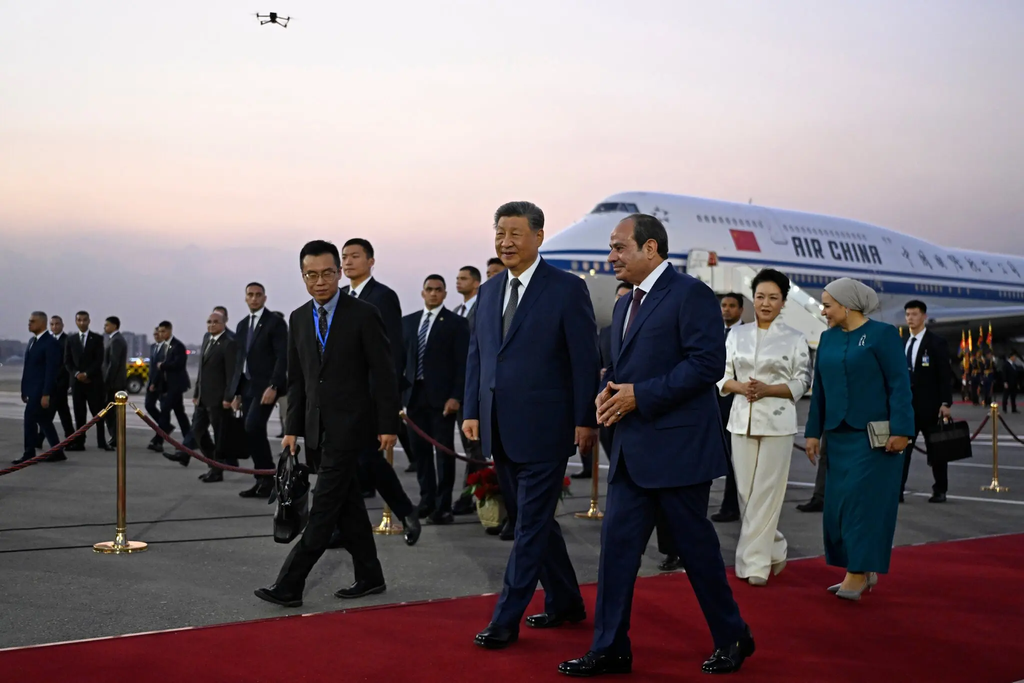
Red flags fluttered along the main avenues of Cairo as Chinese President Xi Jinping landed in Egypt for a three-day state visit. Red carpets were rolled out, military honors were presented, and banners showing the Egyptian Sphinx alongside the Great Wall of China lined the streets. On the surface, this visit marks 70 years of diplomatic relations between the two nations. But beneath the formal speeches and ceremonial handshakes lies a huge shift in global politics.
China is making a major move to expand its presence in the Middle East. At a time when the United States is deeply tied up in regional conflicts and security tensions, Beijing is stepping into the spotlight. Xi Jinping is using his time in Cairo to present China as a stable partner, a massive investor, and a peacemaker.
Egypt has long been one of America’s closest military and political partners in the region. By building deeper ties with Cairo, Beijing is sending a direct message to Washington: China is here to stay, and the old ways of doing things in the Middle East are changing fast.
Why Egypt Matters So Much in This Global Chess Game
Egypt is not just any country in the Arab world. It sits right at the intersection of Africa and Asia, controlling the Suez Canal—one of the most vital shipping lanes on the planet. With over 110 million people, Egypt boasts the largest population in the Arab world and holds huge diplomatic weight across Africa and the Middle East.
When major world powers want to influence the region, Cairo is usually their first stop. For decades, the United States was the primary power broker in Egypt, sending billions of dollars in military assistance every year. However, Egyptian President Abdel Fattah el-Sisi has been working hard to widen his country’s international options.
The $0 Secret To Launching Your Entire Online Empire
Why pay hundreds every month for separate software? Build funnels, send emails, and make sales with Systeme.io completely free.
Get Started For $0Free Forever • No Credit Card Needed • Beginner-Friendly
Instead of relying solely on Washington, Cairo is embracing a strategy of balance. By welcoming Beijing with open arms, Egypt is signaling that it wants strong relationships with every global superpower.
The connection between China and Egypt actually goes back several decades. In 1956, Egypt became the very first Arab and African nation to establish formal diplomatic relations with the People’s Republic of China. China stood by Egypt during the 1956 Suez Crisis, and Egypt supported Beijing when it claimed its seat at the United Nations in 1971. Today, both leaders are building on that history to launch what they call a new era of cooperation.
Money, Bridges, and Megaprojects: China’s Growing Investments in Egypt
China does not just offer friendly words; it brings huge financial backup. Over the past decade, Chinese companies have poured more than $10 billion directly into the Egyptian economy.
If you drive east of Cairo, you will see the most visible symbol of this partnership: Egypt’s New Administrative Capital. The massive Central Business District, featuring towering skyscrapers including Africa’s tallest building, was constructed by the state-owned China State Construction Engineering Corporation.
Chinese firms have also built electric train lines connecting industrial hubs in the Nile Delta, established car tire factories, constructed container ports along the Red Sea, and developed satellite manufacturing centers.
Trade between the two countries is booming. Annual trade has reached an estimated $20 billion, making China one of Egypt’s largest commercial partners. In the first half of the year alone, Egyptian imports from China rose by more than 14 percent compared to the previous year.
A massive part of this growth comes through China’s Belt and Road Initiative, a global infrastructure plan aimed at building trade routes across Asia, Europe, Africa, and the Middle East. Egypt’s location makes it a central piece of this plan. China wants reliable transit routes for its exports, and Egypt needs modern infrastructure to grow its economy.
Beyond basic brick-and-mortar construction, both nations are expanding into modern industries. During summit talks in Cairo, Xi Jinping called for new partnerships in green energy, electric vehicles, aerospace, and advanced digital systems.
As cutting-edge tools reshape industries worldwide, staying informed on breakthroughs like Technology & AI helps people understand how global partnerships drive real-world innovation. China is positioning itself to be Egypt’s top supplier for the technology of tomorrow.
Beyond Trade: Military Drills and Security Cooperation
While economic ties form the backbone of China’s strategy, military cooperation is rapidly catching up. For a long time, Western observers believed China would only focus on business while leaving security matters to the United States. That assumption is no longer true.
Just days before Xi Jinping arrived in Cairo, the Chinese and Egyptian air forces concluded a joint military exercise named “Eagles of Civilization”. Chinese J-16 fighter jets flew across Egyptian skies, executing combat drills alongside Egyptian pilots flying French-made Rafale jets.
This exercise was a major milestone. It demonstrated that China can deploy advanced military equipment thousands of miles away from home with ease. It also showed that Egypt is comfortable exercising its armed forces alongside Chinese units.
During his talks in Cairo, President Xi proposed that Middle Eastern nations work together to build a “new security architecture”. He argued that the people of the Middle East should be the masters of their own affairs, without outside interference or pressure from distant powers.
This statement was a clear critique of Western foreign policy. Beijing is presenting itself as a non-hostile alternative—a power that offers money, trade, and defense cooperation without demanding political shifts or interfering in internal governance.
Changing the Global Balance: BRICS and the Global South
China’s efforts in Egypt are part of a much larger plan to unite nations across the Global South. For decades, global trade and international finance have been dominated by Western institutions. Now, countries across Africa, Asia, and Latin America are seeking alternative avenues for growth.
Send, Spend & Hold Money Worldwide Without Hidden Fees
Transfer money internationally at the real exchange rate and hold 40+ currencies in one account.
Open a Wise AccountMid-market rate • Fast transfers • 40+ currencies
Egypt took a major step in this direction by officially joining the BRICS alliance—a economic block originally formed by Brazil, Russia, India, China, and South Africa. Joining BRICS allows Egypt to conduct trade using local currencies, secure loans for major infrastructure projects, and reduce its vulnerability to sudden fluctuations in the U.S. dollar.
For Beijing, bringing countries like Egypt, Saudi Arabia, and the United Arab Emirates into broader economic coalitions creates a stronger global counterweight to traditional Western economic groups like the G7.
This changing landscape creates endless opportunities for creators, analysts, and entrepreneurs worldwide. Understanding these global shifts opens up new ways to share knowledge. For those interested in digital media and online platforms, learning about YouTube Automation can be a powerful way to build an audience around global news and emerging trends.
How Washington Views Beijing’s Middle East Expansion
Unsurprisingly, leaders in Washington are watching these developments with deep concern. The United States has provided Egypt with around $1.3 billion in annual military aid for decades, viewing Cairo as a cornerstone of regional stability and counter-terrorism efforts.
American officials worry that growing Chinese influence could compromise sensitive military intelligence or give Beijing control over critical trade infrastructure like the Suez Canal. Additionally, Washington has threatened to expand economic sanctions against institutions dealing with regional conflicts. These potential sanctions could impact Egyptian banks and businesses that maintain strong ties with Chinese firms.
However, Egyptian leadership maintains that its relationship with China is not designed to replace its partnership with the United States. Instead, Cairo wants to avoid taking sides in a new Cold War.
Egyptian diplomats point out that diversifying strategic partners is simply smart governance. When one global power is distracted or focused elsewhere, having strong ties with another superpower ensures that a country’s economic development and security needs remain on track.
The Diplomatic Angle: Palestine and Regional Mediation
Another key element of Xi Jinping’s visit is Beijing’s stance on regional diplomacy. China has consistently supported a two-state solution to the Israeli-Palestinian conflict, advocating for an independent Palestinian state.
During summit talks with President Sisi, Xi stressed that the Palestinian question must never be overlooked or pushed to the sidelines. This message resonates strongly across the Arab world, where global support for Palestine remains a fundamental issue.
By taking a clear stance on this issue, China is trying to contrast its approach with American foreign policy, which many in the region view as overly one-sided. Beijing previously demonstrated its diplomatic ambitions by helping broker a surprise peace deal between Saudi Arabia and Iran. Now, by coordinating closely with Egypt—a historic mediator in Middle Eastern peace talks—China is reinforcing its reputation as a serious diplomatic player.
The $0 Secret To Launching Your Entire Online Empire
Why pay hundreds every month for separate software? Build funnels, send emails, and make sales with Systeme.io completely free.
Get Started For $0Free Forever • No Credit Card Needed • Beginner-Friendly
What This Means for Everyday People and the World Economy
It is easy to view these events as distant games played by politicians in grand palaces, but these diplomatic moves directly impact the global economy.
- Safer Shipping Routes: The Suez Canal handles roughly 12 percent of all global trade. When major powers invest heavily in maritime security and infrastructure along the Red Sea, it helps keep global supply chains moving smoothly, preventing price spikes on imported goods.
- Job Creation and Infrastructure: Chinese investments in Egyptian factories, transport systems, and energy plants create thousands of local jobs and boost economic activity across North Africa.
- More Choice for Developing Nations: When developing countries have access to multiple sources of funding and technology, they can negotiate better deals rather than accepting rigid terms from a single dominant power.
- Energy Market Stability: As China expands green hydrogen projects and energy cooperation in North Africa, it speeds up the global transition toward renewable energy while keeping energy markets balanced.
Connect With Us and Join the Conversation
Staying on top of breaking global news and understanding how international politics shapes your world shouldn’t feel complicated. Our team works hard to break down massive news stories into simple, clear, and engaging articles that anyone can enjoy.
To learn more about who we are and what drives our editorial team, check out our About Us page. If you have questions, suggestions, or feedback on our coverage, feel free to reach out directly through our Contact Us page.
We love connecting with our readers across social media! Be sure to join our growing community on Instagram, follow our updates on Facebook, and join the live conversations on X (formerly Twitter).
Frequently Asked Questions
Why did Chinese President Xi Jinping visit Egypt?
President Xi Jinping visited Cairo to celebrate 70 years of diplomatic relations between China and Egypt, sign new economic and infrastructure agreements, and strengthen political and defense ties with a key Middle Eastern ally.
Is Egypt turning its back on the United States?
No, Egypt is pursuing a balanced foreign policy. While Cairo receives significant military aid from the United States, it is actively building deeper economic and security ties with China to avoid relying on a single superpower.
What was the “Eagles of Civilization” military exercise?
It was a joint air force exercise conducted by Egypt and China in late August 2026. The exercise featured Chinese J-16 jets flying alongside Egyptian Rafale aircraft, highlighting growing defense cooperation between the two nations.
How much money has China invested in Egypt?
China has invested over $10 billion in Egyptian infrastructure, including the business district of the New Administrative Capital, electric train lines, ports, and green hydrogen projects. Annual trade between the two nations sits at around $20 billion.
What is China’s stance on the Middle East conflict?
China supports a two-state solution and the establishment of an independent Palestinian state. Beijing presents itself as a peaceful negotiator and advocates for a security framework organized by Middle Eastern countries without outside interference.
Xi Jinping’s historic trip to Cairo is a clear signal that global power dynamics are shifting rapidly. By combining billions of dollars in infrastructure investments with expanding military exercises and strong diplomatic support, Beijing has established itself as a major power player in the Middle East. As Egypt continues to balance its relationships between Washington and Beijing, the rest of the world will be watching closely to see how this new era of competition shapes global trade, regional security, and international relations.
