
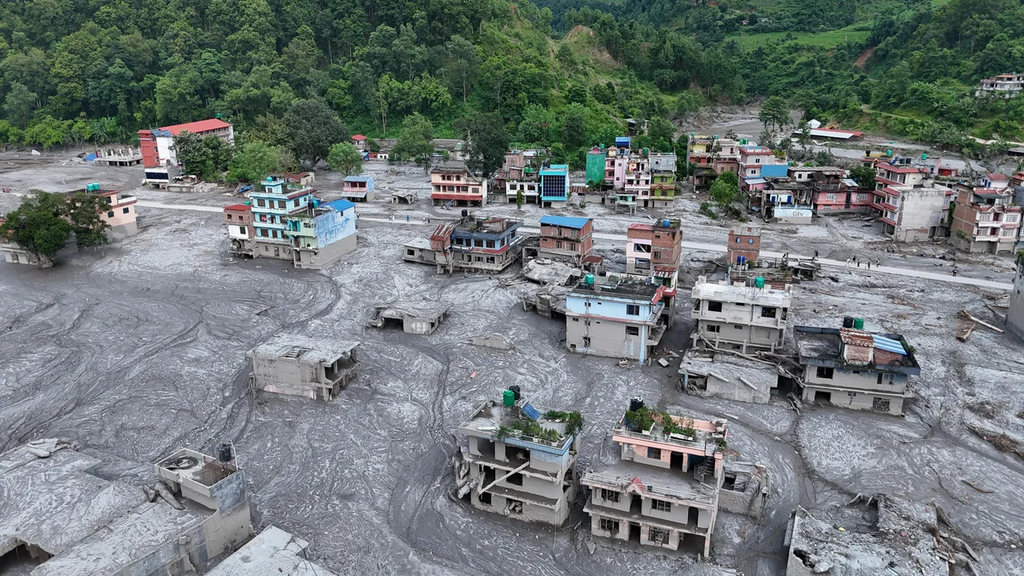
A catastrophic flash flood has ripped through the mountain valleys along the border between Nepal and Tibet, leaving a trail of destruction that emergency workers are still trying to comprehend. The official death toll has passed 600, while nearly 3,000 people remain missing across the affected regions. Heavy rains, thick fog, and treacherous mud are severely delaying rescue teams as they search for survivors buried beneath the rubble.
The disaster struck early Wednesday morning when a massive chunk of a mountain glacier collapsed high in the Himalayas. The sudden collapse sent millions of tons of ice, rock, and water tearing down narrow river channels. Whole villages, hydro power stations, bridges, and highways were swept away in a matter of minutes.
Right now, emergency teams are working against time under dangerous conditions. Heavy weather has grounded helicopter missions, leaving ground crews to clear feet of thick brown mud using basic tools and heavy machinery. The situation remains critical as authorities warn that a newly formed mountain lake could overflow and trigger another wave of flooding.
How the Himalaya Avalanche Triggered the Massive Flood
Understanding how a sudden event high in the mountains could cause such massive destruction miles downstream comes down to geology and geography. The disaster started roughly 5,200 meters up in the Himalayan range along the border zone. A huge rocky ledge supporting part of an ancient glacier failed and broke off.
When the rock and ice collapsed, it fell nearly 1,200 meters straight down into the Lende River basin. The force of the impact was so intense that geological centers originally picked up the vibration as a magnitude 5.2 earthquake. However, scientists reviewing satellite imagery quickly confirmed that the seismic signal was actually created by the massive landslide itself.
The $0 Secret To Launching Your Entire Online Empire
Why pay hundreds every month for separate software? Build funnels, send emails, and make sales with Systeme.io completely free.
Get Started For $0Free Forever • No Credit Card Needed • Beginner-Friendly
As the debris slammed into the river below, it pushed a wall of mud, melted ice, and river water down the valley. The rush of water reached the Trishuli River system, causing water levels to rise by an astonishing 9 meters in just 30 minutes. People living downstream in districts like Rasuwa, Nuwakot, and Dhading had almost no warning before torrents of water rushed into their towns.
Reporting from global news networks like Al Jazeera shows that whole stretches of road were completely wiped out, leaving thousands of people cut off from clean water, food, and electricity.
The Human Toll: Workers, Local Families, and Foreign Pilgrims
The loss of life across Nepal and Tibet is heartbreak on a huge scale. Local police and disaster relief agencies report that at least 626 people have been confirmed dead in Nepal, with additional deaths confirmed on the Tibetan side of the border. However, the number that worries rescue teams most is the missing list, which currently numbers around 2,400 in Nepal and over 500 in Tibet.
Many of those unaccounted for were working at industrial and infrastructure sites built along the river banks. One of the worst-hit spots was the Upper Trishuli-1 Hydropower construction project in Rasuwa district. More than 100 workers became trapped deep inside an underground construction tunnel when thick brown sludge filled the entrance.
Rescuers have been working around the clock to clear the 4 to 5 feet of sticky mud blocking the tunnel mouth. Emergency workers managed to pull out several men covered head-to-toe in mud, but dozens remain trapped inside as air supply and space grow limited.
The victims also include hundreds of international visitors. The mountain border area is a famous route for trekkers, mountain climbers, and religious pilgrims traveling to Mount Kailash in Tibet, a site sacred to Hindus, Buddhists, and Jains.
Families around the world are waiting for news about loved ones who went quiet after Wednesday morning. Disaster organizations like the Red Cross estimate that nearly 90,000 people across the region have been directly impacted by loss of shelter, damaged property, or cut-off supplies.
Rescuers Battle Treacherous Mud and Harsh Weather
Rescuing survivors in a high-altitude mountain region is already tough, but the current weather is making it almost impossible. Over the past three days, low-hanging clouds, heavy fog, and sudden rainstorms have forced military helicopters to ground their flights repeatedly. Helicopter pilots carrying rescue baskets and emergency medical gear cannot land safely in the narrow, mud-slicked valleys.
Ground forces have had to take on the heavy load. Soldiers from the Nepali Army, police personnel, and local volunteers are wading through deep mud that acts like quicksand. In many places, bridges crossing the rivers have collapsed entirely, so teams are using ropes and makeshift cable lines to zip across swollen rivers just to reach isolated communities.
The physical toll on relief workers is severe. They are lifting heavy debris by hand because excavator machinery cannot cross washed-out roads. Despite these harsh conditions, over 3,700 people have been successfully pulled to safety so far and moved to temporary relief centers set up in local schools and public halls.
Threat of a Second Wave: The Rising Barrier Lake
Even as search efforts continue, a new danger is keeping disaster teams on high alert. When the landslide crashed into the valley on Wednesday, the immense pile of rocks, dirt, and ice formed a natural dam across the river upstream.
Water coming down from melting snow and upper mountain streams has quickly collected behind this natural dam, creating a brand-new lake high up in the mountains. Glacial experts and scientists warned that this temporary dam is made of loose, unstable debris that could fail at any moment.
If the dam breaks open suddenly, it will release millions of gallons of backed-up water down the exact same valleys that were just destroyed. In fact, search efforts had to be temporarily paused when water began spilling over the top of the debris dam, sending panic through downstream villages.
Engineers and mountain experts from both Nepal and China are watching the lake closely. They are trying to manually create safe drainage channels through the debris wall to let the water spill out slowly and naturally rather than bursting all at once.
Global Relief Efforts and Emergency Response
Because the scale of this disaster is so big, international help has started arriving to support local emergency crews. Nepal’s government officially asked for specialized assistance from neighboring countries to fill urgent gaps in technical rescue skills, especially for deep tunnel operations.
Send, Spend & Hold Money Worldwide Without Hidden Fees
Transfer money internationally at the real exchange rate and hold 40+ currencies in one account.
Open a Wise AccountMid-market rate • Fast transfers • 40+ currencies
Specialized disaster relief units from India and China are joining local teams on the ground. Meanwhile, global humanitarian groups are delivering basic survival supplies:
- Temporary Shelter: Delivering thousands of heavy plastic tarps, warm blankets, and insulated foam flooring mats for families whose homes were crushed or washed away.
- Food and Clean Water: Distributing tons of ready-to-eat dry meals, rice, clean drinking water, and water purification tablets to stop the spread of waterborne diseases.
- Medical Aid: Distributing basic medical kits, mosquito nets, and hygiene items to emergency shelter camps set up in safer locations.
The United States Embassy, foreign relief funds, and United Nations agencies have pledged emergency funding and supplies to make sure people stranded in high mountain zones receive help quickly.
Understanding Climate Risks in High Mountain Regions
This tragic flash flood points to a broader trend that scientists have been warning about for years. High mountain ranges like the Himalayas are experiencing rapid shifts due to changing weather patterns and warming temperatures.
When temperatures rise, permafrost—the frozen soil and rock that glues steep mountain slopes together—begins to thaw. At the same time, glaciers melt faster, creating large pockets of trapped water under ice sheets. This combination makes mountain walls weaker and far more prone to sudden rockfalls, landslides, and glacial lake outburst floods.
Communities living in mountain valleys depend heavily on rivers for farming, water, and hydro energy. However, building large infrastructure projects in steep, unstable valleys increases the risk when nature shifts suddenly. Scientists stress that better early-warning systems, satellite tracking, and stronger building standards are desperately needed to protect vulnerable communities in these high-altitude zones.
Modern media and digital channels play a huge role in getting emergency updates out to the public during events like this. Many independent news creators use automated production methods to quickly broadcast safety instructions and news. If you want to see how digital media workflows operate behind the scenes, check out our guide on YouTube automation to see how modern content creators publish breaking news efficiently.
Satellite Tracking and AI in Disaster Management
In times of natural disaster, technology plays a major role in saving lives. Rescue agencies no longer rely solely on ground visual checks. Today, high-resolution satellite imagery, radar mapping, and artificial intelligence help teams track land shifts in real time.
When the Himalayan collapse occurred, satellite sensors detected the massive shift instantly, allowing geologists to trace the exact source of the flow and predict which downstream villages were in the path of destruction. AI models can analyze weather forecasts, soil saturation levels, and river flow rates to predict secondary landslides before they happen.
To learn more about how advanced technologies and smart algorithms are changing industries and helping solve real-world problems, visit our dedicated technology and AI section.
How Communities Can Prepare for Mountain Disasters
While natural events cannot always be stopped, preparation saves lives. Communities located near rivers flowing out of high mountain ranges can take smart steps to stay safe when sudden weather shifts occur:
The $0 Secret To Launching Your Entire Online Empire
Why pay hundreds every month for separate software? Build funnels, send emails, and make sales with Systeme.io completely free.
Get Started For $0Free Forever • No Credit Card Needed • Beginner-Friendly
- Know the Warning Signals: Pay attention to sudden shifts in river color or water levels. If a clear river suddenly turns dark brown with mud or drops in volume without warning, it often means a landslide has blocked the river upstream.
- Identify High Ground Routes: Families should know the fastest walking routes to reach high ground that sits well above historical flood lines.
- Keep Emergency Kits Ready: Maintain a go-bag containing non-perishable food, flashlights, extra batteries, basic medicines, water purification tablets, and copies of important documents.
- Follow Official Weather Bulletins: Listen closely to local radio broadcasts and government emergency alerts, especially during heavy rainfall or extreme weather advisories.
For more information on our work and how we source world news, visit our About Us page. If you have news tips, questions, or updates regarding ongoing relief efforts, you can easily get in touch through our contact page.
Frequently Asked Questions (FAQs)
What caused the massive flash flood in Nepal and Tibet?
The flood was caused by a sudden collapse of a rocky mountain ledge and a massive piece of a glacier at an altitude of roughly 5,200 meters. The falling rock and ice crashed into the river below, driving a torrent of mud, debris, and water downstream into several districts.
How many people have been killed or reported missing?
The confirmed death toll has exceeded 600 people, while nearly 3,000 individuals remain missing across both Nepal and Tibet. Officials caution that the death toll could climb higher as rescue workers reach remote villages cut off by mud and destroyed roads.
Why are helicopter rescue missions being suspended?
Helicopter operations have been repeatedly put on hold due to poor weather, heavy fog, and low visibility in narrow mountain valleys. Pilots cannot safely land or lower rescue equipment when clouds blanket the terrain.
What is the new danger from the mountain lake?
The landslide created an unstable natural dam made of rocks and dirt across the river. Water has accumulated behind this barrier, creating a rising lake. If this temporary dam breaks suddenly, it could trigger a dangerous second flash flood downstream.
How are international organizations helping the flood victims?
International groups, including the Red Cross, UN agencies, and neighboring countries like India and China, are delivering tons of emergency food, clean water, blankets, temporary shelter kits, and specialized tunnel rescue personnel to support local teams.
The Road Ahead for Recovery
The coming weeks will be crucial for the mountain regions of Nepal and Tibet. Emergency teams are focusing every resource on clearing mud, searching for trapped workers, and stabilizing the dangerous mountain lake before more rain falls. Reconstruction of roads, bridges, and power stations will take months, but the immediate priority remains finding survivors and providing safe shelter for thousands of displaced families.
Staying informed during major global events helps keep communities connected and supported. Follow our community updates on Instagram, check our stories on Facebook, and join the real-time discussion on X (formerly Twitter).
