
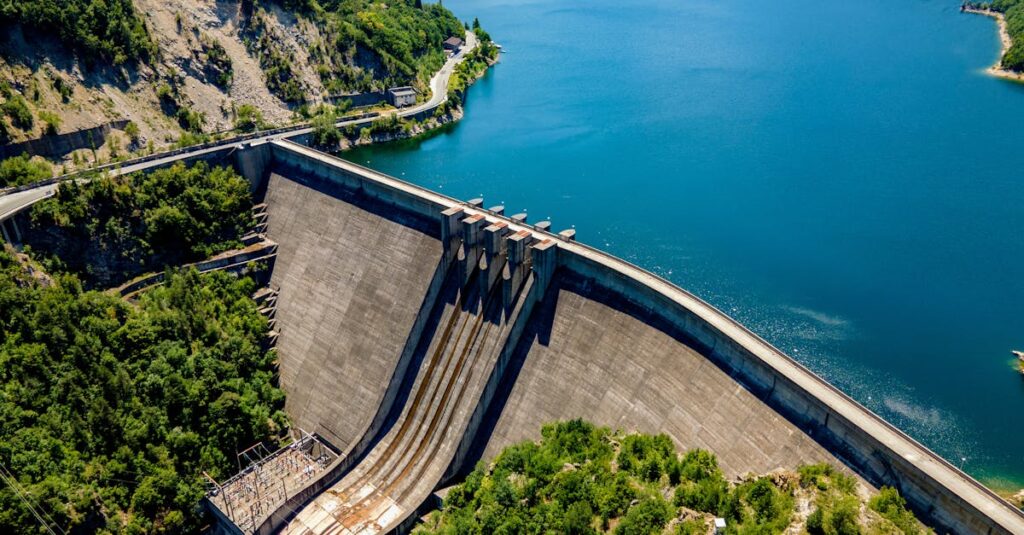
If you have ever looked into Nigeria’s power sector or wondered where some of the country’s electricity comes from, you have probably come across the name Kainji Dam. It is one of the oldest and most important dams in West Africa. But what exactly is it, and how much power can it actually produce?
Let me break this down in plain language. No complicated engineering talk. Just the straight facts you need.
A Quick Look At The Kainji Dam
The Kainji Dam sits on the Niger River in north-central Nigeria, specifically in Niger State. Construction started back in 1964 and finished in 1968. That makes it over 50 years old. But age does not mean useless. It still plays a major role in keeping lights on across the country.
The dam was built for two main reasons. First, to generate hydroelectric power. Second, to control flooding along the Niger River. Over the years, it has also helped with irrigation and fishing. So it is more than just a power plant. It is a multi-purpose structure that supports local communities.
How Big Is The Kainji Dam? Let Us Talk Capacity
When people ask about the capacity of a dam, they usually mean two different things. One is electricity capacity. The other is water storage capacity. Both matter. Let me explain each one separately.
Electricity Generation Capacity
The Kainji Dam has an installed capacity of 760 megawatts (MW). That is the official number you will find from the government and power authorities.
To put that in perspective, a single megawatt can power roughly 200 to 300 homes during normal conditions. So 760 MW could theoretically power over 150,000 homes. But theoretical numbers do not always match reality. More on that in a bit.
The dam uses 12 turbines to generate electricity. Each turbine was originally designed to produce 80 MW. But over the years, upgrades have been made. Some turbines now run more efficiently than when they were first installed.
Here is the honest truth. The actual power output often falls short of 760 MW. Why? Several reasons. Sediment buildup reduces water flow. Equipment ages. Maintenance gets delayed. And water levels in the Niger River change with the seasons. During dry months, less water means less power.
At its best, the dam operates close to full capacity. But that does not happen all year round. So when you read 760 MW, think of it as the maximum possible, not the everyday reality.
Water Storage Capacity
The dam creates a reservoir called Lake Kainji. This lake stretches about 136 kilometers (85 miles) upstream. It covers an area of roughly 1,270 square kilometers. That is bigger than many small countries.
The total storage capacity of Lake Kainji is approximately 15 billion cubic meters of water. That is a massive amount. To give you a mental picture, that is like filling 6 million Olympic swimming pools.
Why does water storage matter? Because hydroelectric dams need a steady water supply to generate power consistently. The reservoir acts like a battery. It stores water during rainy seasons so the dam can keep running during dry spells.
The dam also has floodgates that release controlled amounts of water downstream. This prevents villages and farmlands from getting washed away when rains are heavy. So the storage capacity is not just about electricity. It is about safety too.
Why The Kainji Dam Still Matters Today
You might wonder why an old dam still gets attention. Fair question. Nigeria has newer power plants. Gas plants, solar projects, even other hydro dams like Jebba and Shiroro. But Kainji Dam remains critical for a few reasons.
It provides base load power. Unlike solar or wind, hydro can run 24 hours a day as long as water is available. That makes it reliable in a grid that struggles with stability.
It helps control the Niger River. Without the dam, seasonal floods would destroy homes and farms every year. The dam smooths out those peaks and troughs.
It supports local fishing and farming. The reservoir created a new ecosystem. Thousands of people fish on Lake Kainji for a living. Farmers downstream get more predictable water for irrigation.
It is a backup for the national grid. When gas shortages happen or other plants fail, Kainji Dam can ramp up production. That keeps hospitals, factories, and homes from going completely dark.
Challenges The Dam Faces
I will not pretend everything runs perfectly. The dam has real problems. And being honest about them helps you understand the full picture.
Sedimentation. Over 50 years, tons of sand and silt have settled behind the dam. This reduces storage capacity and can damage the turbines. Cleaning it out is expensive and slow.
Aging equipment. Some of the original turbines are still running. They need constant repairs. Spare parts are not always available. Upgrades take years and cost millions.
Water management conflicts. Upstream countries like Guinea, Mali, and Niger also use Niger River water. As their populations grow, less water reaches Nigeria. The dam cannot generate power if the river runs low.
Transmission issues. Even when the dam produces 760 MW, the power lines sometimes cannot carry all of it to cities. Old transformers and poorly maintained cables waste electricity before it reaches your home.
None of these problems make the dam useless. They just mean its real-world capacity is often lower than the official number.
How The Kainji Dam Compares To Others
To give you some context, here are a few comparisons.
The Jebba Dam, also in Nigeria, has a capacity of 540 MW. The Shiroro Dam has 600 MW. So Kainji is the largest of the three Nigerian hydro dams.
But compare it to the Grand Ethiopian Renaissance Dam on the Blue Nile. That one aims for over 5,000 MW. So Kainji is not the biggest in Africa. But it was a huge achievement for Nigeria in the 1960s. And it still provides about 10 to 15 percent of the country’s total grid electricity on a good day.
Frequently Asked Questions
Is the Kainji Dam open to visitors?
Yes, there is a tourist center nearby. You can see the dam wall, the lake, and sometimes the turbine hall. But check ahead because security rules in the area can change.
Does the dam affect fish populations?
It changed them. Some species moved upstream. Others got trapped below the dam. But fishing remains active on Lake Kainji. The government runs a fisheries project to keep stocks healthy.
Can the capacity be increased?
Engineers have discussed adding more turbines or upgrading existing ones. But those plans require money and political will. For now, the focus is on keeping the current capacity stable.
How does the dam affect downstream countries?
Nigeria controls the flow. Downstream countries like Benin get less water during dry seasons. This has caused some tension, but Nigeria says it follows regional agreements on water sharing.
What happens if the dam breaks?
A complete failure would be catastrophic. Floods would destroy towns all the way to the Niger Delta. But the dam is regularly inspected. Concrete structures were built strongly. The risk is very low.
Putting It All Together
The Kainji Dam is a 760 MW hydroelectric dam on the Niger River in Nigeria. It holds back Lake Kainji, which stores about 15 billion cubic meters of water. It is over 50 years old, still running, and still vital to the country’s power grid and flood control.
But the real story is not just the numbers. It is the gap between what the dam can do on paper and what it delivers daily. Aging equipment, sedimentation, and water shortages mean you rarely get the full 760 MW. That is the honest reality of infrastructure everywhere, not just in Nigeria.
If you live in a place that depends on this dam, you already know when power is stable and when it is not. If you are just learning about it, now you have a clear picture of its strengths and its limits.
Here is a question for you. Do you think countries should invest more in upgrading old hydro dams like Kainji, or build new power sources like solar and gas instead? It is a debate worth having.
