
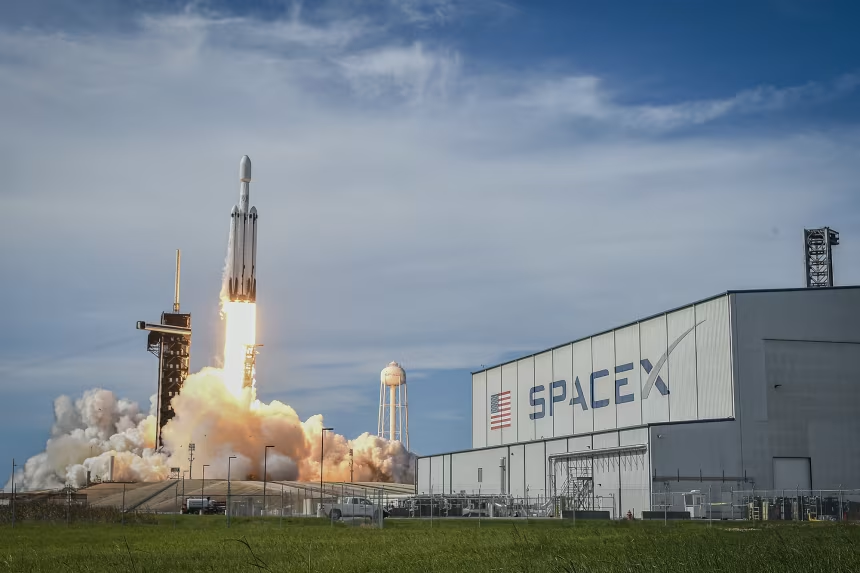
The US government has officially given Elon Musk’s SpaceX permission to launch up to one million satellites into orbit to build artificial intelligence data centers in space.
On Wednesday, November 25, 2026, the Federal Communications Commission (FCC) approved the massive network, which SpaceX calls “Starmind”. Regulators described the decision as a historic milestone that will help the United States stay ahead in the global artificial intelligence race.
To put this number into perspective, there are currently just over 11,000 Starlink satellites in orbit. SpaceX is now asking to multiply its presence in the sky nearly a hundred times over. While tech fans are cheering this giant leap forward, astronomers, space experts, and everyday skywatchers are sounding the alarm.
What Exactly Is the SpaceX Starmind Project?
The Starmind project is a plan to move giant computer servers off Earth and put them into orbit between 500 and 1,002 kilometers above our heads.
Normally, when you ask an AI chatbot a question or generate a video, your request travels to a massive building on the ground packed with thousands of computers. These buildings are called data centers. SpaceX wants to shrink those servers down into individual “orbital compute modules” and float them around the planet.
The $0 Secret To Launching Your Entire Online Empire
Why pay hundreds every month for separate software? Build funnels, send emails, and make sales with Systeme.io completely free.
Get Started For $0Free Forever • No Credit Card Needed • Beginner-Friendly
Instead of plugging into a local city power grid, each Starmind satellite will carry a giant 210-kilowatt solar array to soak up energy directly from the sun. Once the satellites process the data in space, they will beam the results back down to Earth—or pass them along to existing Starlink satellites—using high-speed laser links. Radio signals will act as a backup in case something goes wrong.
According to the official Federal Communications Commission press release, Chairman Brendan Carr stated that this approval will support America’s booming super intelligence economy. The agency even went as far as to say the project brings humanity closer to harnessing the full power of the sun.
Why Does Elon Musk Want AI Data Centers in Space?
Artificial intelligence is hungry—very hungry. Training and running modern AI models requires an unbelievable amount of electricity and water.
Here on Earth, tech companies are running into major roadblocks:
- Power shortages: Local electrical grids are struggling to keep up with the massive power demands of new AI warehouses.
- Water usage: Ground data centers get very hot, and companies use millions of gallons of fresh water every day to keep the computers from melting.
- Public pushback: Local communities are tired of noisy, power-draining data centers being built in their backyards. In fact, during recent elections, American voters approved dozens of local rules aimed at restricting new data centers on the ground.
SpaceX argues that putting data centers in space solves these headaches. Up in orbit, the sun shines almost constantly without clouds or night getting in the way, offering free and endless solar energy. Plus, there are no neighbors complaining about noise or rising electricity bills.
SpaceX is betting heavily on its massive, reusable Starship rocket to carry these satellites into orbit at a much lower cost than traditional rockets. Without Starship working smoothly and cheaply, launching a million satellites would simply be too expensive.
When Will These One Million Satellites Actually Launch?
Even though SpaceX got the green light, you will not wake up tomorrow to see a million new lights in the night sky. Launching that many machines takes years, and the FCC has set a strict schedule that SpaceX must follow to keep its license.
Under the official timeline, SpaceX must hit four major milestones:
- November 2033: SpaceX must launch at least its first operational satellite to officially begin deployment.
- November 2035: At least 10 percent of the network—100,000 satellites—must be up and running.
- November 2038: Half of the network—500,000 satellites—must be in orbit.
- November 2040: The full one million satellite constellation must be completely deployed.
While the government gives SpaceX until 2033 to get started, Elon Musk’s team wants to move much faster. In financial documents filed ahead of its public stock offering, SpaceX stated that it hopes to begin launching its first test satellites as early as 2027 or 2028.
It is also worth noting that satellite companies often ask for permission to launch way more satellites than they actually end up building. For example, SpaceX previously asked for permission to launch 42,000 Starlink satellites, though only around 11,000 are currently flying. Asking for one million gives the company plenty of room to grow as its technology changes.
Can You Really Cool Down Hot Computers in Space?
Many people assume that because space is freezing cold, keeping a computer cool in orbit would be easy. Surprisingly, the exact opposite is true.
Space is a vacuum, meaning there is no air. On Earth, a fan blows cool air over your laptop or phone to carry heat away. In space, there is no air to carry that heat anywhere. Worse yet, an unshielded satellite sitting in direct sunlight can heat up to 120 degrees Celsius, then plunge to minus 160 degrees Celsius when it passes into Earth’s shadow.
To keep these AI computers from frying themselves, SpaceX has to attach massive liquid-filled radiator panels to every single satellite. Each Starmind satellite will unfold a radiator covering 160 square meters—roughly the size of a volleyball court—just to slowly bleed heat out into the emptiness of space.
As ZME Science points out in its report on the engineering hurdles, beaming huge amounts of AI data back and forth between Earth and orbit at high speeds has never been done on this scale before. Even SpaceX admitted in its own investor paperwork that the technology might never become profitable or commercially practical. Other tech leaders, including OpenAI CEO Sam Altman, have openly questioned whether putting data centers in orbit this decade is realistic.
Why Are Scientists and Astronomers So Worried?
While regulators are celebrating, scientists are deeply concerned about what happens when you pack low Earth orbit with one million giant metal boxes.
Send, Spend & Hold Money Worldwide Without Hidden Fees
Transfer money internationally at the real exchange rate and hold 40+ currencies in one account.
Open a Wise AccountMid-market rate • Fast transfers • 40+ currencies
Will It Ruin Our View of the Night Sky?
Astronomers rely on clear, dark skies to study distant galaxies, track dangerous asteroids, and understand how the universe works. Satellites reflect sunlight, leaving bright streaks across telescope images.
The American Astronomical Society has already warned that SpaceX’s existing 11,000 Starlink satellites interfere with scientific research. Adding one million much larger satellites—each with giant solar wings and radiators—could make ground-based astronomy nearly impossible. Even regular people looking up at the night sky after sunset could see a constant stream of moving dots instead of natural stars.
Is Space Getting Too Crowded?
Every satellite launched into orbit increases the chance of a crash. Moving at tens of thousands of kilometers per hour, even a tiny piece of space junk can destroy a working spacecraft.
Scientists worry about a worst-case scenario where two satellites collide, shattering into thousands of pieces. Those pieces then slam into other satellites, creating a chain reaction of destruction that could trap humanity on Earth behind a wall of flying metal.
Interestingly, the FCC noted in its approval order that concerns about light pollution and environmental impacts fall outside its legal authority. In addition, regulators have not yet approved SpaceX’s plan for disposing of dead satellites flying above 600 kilometers. Normally, old satellites must burn up in Earth’s atmosphere within five years of retiring, though SpaceX asked for special permission to push some worn-out AI satellites into distant orbits around the sun instead.
Does Launching This Many Rockets Hurt the Atmosphere?
Rocket launches burn massive amounts of fuel, sending soot and gases directly into the upper layers of our atmosphere. Furthermore, when old satellites eventually fall back to Earth and burn up, they leave behind microscopic metal dust in the sky. Environmental researchers are still studying what happens when tens of thousands of satellites burn up every year, and adding a million more raises serious questions about long-term damage to the ozone layer.
Are Other Tech Giants Trying to Build Space Data Centers?
SpaceX is not the only company looking at the stars to solve the AI power crunch. Several major rivals are working on similar plans, and the FCC confirmed it is actively reviewing applications from competing firms.
- Google: The search giant has been quietly researching an orbital computing concept known as Project Suncatcher.
- Blue Origin: Jeff Bezos’s space company is also exploring ways to put heavy industrial and computing infrastructure into orbit.
- Amazon: While Amazon opposed SpaceX’s massive million-satellite request, the company is building its own satellite networks and cloud infrastructure.
What makes this moment even bigger for Elon Musk is that SpaceX and Tesla have reportedly been discussing a massive all-stock merger that could create a combined company worth trillions of dollars. Linking electric vehicles, robotics, AI software, rockets, and orbital data centers under one roof would give Musk unmatched control over future technology.
What Does This Mean for Everyday People?
You might be wondering how a bunch of floating computers hundreds of kilometers up in the sky affects your daily life.
First, if SpaceX pulls this off, AI tools could become faster, cheaper, and much more powerful without causing your local electricity bill to skyrocket. Right now, the massive power demand from ground data centers is driving up energy costs in several regions. Moving that heavy lifting to solar-powered satellites could take pressure off local power grids.
The $0 Secret To Launching Your Entire Online Empire
Why pay hundreds every month for separate software? Build funnels, send emails, and make sales with Systeme.io completely free.
Get Started For $0Free Forever • No Credit Card Needed • Beginner-Friendly
Second, combining orbital data centers with satellite internet means people living in remote areas—including rural communities across Nigeria and around the world—could access high-speed AI services without needing expensive local server farms.
On the flip side, we are entering an era where private companies are reshaping our shared night sky faster than international laws can keep up. Space belongs to everyone, yet decisions made by a single government agency in Washington will change what billions of people see when they look up at the stars.
Frequently Asked Questions (FAQs)
How many satellites did the US approve for SpaceX?
The US Federal Communications Commission authorized SpaceX to deploy up to one million satellites for its Starmind orbital data center network.
What will these SpaceX satellites actually do?
Unlike Starlink satellites, which beam internet access to homes and phones, Starmind satellites act as floating computer servers. They will process heavy artificial intelligence calculations using solar power and send the finished data back to Earth via lasers.
Will we be able to see one million satellites from the ground?
Yes, especially shortly after sunset and before sunrise when sunlight reflects off the satellites’ large solar panels and radiators. Astronomers warn this could significantly brighten the night sky and disrupt telescope observations.
When will SpaceX launch the first AI data center satellite?
SpaceX hopes to launch its first test satellites as early as 2027 or 2028, though the government’s official deadline requires the first operational satellite to launch by November 2033.
Is it safe to have one million satellites in orbit?
Many scientists and space experts are worried that putting one million satellites in low Earth orbit will drastically increase the risk of space collisions and create dangerous space junk. SpaceX will have to prove it can safely manage traffic and dispose of old satellites.
Final Thoughts on SpaceX’s Million-Satellite Gamble
Approval for one million satellites marks one of the boldest—and riskiest—decisions in the history of space exploration. If SpaceX overcomes the extreme engineering challenges of cooling computers in a vacuum and launching rockets at record speed, Starmind could completely change how artificial intelligence is powered. If things go wrong, however, humanity could end up with a cluttered, dangerous orbit and a permanently altered night sky.
What do you think about putting AI data centers in space? Is this the future of clean computing, or are we crowding our skies too fast?
