
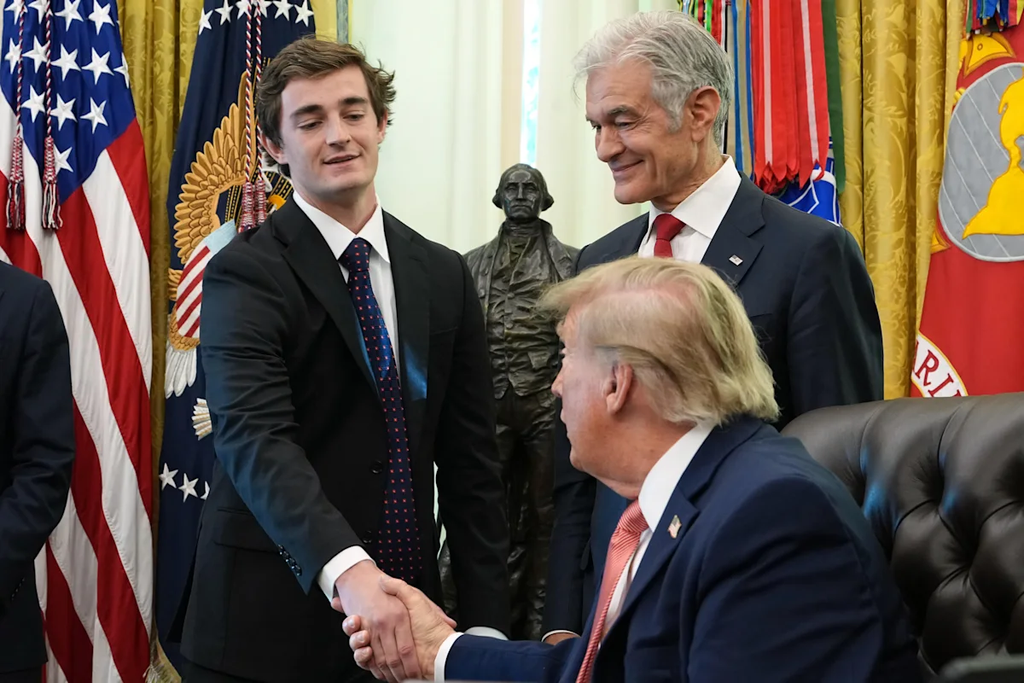
The Oval Office turned into an unexpected game show setting this week. President Donald Trump, standing side by side with Vice President JD Vance, announced a brand-new $25 million government program designed to pay cash rewards to everyday citizens who report fraud against federal programs.
Sitting at the center of the plan is an unusual twist that has legal experts, government watchdogs, and everyday taxpayers scratching their heads. Trump made it clear that federal judges, career auditors, or independent inspectors general will not have the final say on who walks away with the money. Instead, Trump announced that he will personally act as the sole arbitrator to decide who gets paid, how much cash they get, and who walks away empty-handed.
To prove he meant business, Trump brought a 24-year-old internet creator into the White House and handed him a physical $10,000 check on the spot.
This move has kicked off an intense national debate. Supporters view it as an aggressive, common-sense push to clean up wasteful government spending and reward honest tipsters. Critics, however, warn that placing a sitting president in charge of federal cash bounties opens the door to political favoritism, personal vendettas, and serious legal challenges.
Here is a complete look at how this new program works, what went down in the Oval Office, how it clashes with existing whistleblower laws, and what it means for anyone thinking about reporting fraud.
The $0 Secret To Launching Your Entire Online Empire
Why pay hundreds every month for separate software? Build funnels, send emails, and make sales with Systeme.io completely free.
Get Started For $0Free Forever • No Credit Card Needed • Beginner-Friendly
What Is The New Fraud Whistleblower Incentive Program?
The White House officially rolled out the initiative under the name Fraud Whistleblower Incentive Program (WHIP). Backed by an initial $25 million fund, the administration says the goal is simple: put a financial incentive in front of ordinary Americans so they help uncover stolen taxpayer dollars.
Vice President JD Vance has been leading the administration’s Task Force to Eliminate Fraud. During the briefing, Vance described hunting down stolen federal dollars as crucial work, pointing out that billons of public dollars disappear into bogus programs, fake claims, and crooked organizations every year. Vance made it clear that anyone who steps forward to help uncover fraud deserves a piece of the recovered cash.
Tips are being directed through the official government portal at Fraud.gov. According to the Justice Department’s initial guidelines, anyone can submit evidence of suspected abuse across federal agencies. If a tip leads to a formal prosecution, a guilty plea, or a major federal enforcement action, the tipster can qualify for a cash reward.
According to reporting covered by CBS News, the administration wants to streamline how federal agencies collect tips. Instead of waiting years for red tape and slow audits to play out, the White House wants the public to act as an army of digital watchdogs.
The $10,000 Handout: Who Is Nick Shirley?
To give the public a clear example of what he wants, Trump did not highlight a veteran federal auditor or a corporate accountant. Instead, he brought in Nick Shirley, a 24-year-old video creator and conservative influencer.
Shirley gained widespread attention online after publishing an investigative video focused on child care centers in Minnesota. In his reporting, Shirley visited several Somali-run day care facilities that were receiving millions of dollars in federal childcare and food assistance subsidies. His videos claimed that multiple centers had inflated attendance sheets, served phantom meals, and took government reimbursements for kids who were not actually there.
The White House credited Shirley’s video with pushing federal agencies, including the FBI and the Department of Homeland Security, to step up active investigations. Federal prosecutors eventually secured a guilty plea from Fahima Egeh Mahamud, the former CEO of Future Leaders Early Learning Center, who admitted to wire fraud and conspiracy related to false claims.
During the Oval Office meeting, Trump praised Shirley for doing what he described as real investigative work. Trump presented him with a paper check for $10,000, calling him a pioneer of the new bounty model.
While supporters celebrated Shirley as a grassroots hero who exposed corruption, state officials and local community leaders in Minnesota have voiced frustration. They argue that federal and state investigators had already been looking into many of these facilities long before the viral video appeared. Some also raised concerns that highlighting individual online personalities could turn serious criminal investigations into sensational content for social media clicks.
“I Will Be The Arbitrator”: Trump Claims Direct Control Over Rewards
The most unusual part of the announcement came when Trump explained exactly who gets to sign off on the reward checks.
In normal circumstances, whistleblower awards are handled through strict legal frameworks. Independent review boards, judicial orders, or agency rules usually dictate who qualifies based on concrete evidence. Trump threw out that standard playbook.
Speaking directly to the cameras, Trump stated:
“I am going to do something which I think people will like. I will be the arbitrator of all these decisions. It will be a binding arbitration.”
He went on to explain that if two people dispute who gave the tip first, he will personally step in, review the claims, and divide the money however he sees fit. Trump promised that his decisions would be fair, fast, and generous, telling listeners that deserving tipsters would receive their money immediately.
As reported by The Guardian, this level of direct executive involvement is practically unheard of in modern federal law enforcement.
Send, Spend & Hold Money Worldwide Without Hidden Fees
Transfer money internationally at the real exchange rate and hold 40+ currencies in one account.
Open a Wise AccountMid-market rate • Fast transfers • 40+ currencies
Normally, the president stays far away from the distribution of government bounty funds to prevent any appearance of bias. By claiming the role of sole arbitrator, Trump has placed himself right in the middle of a process that controls millions of taxpayer dollars.
Conflicting Numbers: A $30,000 Cap Or Millions In Commissions?
Almost immediately after the briefing ended, confusion broke out over how much money tipsters can actually make.
Official materials published by the Department of Justice state that eligible tipsters who submit information through fraud.gov can receive rewards capped at up to $30,000. That reward is contingent on the tip leading directly to a conviction or an enforcement recovery.
During his live remarks, Trump painted a completely different picture:
- Trump told reporters that tipsters would receive a 1% commission on the total amount of fraud uncovered.
- He stated that successful tipsters could walk away with “millions and millions of dollars” if they uncover massive financial schemes.
- When questioned by reporters about whether a formal criminal charge was necessary to collect, Trump said criminal convictions might not even be required before people get paid.
This split between what the written policy says and what the president stated live on television has left lawyers and prospective tipsters confused.
If someone exposes a $100 million corporate scheme, do they get 1% ($1 million) as Trump described, or are they restricted to the $30,000 ceiling written into the Justice Department documents? Until the administration releases detailed formal guidelines, that gap remains unanswered.
How Does This Compare To Existing Whistleblower Laws?
Whistleblower rewards are not a brand-new invention. The United States actually has some of the strongest and oldest whistleblower laws in the world. Understanding how those systems work helps explain why this new plan looks so unusual.
The False Claims Act (The Lincoln Law)
Passed during the American Civil War to stop dishonest military contractors from selling rotten food and sick horses to the Union Army, the False Claims Act allows regular citizens to sue fraudsters on behalf of the government.
Under what are called qui tam lawsuits, whistleblowers who bring valid evidence of fraud can receive between 15% and 30% of the total funds recovered by the government. Over the past few decades, this law has recovered tens of billions of dollars, and individual whistleblowers have earned tens of millions of dollars in legally protected payouts.
The IRS and SEC Whistleblower Programs
Both the Internal Revenue Service (IRS) and the Securities and Exchange Commission (SEC) have dedicated whistleblower offices.
The $0 Secret To Launching Your Entire Online Empire
Why pay hundreds every month for separate software? Build funnels, send emails, and make sales with Systeme.io completely free.
Get Started For $0Free Forever • No Credit Card Needed • Beginner-Friendly
- The IRS program pays eligible tipsters 15% to 30% of recovered taxes, penalties, and interest when the fraud exceeds $2 million.
- The SEC program rewards insiders who expose Wall Street crimes and corporate accounting tricks, regularly paying out seven-figure rewards.
These established programs operate under federal statutes passed by Congress. The rules are written into law, the payout formulas are strict, and applicants have the right to appeal decisions in federal court.
Under Trump’s new program, Congress did not pass a specific new law. Instead, the administration created an internal incentive fund where the president claims sole authority over who qualifies. Furthermore, a $30,000 maximum payout is tiny compared to the massive percentages offered by the False Claims Act or the IRS.
Why Legal Watchdogs And Critics Are Raising Concerns
While catching con artists sounds like something everyone can agree on, government ethics groups and legal scholars have pointed out several major warning signs.
1. The Risk Of Political Favoritism
The biggest concern centers on the president serving as the personal judge of who gets paid.
When payout decisions rest with a political figure rather than neutral career investigators, there is always the fear that political allies will be rewarded while political opponents are targeted. If a tip targets an organization connected to political friends, will it be ignored? If a tip targets a political enemy, will it be fast-tracked for a cash payout?
Government accountability advocates argue that placing public funds under personal presidential discretion resembles a political patronage system rather than an objective law enforcement tool.
2. Retaliation And Whistleblower Safety
Blowing the whistle is dangerous work. In the corporate and government worlds, people who expose wrongdoing often risk losing their jobs, being blacklisted from their industries, or facing harassment.
Established whistleblower laws come with strong statutory protections against retaliation. Under an informal bounty system where the president publicly awards checks in the Oval Office, tipsters could find their identities exposed to the public. Groups like Whistleblower Aid have warned that turning serious whistleblowing into high-profile political events could endanger the very people who come forward.
3. A Flood Of Flimsy Tips
When you offer cash for accusations, people line up to make accusations.
Law enforcement officials worry that fraud.gov could be flooded with unsubstantiated rumors, personal grudges, and conspiracy theories from people trying to grab a quick reward. Sifting through hundreds of thousands of low-quality tips takes time and resources away from professional investigators who are working on solid, evidence-based cases.
Inviting The Media And Online Sleuths Into The Mix
Another surprising element of Trump’s announcement was his open invitation to working journalists and media outlets.
Trump specifically suggested that reporters should investigate fraud and submit tips to the government to collect their own cash rewards. He noted that journalists often come across evidence of fraud before authorities do, and argued that they should be allowed to cash in on that knowledge as long as their employers allow it.
This idea immediately clashes with basic journalistic ethics. Professional news organizations maintain strict rules preventing reporters from accepting payments, bounties, or financial rewards from the governments or officials they cover. Taking a cash reward from the White House would instantly destroy a reporter’s independence and credibility.
However, the invitation does resonate with the growing world of independent internet creators, citizen journalists, and social media sleuths. Nick Shirley’s $10,000 payout serves as a direct incentive for other creators to travel the country, film suspected facilities, and submit their videos to federal portals in search of a payday.
What Does The Process Look Like If You Have Information?
For everyday citizens who suspect fraud in their workplace or community, knowing the right path to take is essential. Here is how the process currently breaks down:
- Document Everything First: Hearsay and rumors do not hold up in court. Serious fraud tips require documentation, including invoices, emails, financial ledgers, or payment receipts.
- Submitting Through Official Channels: Tips for the new program are submitted through the federal reporting portal at Fraud.gov. Tipsters need to provide specific details about the individuals, businesses, and government agencies involved.
- Consulting A Legal Professional: Before filing a tip through an informal program, anyone sitting on massive evidence of federal fraud should consult with an experienced whistleblower attorney. If the fraud involves millions of dollars, filing a formal qui tam action under the False Claims Act often provides vastly superior legal protections and rewards compared to a capped government tip line.
Local reporting on the program from MPR News highlights how important it is for potential tipsters to understand the fine print before speaking out.
Frequently Asked Questions (FAQs)
What is the Fraud Whistleblower Incentive Program?
The Fraud Whistleblower Incentive Program (WHIP) is an initiative launched by the Trump administration and Vice President JD Vance’s Task Force to Eliminate Fraud. It uses a $25 million fund to pay cash rewards to citizens who submit tips uncovering fraud against federal programs.
How much money can someone actually get paid?
Official Department of Justice guidelines state that rewards can reach up to $30,000 for tips that lead to a conviction or successful enforcement recovery. However, President Trump stated during the announcement that whistleblowers could get a 1% commission on recovered funds, which could amount to millions of dollars in large cases. The administration has not yet clarified how those two competing reward structures will work together.
Does Donald Trump really decide who receives the reward?
Trump stated publicly that he will act as the sole arbitrator to decide who qualifies for the money and resolve disputes between competing tipsters. In typical federal reward programs, independent agencies and courts handle payouts to avoid political influence. Legal experts continue to question whether direct presidential arbitration will hold up against administrative law.
Why did Nick Shirley receive $10,000?
Nick Shirley is an independent video creator who posted viral videos investigating alleged subsidy fraud at Somali-run child care centers in Minnesota. The White House credited his reporting with sparking federal criminal investigations that led to guilty pleas. Trump awarded him a $10,000 check in the Oval Office as the first public recipient of the anti-fraud initiative.
Does this replace the False Claims Act?
No. The False Claims Act is a federal statute passed by Congress that allows private citizens to file qui tam lawsuits on behalf of the government and earn 15% to 30% of recovered funds. The administration’s new program is an executive initiative administered via fraud.gov with a separate reward pool.
Can journalists legally accept these reward checks?
While Trump explicitly invited members of the press to participate, virtually all reputable media organizations have strict ethics codes prohibiting journalists from accepting cash bounties or payments from government sources. Doing so creates a direct conflict of interest.
Navigating The New Era Of Public Oversight
The White House’s new whistleblower program shows just how dramatically modern politics, digital media, and law enforcement are blending together.
On one hand, giving regular Americans a simple way to speak up against government waste tackles a real problem. Stolen taxpayer dollars hurt public services, and motivating everyday citizens to keep their eyes open can bring hidden scams into the open.
On the other hand, running a federal bounty system where the head of state hand-delivers checks and claims sole authority over payouts creates genuine risks. Keeping public accountability independent from political motives is one of the bedrocks of fair governance. If whistleblowing turns into a system of executive rewards, the line between justice and patronage can blur quickly.
As the Justice Department begins processing tips on fraud.gov, everyone from corporate workers to online creators will be watching closely to see who actually gets paid, how disputes are handled, and whether this new bounty model delivers real accountability or just good television.
