
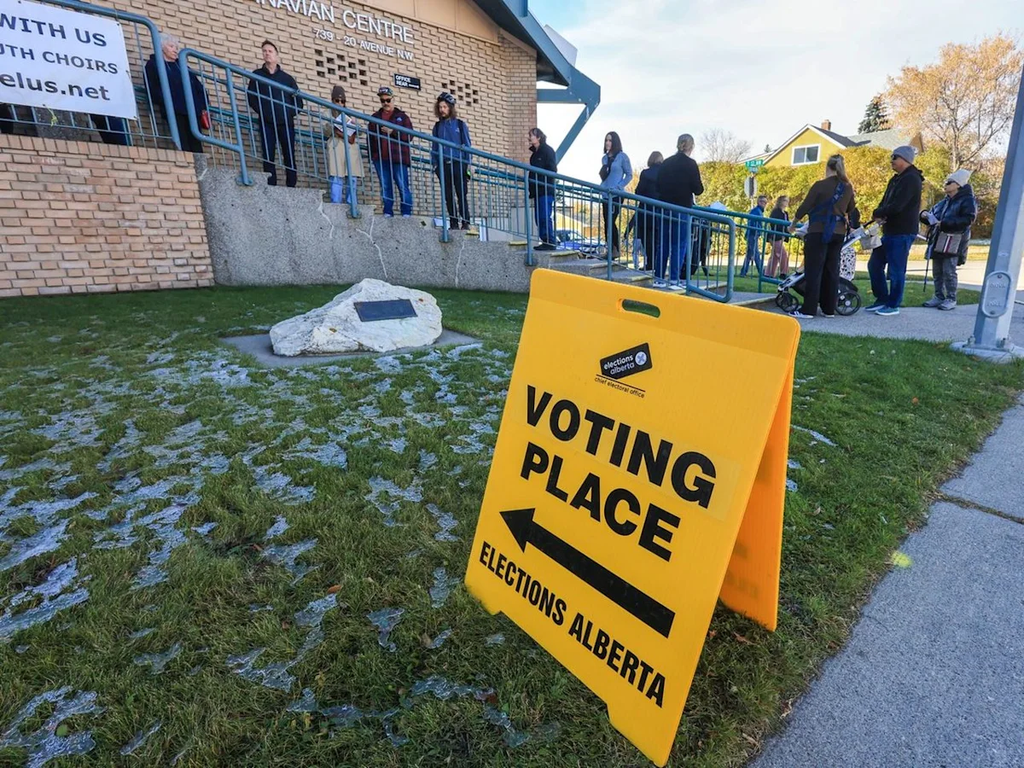
Albertans are heading to the ballot boxes on October 19, and political noise across the province has reached a fever pitch. If you follow the daily headlines, you probably think this entire provincial referendum is about separation and national unity.
That is only half of the story.
Tucked quietly behind the big debates about national borders are five specific questions that take direct aim at immigrants, international students, and temporary workers. These questions ask voters whether the province should block certain newcomers, push them to the back of the line for jobs, and even force their families to pay extra fees to access public clinics and local schools.
Legal experts and civil rights advocates, including Niki Bains, Avnit Dhanoa, and Eric Crowther from Justice & Equity Alberta, recently published a stark warning in the Calgary Herald column section. Their message is simple: Canada has spent more than a century falling into the exact same trap of scapegoating newcomers whenever times get tough, and Alberta is on the verge of doing it all over again.
Even three former Alberta premiers—Rachel Notley, Alison Redford, and Ed Stelmach—have joined forces across party lines to sound the alarm. They are urging everyone to vote “No” on the immigration measures because targeting newcomers puts the province’s own future at risk.
The $0 Secret To Launching Your Entire Online Empire
Why pay hundreds every month for separate software? Build funnels, send emails, and make sales with Systeme.io completely free.
Get Started For $0Free Forever • No Credit Card Needed • Beginner-Friendly
To understand what is happening right now, you have to look past the political speeches and see what is actually on the ballot, why it is happening, and where this road has taken Canada in the past.
What Albertans Are Actually Voting on This October
When voters walk into the polling booth, they will face ten separate referendum questions. While the question about leaving Canada gets all the television coverage, five of those ten questions deal exclusively with immigration.
The wording on these questions might sound technical at first glance, but the real-world impact is direct and personal.
Breaking Down the Five Immigration Ballot Questions
The first immigration question asks whether the Alberta government should take over control of immigration from the federal government. The stated goal is to slash newcomer numbers to what the government labels “sustainable levels,” prioritize economic applicants, and give Albertans priority for newly created jobs.
The government has never clearly defined what “sustainable” means in real numbers. They also have not clarified who qualifies as an “Albertan” who gets first dibs on employment. If you moved to Calgary or Edmonton two years ago, pay taxes, and run a crew, do you count? The ballot does not say.
The remaining immigration questions go even further into daily life. They ask voters to approve policies that would restrict temporary residents—including international students and temporary foreign workers—from accessing basic provincial services unless they hold a special “Alberta-approved” status.
For a detailed look at how these questions were put together, you can read the breakdown on CBC News Calgary.
The Hidden Costs: Paying More for Healthcare and Schooling
The fourth question proposes charging temporary residents an extra fee or special cash premium just to let their kids go to public school or visit a doctor.
Think about how that works in real life. These workers already have income tax deducted from their paycheques every single month. They pay fuel tax when filling their cars, and they pay rent that covers property taxes for local schools.
Singling out one group of working taxpayers and telling them their children cannot enter a classroom without an extra cash payment sets a dangerous precedent. It creates two classes of people living in the exact same neighborhoods.
The Scapegoat Playbook: Blaming Newcomers for Government Failures
It is no secret that life has felt harder across Alberta lately. Finding an affordable apartment in Calgary has turned into a daily headache. Emergency rooms in Edmonton have long wait times, and many parents worry that their local elementary classrooms are packed to the brim.
These are genuine, painful problems that affect regular families every single day.
When people are stressed about money, housing, and healthcare, human nature looks for someone to blame. Politicians understand this psychology very well. Instead of explaining why hospitals have been understaffed for years, or why public homebuilding programs were cut decades ago, it is far easier to point at the person who arrived at the airport yesterday.
Newcomers did not cause the shortage of family doctors. Years of budget cuts, disputes with physicians, and poor long-term planning created those shortages. Newcomers did not cause the sudden spike in rent; high interest rates, corporate land speculation, and a lack of affordable housing construction did.
Blaming temporary workers is an easy distraction. It gives struggling citizens an identifiable target to be upset with, while letting policymakers off the hook for failing to build the basic infrastructure a growing province needs.
Send, Spend & Hold Money Worldwide Without Hidden Fees
Transfer money internationally at the real exchange rate and hold 40+ currencies in one account.
Open a Wise AccountMid-market rate • Fast transfers • 40+ currencies
Canada’s Hidden History: We Have Seen This Movie Before
Many people grow up believing that Canada has always been an open, welcoming country that celebrates diversity without hesitation. While everyday Canadians often show immense kindness to their neighbors, the country’s official policy record tells a very different story.
Whenever the Canadian economy ran into trouble over the past 140 years, governments consistently turned against immigrants, using the law to exclude, tax, and isolate them. The University of Calgary’s Anti-Racism Knowledge Hub documents this pattern in extensive historical detail.
The Chinese Head Tax and the Exclusion Act
During the late 1800s, Canada welcomed thousands of Chinese laborers because the country needed cheap, dangerous labor to blast through mountains and finish the Canadian Pacific Railway. The moment the last railway spike was driven into the ground in 1885, the federal government changed its tune immediately.
They slapped a $50 “Head Tax” on Chinese arrivals. When people kept coming anyway to build better lives, the government raised the fee to $100, and then bumped it up to $500 in 1903—an enormous fortune at the time. By 1923, Canada banned Chinese immigration entirely through the Chinese Exclusion Act, a law that stayed on the books until 1947.
The lesson was clear: Canada wanted the labor, but did not want to grant the human beings who provided it equal rights.
The Continuous Journey Rule and the Komagata Maru
In the early 1900s, British subjects from India began moving to Western Canada to work in lumber mills and farming. Because India was part of the British Empire, Canadian officials could not simply pass a law explicitly naming Indian people without embarrassing the British Crown.
Instead, they invented a sneaky administrative rule called the “Continuous Journey Regulation” in 1908. It stated that immigrants could only enter Canada if they traveled on a ship with an unbroken, continuous ticket from their country of birth.
At that time, no steamship line ran directly from India to Canada without stopping in Hong Kong or Japan to refuel. The government knew this rule made legal entry physically impossible.
When a chartered ship named the Komagata Maru arrived in Vancouver harbor in 1914 carrying over 350 passengers, authorities forced them to sit offshore for two agonizing months with little food and water before sending them back at gunpoint. It was discrimination wrapped in neutral-sounding paperwork.
The 1911 Secret Ban on Black Farmers
A similar injustice played out right here on the Canadian Prairies. Between 1905 and 1911, around 1,000 Black American farmers fled brutal Jim Crow laws in the American South to settle in rural Alberta and Saskatchewan, building prosperous communities like Amber Valley.
The $0 Secret To Launching Your Entire Online Empire
Why pay hundreds every month for separate software? Build funnels, send emails, and make sales with Systeme.io completely free.
Get Started For $0Free Forever • No Credit Card Needed • Beginner-Friendly
Local boards of trade and politicians panicked. They petitioned Ottawa to stop Black immigration. In August 1911, Prime Minister Wilfrid Laurier’s cabinet approved an official Order-in-Council declaring that immigrants belonging to the Black race were deemed “unsuitable to the climate and requirements of Canada”.
The government hired border agents to deliberately turn away Black travelers under false health pretexts. Again, the system shut its doors purely out of prejudice.
Alberta’s Own Dark Record: Eugenics and Property Bans
Alberta also has unique historical chapters that many textbooks overlook. In 1928, Alberta passed the Sexual Sterilization Act, establishing a government board that forcibly sterilized thousands of vulnerable people, heavily targeting young Indigenous girls and racialized individuals until the law was finally repealed in 1972.
During the 1940s, the provincial government targeted Hutterite communities, passing laws like the Land Sales Prohibition Act and the Communal Property Act to restrict their ability to buy agricultural land and grow their farming settlements.
Every single time these laws were passed, politicians told the public it was necessary to protect local resources, jobs, and standard ways of living. Decades later, history judges those laws as shameful mistakes.
Today, the Canadian Human Rights Commission works to eliminate systemic barriers precisely because history shows how easy it is for governments to turn biases into policy.
Why Penalizing Immigrants Will Hurt Alberta’s Economy
Beyond the clear moral and human rights problems, pushing anti-immigrant policies makes zero economic sense for Alberta.
Alberta has built its reputation as Canada’s economic engine. It became an energy powerhouse, an agricultural giant, and a booming tech hub because ambitious, hardworking people from all over the world packed their bags and brought their talents here.
Look around any job site in Calgary, Edmonton, Red Deer, or Fort McMurray:
- Construction and Trades: You cannot build the homes Alberta desperately needs without the framers, electricians, dry-wallers, and roofers who come from abroad.
- Healthcare and Senior Care: Thousands of nursing aides, hospital support workers, and home-care providers are temporary residents and recent newcomers who keep clinics running around the clock.
- Food Production and Hospitality: From the meat processing facilities in Brooks and High River to local grocery stores and family diners, newcomers do the heavy lifting that keeps food on our tables.
- University Research and Innovation: International students pay triple the tuition of domestic students, effectively keeping provincial universities and technical colleges financially solvent while filling research labs.
When a province tells temporary residents that their families are not welcome to use standard healthcare or that their children will face extra fees at school, those workers will not simply accept second-class status. They will pack up and take their skills to British Columbia, Ontario, or overseas.
That is why three former Alberta premiers from conservative and progressive backgrounds took the unprecedented step of speaking out together. They know that turning off the immigration tap during an aging demographic crisis will choke off business growth, shutter small shops, and shrink the tax base needed to fund pensions and road repairs.
The Human Cost: What Life Feels Like on the Ground Right Now
Behind every statistic and ballot question, there is an actual family trying to navigate their morning routine.
Imagine you are an IT worker or a heavy equipment mechanic who arrived in Alberta on a temporary work permit three years ago. You work 50 hours a week, pay your Canadian income taxes, support local businesses, and volunteer at your neighborhood community league.
Suddenly, you wake up to find posters and social media campaigns questioning whether your seven-year-old child deserves to sit in a public school classroom without paying an extra cash surcharge. You hear speeches suggesting you are personally to blame for the long wait times at the local emergency room.
That creates an atmosphere of fear, anxiety, and division. It changes how people look at their neighbors at the bus stop or in the grocery aisle.
The Alberta Human Rights Commission frequently reminds the public that human rights are not privileges handed out only to people with specific passports. They are basic standards of dignity that protect everyone living within the community. When you undermine those protections for the most vulnerable group, you weaken legal protections for everyone else too.
How Albertans Can Break the Historical Cycle
History does not have to repeat itself.
The upcoming vote on October 19 gives Albertans a rare and critical choice. It is a moment to decide what kind of society Alberta wants to build for the next fifty years.
Do we want a province that looks backward, closes in on itself, and blames newcomers for structural problems that require real government investment? Or do we want a confident, modern province that welcomes hard workers, invests in public services, and builds enough homes and schools for everyone?
Saying “No” to the referendum’s immigration questions is not about ignoring real challenges. It is about being honest about where those challenges come from. If we want shorter hospital wait times, the solution is funding more residency spots, hiring more nurses, and removing red tape so foreign-trained doctors can practice here. If we want cheaper housing, the solution is building more homes, not penalizing the people helping to build them.
Voting responsibly means rejecting scapegoats and demanding real solutions from elected leaders.
Frequently Asked Questions About the Alberta Referendum
When is the Alberta referendum taking place?
The provincial referendum vote takes place on Monday, October 19, 2026, alongside advanced voting days scheduled throughout the preceding week.
Are the results of this referendum legally binding?
Referendums in Alberta are generally consultative rather than self-executing. However, a “Yes” vote gives the provincial government a political mandate to introduce new legislation, change provincial regulations, and challenge federal powers in court.
Why are temporary foreign workers and international students singled out?
Temporary residents are often targeted in political debates because they do not have the right to vote in Canadian elections. This makes them an easy political target for governments wanting to show tough policy moves without risking votes from that specific group.
Do temporary residents pay taxes in Alberta?
Yes. Every person working legally in Alberta pays federal and provincial income taxes, Canada Pension Plan contributions, and Employment Insurance deductions directly from their wages. They also pay local property taxes indirectly through their rent, as well as municipal utility rates and fuel taxes.
What are former Alberta premiers saying about the vote?
Former premiers Rachel Notley, Alison Redford, and Ed Stelmach have united to urge Albertans to vote “No” on the five immigration questions. They warn that targeting immigrants harms the province’s economic growth, scares away investors, and ruins Alberta’s welcoming reputation.
Building a prosperous province has never been about shutting people out. It has always been about working together to build something bigger and better for future generations. When communities pull together rather than turning on each other, real solutions to housing, healthcare, and education become possible.
