
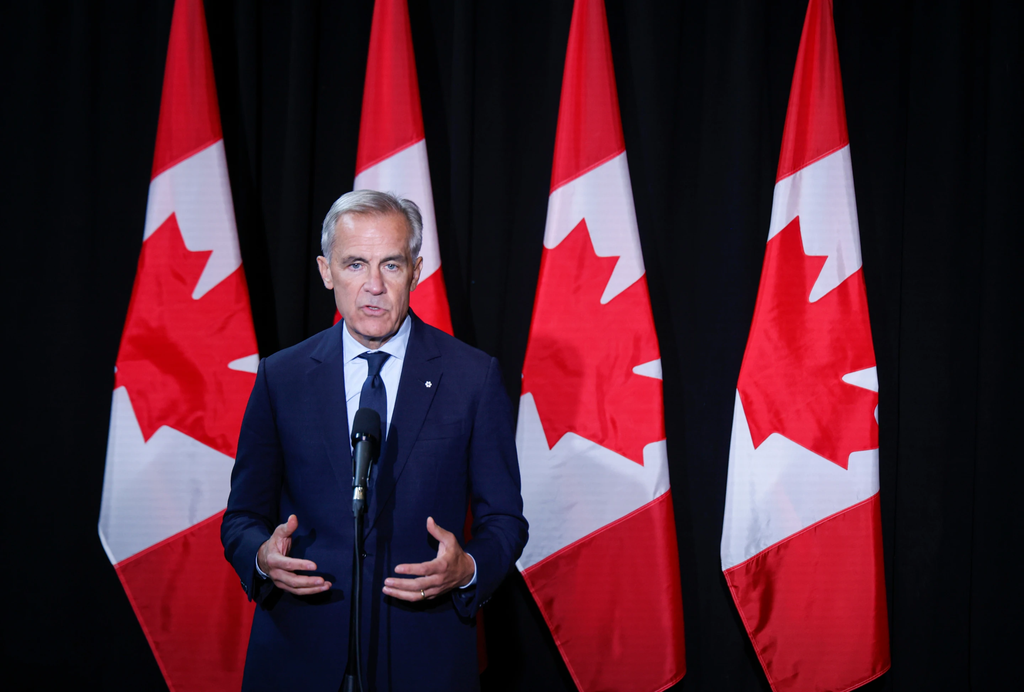
Canadian Prime Minister Mark Carney did not hold back when he took the stage in Calgary. Facing a packed arena of thousands waving Canadian flags, Carney dropped a massive statement that immediately sent shockwaves across North America. He warned that outside forces in the United States are actively trying to divide and break Canada apart so they can control its resources and take over its future.
This was not an ordinary political rally. The speech came just days before Alberta heads to the polls for a high-stakes referendum on Monday, October 19, 2026. The vote could trigger the legal process for the oil-rich province to leave the Canadian confederation.
Advance voting is already underway across the province. In fact, long queues formed outside polling stations immediately, with over 174,000 ballots cast on the very first day alone.
Carney spoke directly to voters who might view the referendum as an easy way to vent frustration at the federal government. He warned the crowd that casting a ballot against Canada is not a game.
A vote to break the country, Carney stated, is a dangerous bluff that could drag everyone into years of bitter division, economic chaos, and lost opportunities.
The $0 Secret To Launching Your Entire Online Empire
Why pay hundreds every month for separate software? Build funnels, send emails, and make sales with Systeme.io completely free.
Get Started For $0Free Forever • No Credit Card Needed • Beginner-Friendly
The Calgary Rally: “Vote Like Canada Depends on It”
The scene inside the BMO Centre in Calgary looked more like an international hockey championship than a political event. Supporters packed into the hall wearing red and white jerseys, waving maple leaf flags attached to hockey sticks, and chanting for a united country.
The massive event was organized by the Forever Canadian campaign, an advocacy group created by former Alberta Deputy Premier Thomas Lukaszuk. The group aims to give voice to the millions of Albertans who want to stay part of the national family.
Retired Canadian football star Jon Cornish also took the stage to fire up the audience. He urged locals to stand tall for unity and reject any political paths that weaken the nation.
For Carney, the trip to Calgary was deeply personal. Although he leads the federal government in Ottawa, he grew up in Alberta and spent his youth in Edmonton. He leaned into those local roots throughout his address.
Carney told the crowd that he knows why people in western Canada feel frustrated. Albertans have felt ignored by central Canada for decades. But walking away from the country their ancestors helped build, he argued, will solve nothing.
Federal Liberal leaders rarely receive standing ovations in Calgary. Yet this event brought together people from across the political spectrum. Liberal supporters, New Democratic Party members, and traditional provincial Conservatives stood side-by-side to wave flags and sing the national anthem.
The American Threat: Why Washington Is in the Crosshairs
Why did Carney bring up the United States during a Canadian provincial vote? The answer lies in growing cross-border friction and controversial rhetoric coming out of Washington.
Over the past year, former U.S. President Donald Trump has repeatedly stirred international controversy with remarks about Canada. Trump publicly declared that Canada should become the 51st American state, arguing that the country’s economy and defense cannot survive without American support.
Alongside those public comments, trade tensions between the two neighbors have grown hotter. Cross-border tariffs, disputes over manufacturing, and arguments over energy pipelines have put Canadian leaders on edge.
Carney pointed out that a fragmented Canada would have very little power to stand up to its southern neighbor. If provinces break away into smaller, independent territories, they lose the collective strength of an entire nation.
Alberta holds the third-largest proven crude oil reserves in the world. For years, American refineries have purchased Canadian oil at steep discounts because Canadian producers had limited pipeline routes to sell to overseas buyers.
Carney warned that powerful outside commercial and political interests would love nothing more than an isolated Alberta. Without the backing of a sovereign Canadian state, a breakaway province would find itself completely dependent on American trade rules and corporate interests.
As Carney put it bluntly to the crowd, outside forces want to break Canada so they can own it. He cautioned that breaking apart would turn an energy powerhouse into a dependent border region with almost no say over its own destiny.
Decoding the Ballot: What Albertans Are Actually Voting On
Many people following the news are confused about what the October 19 referendum actually decides. It is important to look closely at the ballot.
The vote will not immediately create an independent country overnight. If the pro-separation side wins, Alberta does not automatically print its own passports or establish border checkpoints next week.
Send, Spend & Hold Money Worldwide Without Hidden Fees
Transfer money internationally at the real exchange rate and hold 40+ currencies in one account.
Open a Wise AccountMid-market rate • Fast transfers • 40+ currencies
The ballot contains ten separate questions. The final question, Question 10, is the main event.
Question 10 offers voters a clear choice between two distinct paths:
- Option 1: Alberta should remain a province of Canada.
- Option 2: The Government of Alberta should commence the legal process required under the Canadian Constitution to hold a binding provincial referendum on separation.
A vote for Option 2 gives the provincial government the legal authority to begin formal separation steps and prepare for a final, binding exit vote down the road.
The first nine questions on the ballot focus on completely different provincial complaints. Premier Danielle Smith and her governing United Conservative Party placed nine proposals before voters covering immigration rules, replacing the RCMP with a provincial police force, altering how federal judges are picked, changing social service funding, and demanding Senate reform.
Opponents of the provincial government have launched a counter-campaign called “No to the 9”. They argue that the first nine questions are designed to blame newcomers and Ottawa for local problems like hospital wait times and school crowding, while slowly driving a wedge between Alberta and the rest of Canada.
The Complicated Position of Premier Danielle Smith
One of the most surprising parts of this political battle is where Alberta’s top leader stands.
Premier Danielle Smith called the referendum after facing intense pressure from separatist factions within her party. Many activists wanted a direct vote on leaving Canada immediately. Smith decided to place the question on the ballot to let voters settle the issue.
When Smith walked into an advance polling station to cast her ballot, she voted to stay in Canada.
Smith told reporters outside the voting booth that Canada can still work, but insisted that the system needs big structural changes. She has urged Albertans to vote against full separation on Question 10, while encouraging them to vote “Yes” on the first nine questions to give her leverage when demanding concessions from Ottawa.
This position puts Smith right in the middle of a political storm. Pro-unity voters wonder why she scheduled a separation referendum if she wants to stay, while hardline separatists accuse her of backing down when the moment arrived.
The $0 Secret To Launching Your Entire Online Empire
Why pay hundreds every month for separate software? Build funnels, send emails, and make sales with Systeme.io completely free.
Get Started For $0Free Forever • No Credit Card Needed • Beginner-Friendly
Separatist leaders are actively pushing people to vote for Option 2 on Question 10. Keith Wilson, one of the leaders of the Let Alberta Decide campaign, dismissed Carney’s warnings about global danger. Wilson argued that if the world is unstable, that is the exact reason Alberta should take control of its own borders and natural resources rather than trusting Ottawa.
Pierre Poilievre and the Conservative Balance
The referendum has created complex challenges for federal Conservative Leader Pierre Poilievre as well.
Alberta is the political heartland of the Conservative Party of Canada. The province reliably delivers dozens of parliamentary seats and millions of dollars in fundraising to conservative campaigns.
Poilievre has spent years criticizing federal Liberal policies, arguing that high carbon taxes, heavy regulations, and spending have hurt Canadian families and damaged the western energy industry.
When it comes to breaking up the country, Poilievre has drawn a firm line. He traveled to Alberta to speak out directly in defense of Canadian unity.
Poilievre told Albertans that the right way to fix their problems is not to leave Confederation, but to replace the government in Ottawa through the next federal election.
This creates a rare situation where federal Liberals, New Democrats, and federal Conservatives agree on the central issue. While they disagree on taxes, budgets, and climate policy, all major federal leaders agree that an Alberta separation would harm everyone involved.
Pipelines, Cash, and Natural Resources
Money is at the heart of the debate between Alberta and the federal government.
Alberta produces the bulk of Canada’s oil and natural gas, contributing billions of dollars to the national economy every year. Under Canada’s equalization program, a portion of federal tax revenue flows from wealthier provinces to provinces with lower revenue capacity.
Many Albertans feel they contribute far more to the national purse than they receive in return. They point out that while Alberta money helps fund schools and hospitals across Canada, federal regulations have made it difficult to build new oil pipelines to ocean ports.
During his Calgary appearance, Carney directly addressed these economic frustrations. Instead of lecturing workers about energy transitions, he put major infrastructure at the center of his speech.
Carney highlighted the proposed Pacific Link pipeline project. He noted that this major energy corridor would create more than 140,000 jobs and provide a clear shipping route to export Canadian energy directly to Asian markets.
By selling resources across the Pacific, Carney explained, Alberta can stop selling oil at discounted rates to the United States and build genuine economic independence.
His central message to the province was simple: let Alberta lead, not leave.
Economists have outlined serious financial risks for a breakaway province. If Alberta leaves, it becomes a landlocked territory bordered entirely by Canada and the United States.
An independent Alberta would have to negotiate access to ocean ports, build border controls, set up its own trade deals, and take on its share of Canada’s national debt. It would also have to decide whether to launch its own currency, rely on the Canadian dollar without having a voice at the central bank, or adopt the U.S. dollar.
For more context on Canadian political affairs and breaking stories, you can read more reporting on CP24’s live news updates.
The Legal Reality: Can Alberta Legally Walk Away?
Even if voters choose Option 2, leaving Canada is not legally straightforward.
The Canadian legal framework for separation was established in 1998, when the Supreme Court of Canada issued its famous Secession Reference decision. That case arose after Quebec came within a fraction of a percent of voting to leave Canada in 1995.
The Supreme Court ruled that no Canadian province has the legal right to declare independence unilaterally. A province cannot simply declare itself an independent republic under Canadian or international law.
Instead, the court ruled that if a clear majority votes in favor of separation on a clear question, the federal government and all other provinces are required to enter good-faith negotiations.
Those negotiations would cover everything from dividing federal assets and national debt to setting borders, citizenship rights, and trade corridors. Any final agreement would require formal constitutional amendments, which require approval from federal and provincial parliaments.
There is also the matter of Indigenous treaty rights. Alberta sits on the traditional lands of First Nations covered by Treaty 6, Treaty 7, and Treaty 8.
These treaties were signed with the British Crown and the Canadian federal government, not with the provincial legislature of Alberta.
Earlier in 2026, the Alberta Court of King’s Bench struck down an initial separatist petition because organizers failed to consult Indigenous communities. First Nations leaders across Alberta have stated clearly that their treaty rights cannot be erased by a provincial referendum, and they will fight any attempt to take their lands out of Canada.
You can track further legal and national developments on AP News international coverage.
What Everyday Albertans Are Saying
Conversations across Alberta reveal an electorate with varied opinions.
In major urban centers like Calgary and Edmonton, many residents worry that constant separation talk harms the local economy. Business owners express concern that large companies may hesitate to build offices or invest in the province if constitutional stability is questioned.
Families in the cities frequently focus on everyday challenges. People talk about the price of groceries, high utility bills, crowded school classrooms, and long waits at hospital clinics.
Many voters feel the provincial government is spending time and taxpayer money on a referendum to distract from domestic public services.
In rural towns and oil-producing communities, the mood often reflects frustration. In Coutts, a border town known for high-profile political demonstrations, residents still feel Ottawa overlooks western workers.
For many rural voters, choosing Option 2 on the ballot is a way to deliver a wake-up call to eastern politicians. They want Ottawa to respect their resource economy and lower federal taxes.
Carney stressed in his speech that using a separation vote as a bluff is dangerous. Once a province votes to start separation proceedings, the legal and economic processes take on a life of their own, creating business uncertainty that can last for years.
Frequently Asked Questions
Will Alberta immediately separate if Option 2 wins on Monday?
No. Option 2 on Question 10 does not declare independence. It directs the Alberta government to begin the formal legal and constitutional process required under the Canadian Constitution to hold a second, legally binding referendum in the future.
Why did Mark Carney claim the United States wants to break Canada?
Carney pointed to aggressive trade policies, tariff threats, and recent public remarks by Donald Trump suggesting Canada become the 51st American state. Carney argued that outside commercial and political interests want a fragmented Canada because isolated provinces would have no bargaining power over their oil, gas, and trade.
How did Premier Danielle Smith vote in the referendum?
Danielle Smith cast her advance ballot in favor of staying in Canada on Question 10. However, she encouraged voters to support the first nine questions on the ballot to give her government more leverage when negotiating constitutional powers with Ottawa.
What are the “first nine questions” on the ballot?
The first nine questions ask voters about provincial jurisdiction, including taking control of immigration, replacing the RCMP with a provincial police force, altering how judges are appointed, and eliminating the federal Senate. Critics have launched a “No to the 9” campaign, arguing these questions create unnecessary division.
Can Alberta legally separate on its own?
Under the 1998 Supreme Court Secession Reference, unilateral separation is illegal under Canadian and international law. An exit would require formal negotiations with the federal government and the other provinces, alongside constitutional amendments and consultations with Indigenous First Nations.
When will the official results be known?
Advance voting runs through Saturday, with the final polling day taking place on Monday, October 19, 2026. Official ballot counts will be tabulated and announced by Elections Alberta shortly after polls close Monday evening.
The Road Ahead for Alberta and Canada
This referendum represents a defining political moment for modern Canada. The vote tests whether the country can resolve deep-seated regional complaints while keeping its national borders intact.
Carney’s Calgary speech made it clear that the federal government plans to defend Confederation directly, arguing that national strength and energy independence are the best protection against outside pressure. When polls close on Monday night, Albertans will decide whether to double down on national unity or embark on an uncharted constitutional journey.
