
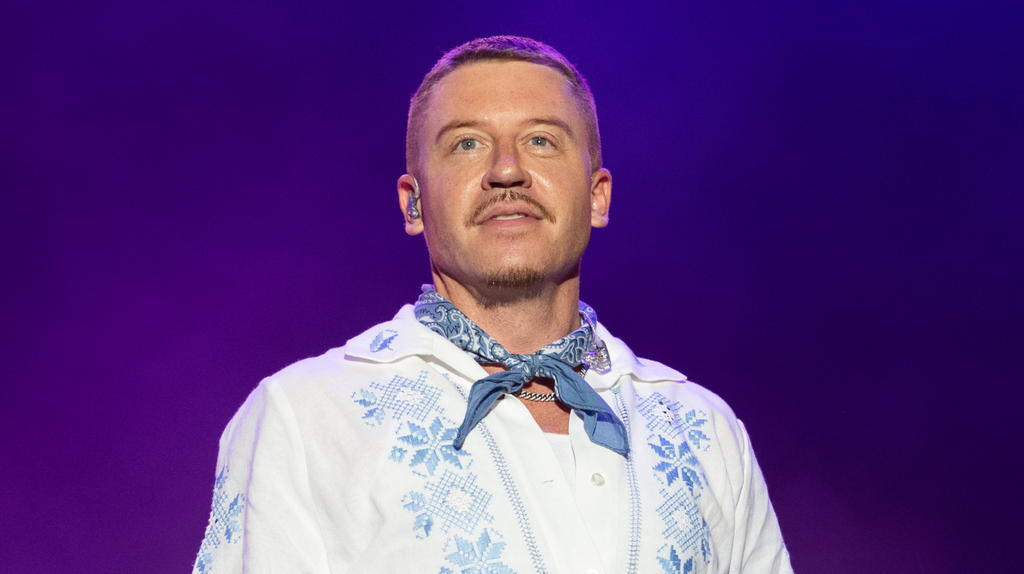
A massive stadium tour involving two of the biggest names in music just turned into one of the most intense free speech battles the entertainment world has seen in years. What was supposed to be a massive celebration of pop hits and hip-hop energy across American stadiums took a sudden and dramatic turn when Macklemore was officially dropped from Ed Sheeran’s massive Loop Tour.
The decision came after Macklemore took the stage at MetLife Stadium in New Jersey and delivered an onstage speech in support of Palestine. Within days, billionaire stadium owners, powerful concert promoters, and major political action groups pushed back. When venue owners threatened to lock Ed Sheeran out of major stadiums if Macklemore remained on the bill, the promoter made the call to cut the rapper from the remaining dates.
What followed was a complete chain reaction. Instead of the controversy quietly dying down, every single remaining opening act on the tour pulled out in solidarity with Macklemore. The fallout left Ed Sheeran standing on stage alone in Philadelphia, forced to address a global humanitarian crisis and a growing debate over artistic censorship.
Here is the complete breakdown of how an onstage speech sparked a million-dollar charity pledge, a massive musician boycott, and a fierce debate over who controls the microphone in major venues.
The Onstage Speech That Started the Fire
To understand how this situation exploded, you have to look at what actually happened on stage during the tour’s stop in New Jersey. Macklemore, born Benjamin Haggerty, has never been a stranger to political activism. Throughout his career, he has used his music to talk about social issues, addiction, and human rights. Over the past year, he became one of the most visible American musicians vocalizing support for Palestinian civilians amid the war in Gaza.
The $0 Secret To Launching Your Entire Online Empire
Why pay hundreds every month for separate software? Build funnels, send emails, and make sales with Systeme.io completely free.
Get Started For $0Free Forever • No Credit Card Needed • Beginner-Friendly
Earlier this year, Macklemore released “Hind’s Hall,” a viral protest track named in honor of Hind Rajab, a five-year-old Palestinian girl killed in Gaza. The song directly criticized corporate media, political leaders, and the music industry’s silence. When he joined Ed Sheeran’s tour as a primary opening act, many wondered if he would bring those political themes to huge stadium crowds.
During his opening set at MetLife Stadium, Macklemore did exactly that. He stopped his set to address the audience directly about the ongoing crisis in Gaza and the West Bank.
He told the crowd that a major reason he wanted to perform on such a massive platform was to speak up for people who feel forgotten. He shouted “Free Palestine” to the audience, explaining that he wanted those words to echo all the way to Gaza so people living under bombardment knew that regular people in America were paying attention. He also made sure to address Jewish members of the audience directly, clarifying that standing up against military action or criticizing a government is not the same as hating Jewish people.
While many fans in the stadium cheered, the speech immediately created a wave of opposition outside the venue walls. Pro-Israel organizations and political groups quickly mobilized, launching online petitions and demanding that tour organizers take action. Reports from major outlets like The Guardian confirmed that the backlash gathered speed within forty-eight hours.
Behind Closed Doors: The Billionaire Ultimatum
The pushback against Macklemore did not just stay on social media. It moved straight into corporate boardrooms and stadium front offices.
At the center of the push to remove Macklemore was Robert Kraft, the billionaire owner of the New England Patriots and Gillette Stadium in Massachusetts. Kraft, who is a prominent donor to Israeli causes, took personal issue with Macklemore’s presence on the tour lineup.
Behind the scenes, stadium owners formed a coalition. Instead of just refusing to host Macklemore individually, key venue owners delivered a joint ultimatum to Messina Touring Group, the promoter handling the US leg of Ed Sheeran’s tour.
The ultimatum was simple and ruthless: if Macklemore stayed on the lineup, Ed Sheeran would not be allowed to perform at their venues.
For a tour of this size, losing venues like Gillette Stadium would mean cancelling shows for hundreds of thousands of fans who had already bought tickets a year in advance. The financial and logistical damage would have been catastrophic for the production team. Facing the threat of full concert cancellations, Messina Touring Group officially announced that Macklemore was removed from all remaining support dates on the tour.
Promoters released a brief statement explaining that after discussions with venue owners and stakeholders, dropping Macklemore was the only way to ensure the shows could go on. But while the organizers hoped this decision would put an end to the controversy, it actually triggered an even larger crisis.
Macklemore’s Response and the $1 Million Gaza Pledge
When news broke that he was officially kicked off the tour, Macklemore did not throw a tantrum or attack his long-time friend Ed Sheeran. Instead, he posted a long, reflective statement on his personal Instagram channel that quickly went viral across the internet.
He made it clear right away that he did not see himself as a victim. He emphasized that being removed from a stadium tour was a minor inconvenience compared to the real suffering experienced every day by families, children, and aid workers in Gaza. He explained that standing up for human rights comes with real costs, including lost brand deals, cancelled shows, and lost income, but insisted that some principles are worth more than a paycheck.
Macklemore then announced a major move: he decided to donate his entire $1 million earnings from his time on Ed Sheeran’s tour to six non-profit organizations providing direct humanitarian relief and medical support to Palestinians in Gaza.
In his statement, he directly challenged Robert Kraft. He invited the billionaire owner to match his $1 million gift, suggesting that regardless of their political disagreements, both men should be able to agree that saving civilian lives and protecting innocent children is a goal worth supporting.
As detailed by coverage from AP News, Kraft later responded through a representative, stating that he and Ed Sheeran had agreed to commit funds to humanitarian relief in the region. However, Kraft maintained that his decision to ban Macklemore was based on what he described as hurtful rhetoric. Macklemore firmly rejected any accusations of antisemitism, restating his core message: criticizing government policies and standing up for human rights should never be confused with hate speech against a group of people.
Send, Spend & Hold Money Worldwide Without Hidden Fees
Transfer money internationally at the real exchange rate and hold 40+ currencies in one account.
Open a Wise AccountMid-market rate • Fast transfers • 40+ currencies
The Domino Effect: Every Single Opener Walks Away
If the stadium owners thought removing Macklemore would clean up the tour schedule, they severely underestimated the solidarity among the performing artists.
Within forty-eight hours of Macklemore being cut, a quiet revolt broke out among the remaining artists on the tour roster. One by one, every single opening act announced they were withdrawing from Ed Sheeran’s tour in direct support of Macklemore and free expression.
First, Irish folk band Beoga, who had collaborated with Ed Sheeran on major hits in the past, announced they were stepping down. Next came Danish pop group Lukas Graham and singer-songwriter Aaron Rowe, both stating that they could not comfortably perform under conditions where an artist was silenced for holding political views.
The biggest blow came when Finneas, the Oscar and Grammy-winning producer and artist (and brother of Billie Eilish), announced he was pulling out of his scheduled opening slots on the international dates.
Suddenly, Ed Sheeran was left with an entire stadium tour and zero opening acts.
This solidarity movement sent shockwaves through the live music industry. It proved that young artists were unwilling to accept venue-enforced censorship, even when performing on the world’s biggest stages. Music journalists and industry analysts noted that while stadium owners held the power over venue keys, artists still held the power over the stage itself.
For creator communities and digital publishers following pop culture trends, this event became a massive topic of discussion. If you track trends in modern content creation or cover viral industry news, you can read more about how online media covers these rapid news cycles in our breakdown on YouTube Automation and how modern digital channels operate today.
Ed Sheeran Breaks Silence on Stage
For over a week, Ed Sheeran remained caught in an extremely difficult position. Known throughout his career for avoiding political commentary and focusing purely on music, Sheeran was suddenly dragged into the middle of one of the most volatile geopolitical debates on earth.
Critics like Charlotte Church accused Sheeran of choosing profits over principles by allowing his promoter to drop Macklemore. Meanwhile, pro-Israel groups monitored his every move to see if he would endorse Macklemore’s statements.
When the tour reached Lincoln Financial Field in Philadelphia, Sheeran finally broke his silence in front of tens of thousands of fans. Standing alone with his guitar on a stage with no opening acts to precede him, he addressed the crowd directly before playing his set.
The $0 Secret To Launching Your Entire Online Empire
Why pay hundreds every month for separate software? Build funnels, send emails, and make sales with Systeme.io completely free.
Get Started For $0Free Forever • No Credit Card Needed • Beginner-Friendly
Sheeran acknowledged the heavy atmosphere surrounding the tour. He explained that he had spent his entire career trying to keep his shows political-free spaces where people from all walks of life could come together. But he admitted that the events of the past week made it impossible to stay quiet any longer.
In a candid speech reported by Al Arabiya English, Sheeran described the situation in Gaza as “catastrophic and unjustifiable.” He expressed heartbreak over the loss of civilian lives, particularly children, and criticized the systemic violence in the West Bank. At the same time, he condemned the October 7 attacks in Israel, acknowledging the deep pain felt by Jewish communities worldwide.
Crucially, Sheeran expressed deep concern about venue owners attempting to pre-approve or filter what artists can say on stage. He told the audience that while he did not make the decision to drop Macklemore—placing that responsibility on venue owners and promoters—he believed concerts must remain spaces where people can speak freely and where audience members with differing views can coexist.
Free Speech, Big Money, and the Future of Live Music
The fallout from Ed Sheeran’s tour represents a major turning point in how big money, venue ownership, and artist rights intersect.
Historically, stadium tours have operated under strict corporate guidelines. Major venues rely on corporate sponsorships, luxury box sales, and public tax funding. When artists use those platforms to take bold political stands, it puts stadium owners in uncomfortable positions with their corporate partners and donors.
However, the Macklemore situation demonstrated that enforcing corporate censorship can backfire dramatically. By trying to silence one artist, venue owners inadvertently created a much bigger headline, sparked an artist boycott, and forced the headlining star to address the topic head-on.
This event highlights a growing gap between corporate stadium executives and the artists who fill their seats. Today’s audiences expect artists to be genuine and speak their minds. When venues step in to edit or cancel performers, fans notice—and artists respond by sticking together.
As technology and digital media continue to shape how news spreads instantly around the globe, live events are no longer contained within stadium walls. The moment an artist says something on stage, millions of people see it online within minutes. To understand how technology and real-time digital reporting are transforming modern communications, check out our insights on Tech & AI to see where digital media is heading next.
How Macklemore Turned a Setback Into a Victory
Looking back at how this situation unfolded, Macklemore managed to transform what could have been a career setback into an impactful moment for his cause.
When an artist gets kicked off a major tour, it usually comes with a sense of embarrassment or defeat. But by refusing to play the victim, pledging his entire $1 million tour earnings to Gaza relief, and maintaining a respectful tone toward Ed Sheeran, Macklemore controlled the narrative from start to finish.
His protest song “Hind’s Hall” gained millions of new streams across streaming platforms as news of the tour removal spread. Rather than hiding his message, the venue ban amplified his voice far beyond the audiences at those eight stadium shows.
It also forced a broader conversation within the music industry about solidarity. When artists stand up for one another, they show that corporate pressure has limits. When every single opener walked off the tour, they sent a strong signal that censorship carries a heavy cost for promoters and venue owners too.
What This Means for Future Stadium Tours
As concert promoters look ahead to future stadium tours, this controversy will undoubtedly change how contracts and artist agreements are written.
Venues may attempt to introduce stricter code-of-conduct clauses into performance contracts, giving them explicit rights to cancel artists who engage in political speech. However, artists and talent agencies are likely to push back against these restrictions, fearing that agreeing to such terms sets a dangerous precedent for artistic freedom.
For fans attending live concerts, the atmosphere around stadium shows is evolving. Music has always been deeply connected to social movements, from anti-war concerts in past decades to modern benefit shows. The events surrounding Ed Sheeran’s tour prove that live music remains a primary arena where social and political ideas are voiced and tested.
Whether concert promoters like it or not, the era of keeping major cultural events completely separate from real-world issues seems to be over. Artists with passionate beliefs will continue to use their platforms, and fans will continue to support those who speak with honesty.
Frequently Asked Questions (FAQs)
Why was Macklemore dropped from Ed Sheeran’s tour?
Macklemore was dropped from the tour after making pro-Palestinian comments and saying “Free Palestine” during an onstage speech at MetLife Stadium in New Jersey. Following the speech, major venue owners, including New England Patriots owner Robert Kraft, gave tour promoters an ultimatum that they would not allow the tour to play at their stadiums if Macklemore remained on the lineup.
Which artists quit Ed Sheeran’s tour in solidarity?
Every remaining opening act on the tour withdrew in solidarity with Macklemore. This included Irish folk group Beoga, Danish band Lukas Graham, singer-songwriter Aaron Rowe, and producer-artist Finneas.
How much money did Macklemore donate to Gaza relief?
Macklemore pledged his entire net earnings from the tour, totaling $1 million, to six non-profit organizations providing direct humanitarian aid and medical support to Palestinians in Gaza.
What did Ed Sheeran say about the controversy?
Ed Sheeran addressed the controversy on stage in Philadelphia, calling the situation in Gaza “catastrophic and unjustifiable” while also condemning the October 7 attacks in Israel. He expressed deep concern over venue owners attempting to censor what artists can say on stage, while explaining that the decision to drop Macklemore was made by promoters and venue owners.
Will Macklemore and Ed Sheeran remain friends?
Yes. Macklemore stated in his public post that he holds no ill will toward Ed Sheeran, acknowledging that Sheeran was placed in a tough spot by stadium owners. He expressed hope that their thirteen-year friendship would remain intact despite the disagreement over how the tour handled the situation.
The intersection of music, free speech, and global politics is moving faster than ever. When major cultural moments happen, staying informed with clear, straightforward coverage helps you see the bigger picture beyond the headlines.
To learn more about our team, our mission, and why we cover the stories shaping global pop culture, visit our About Us page. If you have thoughts on this story, a news tip, or feedback you would like to share directly with our editorial staff, head over to our Contact Us page to send us a message.
You can also follow us across all our social media channels to get instant updates on trending news, music culture, and viral stories:
- Follow us on Instagram for visual stories and daily highlights.
- Join the community on Facebook for discussions and full articles.
- Catch real-time news updates on X (formerly Twitter).
As this story continues to develop across the music industry, we will keep bringing you the facts, the context, and the honest analysis you need to stay ahead of the curve.
