
I have tested more marketing tools over the past six years than I care to count. Most promise the world on their free plans. Then you sign up, hit a wall two weeks later, and suddenly you are staring at a $97 monthly bill just to send emails to more than 500 people.
Systeme.io is different in some ways. But it is not magic. The free plan exists, it works, and plenty of people build real businesses on it. But you need to know exactly what you are getting into before you move all your courses, funnels, and email lists over.
Let me walk you through what actually happens when you start with Systeme.io’s free plan, where the limits hurt the most, and whether you should stay on free or upgrade.
What Is Systeme.io Anyway?
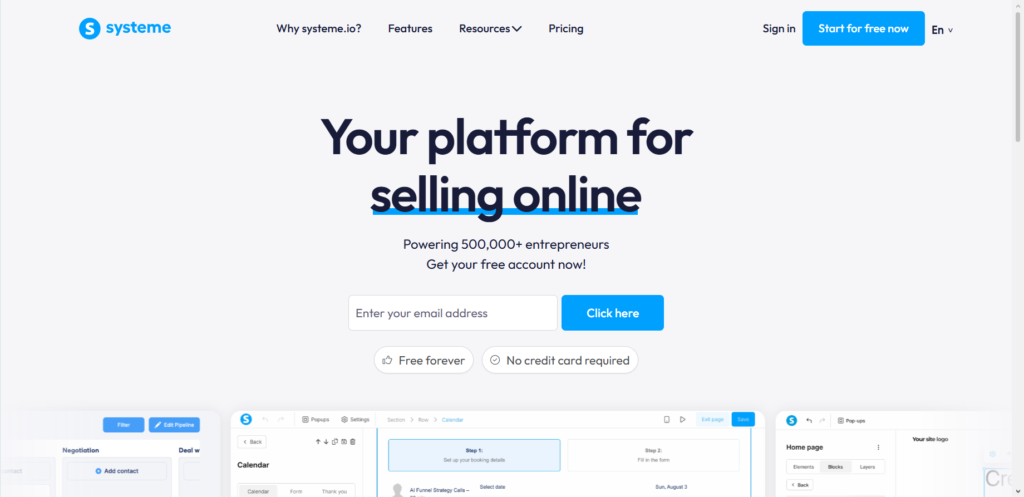
For anyone new to the name, Systeme.io is an all-in-one marketing platform. It handles sales funnels, email marketing, online courses, affiliate programs, blog posts, and basic eCommerce. Think of it as a cheaper, simpler alternative to ClickFunnels or Kajabi.
I started using Systeme.io around 2019 when I got tired of paying for four different tools that did not talk to each other. My email platform was separate from my funnel builder, my course host was another bill, and my affiliate system barely worked. Systeme.io put everything under one roof.
The $0 Secret To Launching Your Entire Online Empire
Why pay hundreds every month for separate software? Build funnels, send emails, and make sales with Systeme.io completely free.
Get Started For $0Free Forever • No Credit Card Needed • Beginner-Friendly
The company behind it has been around since 2016. They are French, bootstrapped, and surprisingly transparent about their pricing. That alone made me trust them more than the venture-backed giants that keep raising prices every year.
The Honest Answer: Yes, Systeme.io Has a Free Plan
Systeme.io offers a free plan that never expires. You do not need to enter a credit card to start. You can use it for as long as you want without paying a single dollar.
But free means you get a limited version. The company needs to make money somewhere, and they do that by encouraging you to upgrade when your business outgrows the free tier.
I have seen people run small digital product stores on the free plan for over a year. I have also seen people upgrade within two weeks because they needed just one more feature.
Neither is wrong. It just depends on what you are building.
What You Actually Get on the Free Plan
Here is the breakdown of the free plan as of now. Keep in mind that Systeme.io updates their features occasionally, so double-check their official page if you are reading this months later.
Contacts and email: You can store up to 2,000 contacts. You can send unlimited emails to them. That last part is unusual. Most free email marketing tools cap your monthly sends at 1,000 or 2,500. Systeme.io does not limit sends, only contacts.
Sales funnels: You can build up to three funnels. Each funnel can have multiple steps like opt-in pages, sales pages, order forms, and thank you pages. For a small side project, three funnels is plenty.
Membership sites and courses: You can create one course or membership area. There is no limit on how many students or members you add. But you only get one.
Blog: You get one blog with unlimited posts. The blogging feature is basic but functional. No custom domains on the free plan, though. Your blog lives on a subdomain like yourname.systeme.io.
Products: You can sell up to five different products. These can be digital products, physical products, or services. Systeme.io handles checkout and payment processing through Stripe or PayPal.
Affiliate program: You can set up an affiliate program for your products, but you are limited to three active affiliates.
File storage: You get 1 GB of storage for videos, PDFs, images, and other files. This is one of the tighter limits. A single course with decent quality videos can eat up 1 GB very quickly.
Custom domain: Not available on free. You have to use Systeme.io subdomains.
Automation rules: You get basic automation. You can tag people, move them between lists, and trigger emails based on their actions. But complex conditional workflows are locked behind paid plans.
Send, Spend & Hold Money Worldwide Without Hidden Fees
Transfer money internationally at the real exchange rate and hold 40+ currencies in one account.
Open a Wise AccountMid-market rate • Fast transfers • 40+ currencies
Where the Free Plan Hurts the Most
After helping dozens of clients set up Systeme.io, I have seen the same pain points come up again and again. These are the limitations that actually matter in real life.
One Membership Site Is Too Few for Some Businesses
The single course or membership limit catches people off guard. Imagine you sell a yoga course and also want to offer a separate meditation membership. That is two memberships. You cannot do that on free.
I had a client who wanted to launch a paid community alongside her existing free course library. She had to upgrade immediately because free only gave her one space. If you plan to sell multiple courses or run more than one membership, the free plan will not work for you.
1 GB of Storage Disappears Faster Than You Think
This is the limit that sneaks up on people. A single one-hour video recorded at decent quality can be 500 MB or more. Add a few PDF worksheets, some images for your sales page, and you are over the limit before you even launch.
I recommend hosting videos on YouTube or Vimeo as unlisted links and embedding them into your Systeme.io course. That way the video files themselves do not count against your storage. Your students still watch the videos inside your course, but the files live somewhere else.
That workaround saves most people. But if you want to upload video files directly, you will need to upgrade.
No Custom Domain Hurts Credibility
Your sales page or blog will live at something like yourbrand.systeme.io. That is fine for testing. But when you start driving paid traffic or asking people to buy from you, a subdomain looks less professional.
I have run split tests on this. Pages with custom domains consistently convert better. Not by a huge margin, maybe five to ten percent, but enough to matter. If you are serious about building a brand, factor in the cost of a paid plan that unlocks custom domains.
Three Funnels Become Limiting Quickly
Three funnels sounds like a lot until you map out your business. One funnel for your lead magnet. One funnel for your main product. One funnel for a webinar registration. Now you are out of funnels. What about a separate funnel for a low-tripwire offer? Or a funnel for an affiliate promotion?
You can delete funnels you are not using, which helps. But you cannot have more than three active at once. For most beginners, three is fine. For anyone running multiple offers or testing different funnels, you will bump into this limit.
The $0 Secret To Launching Your Entire Online Empire
Why pay hundreds every month for separate software? Build funnels, send emails, and make sales with Systeme.io completely free.
Get Started For $0Free Forever • No Credit Card Needed • Beginner-Friendly
Who Should Actually Use the Free Plan
The free plan makes perfect sense for three types of people.
First, absolute beginners who have never built a funnel or sent an email campaign before. Use the free plan to learn the interface, practice writing emails, and test your first product idea. You lose nothing but time if it does not work out.
Second, hobbyists who want to sell a single digital product or run a small newsletter. If you have one ebook, one course, or one membership, and you do not care about having a custom domain, the free plan works indefinitely.
Third, people who want to validate an idea before spending money. Build a simple landing page on the free plan, drive some traffic, and see if anyone joins your email list or buys your product. If the idea flops, you spent zero dollars. If it works, upgrade and move forward.
I used the free plan myself for the first two months when I was testing a low-ticket affiliate course. I did not want to invest in tooling until I knew people would actually buy. The free plan let me run that test honestly.
When You Need to Upgrade
You should upgrade to a paid plan the moment any of these things become true.
You need more than one membership site or course.
You have more than 2,000 contacts on your email list. (At that point, you likely have enough revenue to cover the monthly fee anyway.)
You need a custom domain for credibility.
You have more than three active funnels.
You need advanced automation rules with multiple conditions and delays.
You want to run evergreen webinars, which are only available on paid plans.
You have more than three active affiliates.
The paid plans start at around $27 per month for the Startup plan. That gives you unlimited funnels, unlimited memberships, five custom domains, 5 GB of storage, and 5,000 contacts. The price increases as you need more contacts and features.
Compared to ClickFunnels which starts at $97 or Kajabi at $149, Systeme.io is dramatically cheaper. But do not upgrade just because you think you should. Upgrade only when a real limitation stops you from doing something that makes money.
A Realistic Example From My Own Work
Last year, I helped a freelance writer set up a simple digital product. She wanted to sell a twenty-page guide on pitching publications. That was it. One product, one email list, one sales page.
We used the Systeme.io free plan. She built a two-step funnel. Step one was an opt-in page where people entered their email to get a free sample chapter. Step two was the sales page for the full guide.
She stored around 800 email contacts. Her guide was a PDF under 5 MB. She did not need video storage or multiple courses. The free plan worked perfectly for her. She made about $300 in her first month and eventually upgraded to a paid plan only because she wanted a custom domain.
That is the best case for the free plan. Simple product, low storage needs, single funnel, no complex automation.
I also had a client who tried to run a membership site with weekly video lessons on the free plan. He hit the 1 GB storage limit in three weeks. He got frustrated, blamed the tool, and almost gave up. The problem was not the tool. He just needed the paid plan from day one. His idea was bigger than what free could handle.
Common Questions People Ask Me
Can I start for free and upgrade later without losing my work?
Yes. Everything you build on the free plan stays exactly as it is when you upgrade. Your funnels, emails, contacts, and courses all carry over. No migration needed.
Does Systeme.io put its branding on my pages?
No. Even on the free plan, your sales pages and checkout forms do not show Systeme.io logos. The only branding is the subdomain in the URL. This is better than most free tools that plaster their name all over your content.
Can I accept payments on the free plan?
Yes. You connect Stripe or PayPal. Systeme.io takes no transaction fees on any plan. The payment processors take their usual cut, but Systeme.io does not add anything on top.
Is the free plan safe for building a real business?
For small, simple businesses, yes. For anything with multiple products, courses, or significant traffic, you will want to upgrade eventually. But you can absolutely start on free and make your first sales.
What happens if I go over a limit?
Systeme.io does not suddenly charge you or shut you down. They simply prevent you from adding more until you delete something or upgrade. For example, if you hit 2,000 contacts, new people cannot sign up until you remove some existing contacts or upgrade.
The Bottom Line on Systeme.io Free
The free plan is generous by industry standards. Unlimited emails, no transaction fees, no time limit, and no credit card required. For a beginner with a single product or a small email list, it is more than enough.
But it has real limits. One course. Three funnels. 1 GB of storage. No custom domain. Those limits will stop you once your business grows past the hobby stage.
My advice is simple. Start on the free plan. Build something small. Make your first few sales. Prove that your idea works. Then, when the limits actually get in your way, upgrade without hesitation. The paid plans are reasonably priced, and by that point, your business should cover the cost easily.
The worst mistake I see people make is upgrading too early. They pay for months before they have any revenue, get discouraged, and quit. Do not do that. Let the free plan carry you as far as it can. Only pay when you have to.
What is the smallest possible product or lead magnet you could launch this week using just the free plan?
