
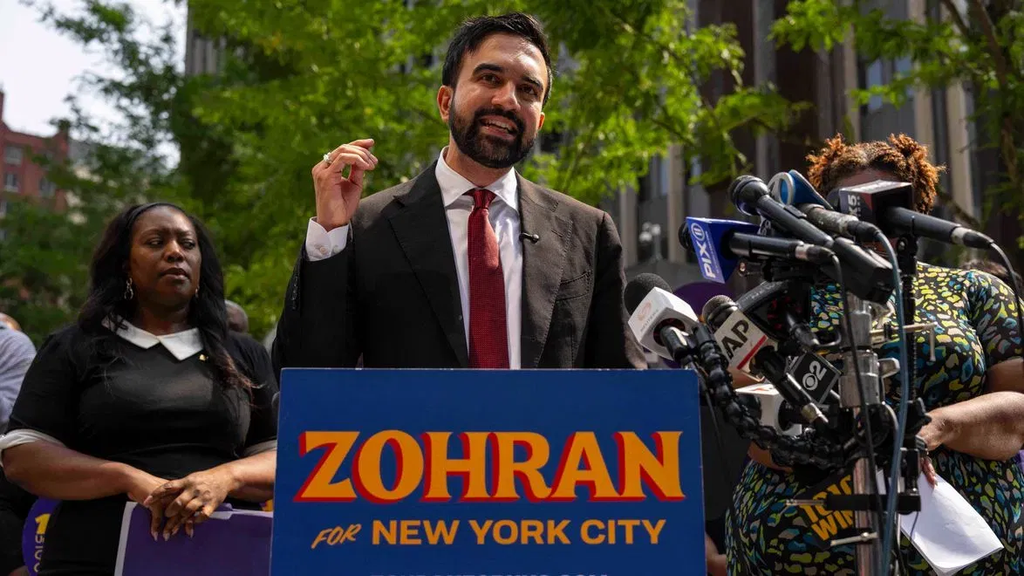
A grieving mother stranded thousands of miles away will finally be allowed to enter the United States to lay her young son to rest, following an unexpected intervention by the federal government. New York State Assembly Member Zohran Mamdani confirmed that Donald Trump agreed to grant an emergency humanitarian visa to the mother of a boy recently killed in a senseless Bronx shooting.
The announcement brings an emotional breakthrough to a heartbreaking saga that has gripped New York City for days. While the decision offers a measure of relief to a shattered family, it also highlights an unusual moment of cooperation between one of New York’s most outspoken progressive lawmakers and a federal administration known for rigid border policies.
The Tragic Afternoon That Shook the Bronx
The nightmare began on what should have been a normal afternoon in the Bronx. A young boy, known by neighbors and schoolmates for his bright spirit and infectious energy, was caught in sudden crossfire on a neighborhood street. Gunshots rang out without warning, sending pedestrians running for cover and leaving the child fatally wounded on the pavement.
Paramedics rushed the child to a nearby hospital, where medical staff worked tirelessly to save his life. Despite their efforts, the injuries were too severe, and he was pronounced dead shortly after arrival. The news sent shockwaves through the local community, sparking candlelight vigils, neighborhood gatherings, and renewed outrage over youth gun violence across the five boroughs.
In the days following the murder, local leaders and community members gathered outside the scene with flowers, candles, and handwritten notes. Yet, beneath the collective public grief lay an excruciating private agony: the boy’s biological mother was outside the country, stuck behind a wall of international borders and bureaucratic red tape.
The $0 Secret To Launching Your Entire Online Empire
Why pay hundreds every month for separate software? Build funnels, send emails, and make sales with Systeme.io completely free.
Get Started For $0Free Forever • No Credit Card Needed • Beginner-Friendly
Without direct authorization from the federal government, she faced the reality of missing her own child’s funeral.
A Mother Trapped by Distance and Bureaucracy
Losing a child is the deepest pain a parent can experience. Having to mourn that loss from across an ocean while waiting for government paperwork is an unimaginable ordeal.
Following the shooting, relatives living in New York quickly tried to bring the boy’s mother to the United States. They reached out to immigration lawyers, local advocates, and community groups to help navigate the system. However, the standard process for obtaining a visitor visa to the United States can take months, or even years, depending on the backlog at individual embassies and consulates.
In normal circumstances, applicants must wait for interview dates, submit extensive financial records, and prove strong ties to their home country to guarantee they will not overstay. For a mother whose primary wish was simply to touch her son’s casket and attend his memorial service, those standard procedures felt impossible.
The only viable option on the table was an emergency application for humanitarian parole or an expedited emergency visitor visa. These mechanisms exist to allow foreign nationals temporary entry into the United States under urgent, compelling circumstances. Even so, humanitarian applications are notoriously difficult to secure. Federal approvals are rare, discretion is tight, and thousands of requests are rejected every year.
With the funeral date rapidly approaching and mortuary costs mounting, the family had almost run out of time.
Zohran Mamdani Steps In to Break the Gridlock
Faced with a closing window, the family turned to New York State Assembly Member Zohran Mamdani for help. Mamdani, who represents the 36th District in Queens and has been an active voice in citywide grassroots organizing, immediately took up the cause.
Mamdani recognized that standard administrative appeals would move too slowly. Instead, he mobilized public attention and directly appealed to federal authorities, demanding that basic human decency supersede political battles. He worked closely with local organizers, faith leaders, and legal advocates to compile the necessary paperwork and elevate the case to the highest levels of the federal government.
Speaking to reporters and community supporters, Mamdani stressed that this issue was not about political affiliation or immigration debates. It was about allowing a mother to mourn her murdered child.
His office coordinated outreach to federal agencies, including the U.S. Department of State and the U.S. Citizenship and Immigration Services, insisting that an emergency humanitarian waiver be issued immediately so the mother could travel before the boy had to be buried.
The Unlikely Bridge: The Trump Administration Approves the Visa
The decisive turn in the case came when the request reached the desk of federal decision-makers. In an unexpected development, Donald Trump and his immigration officials reviewed the appeal and granted approval for the mother to travel to New York.
Mamdani publicly confirmed the decision, expressing profound gratitude on behalf of the family for the federal government’s swift action. For many observers, the approval came as a surprise given the political backdrop. Mamdani is a prominent democratic socialist with strong progressive stances, while Donald Trump has long championed hardline policies on immigration, border enforcement, and entry restrictions.
Yet, in this specific instance, the raw human tragedy of the situation superseded ideological divides. Federal authorities recognized the acute humanitarian nature of the request, clearing the administrative hurdles that had kept the mother stranded.
The expedited clearance means the mother can board a flight, travel directly to New York City, and stand beside her family during the memorial services and burial.
How Humanitarian Visas and Parole Function Under US Law
The legal mechanism used in cases like this provides an important window into how the federal government handles life-or-death travel requests.
Send, Spend & Hold Money Worldwide Without Hidden Fees
Transfer money internationally at the real exchange rate and hold 40+ currencies in one account.
Open a Wise AccountMid-market rate • Fast transfers • 40+ currencies
Under United States immigration law, the federal government possesses discretionary authority to grant temporary entry to foreign citizens who would otherwise be inadmissible. This is primarily done through two channels: an expedited emergency nonimmigrant visa or humanitarian parole.
Expedited Emergency Nonimmigrant Visas
When an individual needs to travel urgently for an unexpected event, such as a sudden death or a critical medical emergency, they can request an expedited appointment through the relevant U.S. embassy.
To qualify, applicants must provide:
- Official documentation proving the nature of the emergency, such as a death certificate, police report, or letter from a licensed physician.
- Proof of relationship to the deceased or hospitalized family member.
- Standard travel documentation, including a valid passport.
Even when an expedited interview is granted, consular officers hold sole discretion to approve or deny the visa based on federal guidelines.
Humanitarian Parole
Humanitarian parole is a separate process handled by the Department of Homeland Security. It is strictly used to bring someone who is otherwise ineligible for a visa into the United States for a temporary period due to an urgent humanitarian reason or significant public benefit.
Parole is not a permanent immigration status. It does not provide a path to permanent residency or citizenship. It merely acts as a temporary permission slip to enter the country, remain for the duration of the crisis, and depart once the authorized period concludes. In high-profile bereavement cases, parole grants family members the legal protection to mourn without fear of detention or immediate deportation.
Because the bar for humanitarian parole is exceptionally high, intervention from elected officials like Mamdani often plays a critical role in bringing relevant files directly before senior directors.
The Reality of Gun Violence in Bronx Neighborhoods
While the visa approval provides a path toward personal closure for one family, it also puts a harsh spotlight on the persistent issue of street violence in the Bronx.
For decades, Bronx communities have wrestled with illegal firearms moving through interstate pipelines. Grassroots organizations and violence interruption teams work around the clock to mediate neighborhood disputes and mentor young people. However, when gunfire erupts in crowded public corridors, children and innocent bystanders often pay the highest price.
Community advocates across New York have pointed out that while securing a visa for a grieving mother is an act of basic compassion, true justice lies in preventing these shootings from happening in the first place.
The $0 Secret To Launching Your Entire Online Empire
Why pay hundreds every month for separate software? Build funnels, send emails, and make sales with Systeme.io completely free.
Get Started For $0Free Forever • No Credit Card Needed • Beginner-Friendly
Local residents are demanding stronger public safety investments that combine responsible policing with deep community-level funding for after-school programs, mental health support, and job training for at-risk youth. The goal is to ensure that no more parents have to face the agony of burying their children.
Community Solidarity: New York Rallies Behind the Family
In the wake of the shooting, community members, local businesses, and mutual aid groups stepped up to support the boy’s relatives.
Crowdfunding efforts were launched to cover funeral costs, international travel arrangements, and basic living expenses for the family while they step away from work to grieve. Neighborhood churches and community centers opened their doors to host prayer sessions, giving neighbors a dedicated space to process their sorrow and express solidarity.
This response reflects a long-standing tradition in working-class New York neighborhoods. When disaster strikes, communities lean on one another. The collaboration between local activists, state representatives, and everyday neighbors was central to keeping pressure on federal authorities until the travel paperwork was signed.
Members of the local community have also organized peaceful walks through the neighborhood to honor the boy’s memory and demand safer streets for all children growing up in the area.
The Intersection of Compassion and Politics
This development stands out as a rare moment where bitter partisan divisions took a back seat to family compassion.
In a political environment where immigration debates often devolve into rigid talking points, the swift approval of this emergency visa demonstrates that human dignity can still prevail. The fact that an appeal initiated by a progressive state lawmaker was honored by federal officials under Donald Trump shows that direct advocacy, grounded in clear moral urgency, can yield meaningful results.
Political observers in New York noted that this outcome highlights the essential duty of elected officials: serving their constituents during moments of profound vulnerability. When bureaucratic systems stall, direct political advocacy remains one of the few tools capable of breaking through federal gridlock.
Frequently Asked Questions
Why did the mother need an emergency visa to enter the United States?
The mother lived outside the United States and did not hold an active American visa or travel authorization. Because standard visitor visa wait times can stretch across several months, she required an expedited emergency humanitarian visa or parole to travel in time for her son’s funeral.
Who is Zohran Mamdani and what role did he play in the case?
Zohran Mamdani is a New York State Assembly Member representing Astoria, Queens. After the family reached out for assistance, Mamdani championed their cause, using his platform to contact federal immigration agencies and publicly advocate for an emergency travel waiver.
Why was Donald Trump’s involvement significant?
The decision drew significant public attention because Donald Trump and his administration are widely recognized for enforcing strict border and immigration restrictions. The approval of an emergency visa based on an appeal from a progressive lawmaker represents a rare moment of cross-ideological agreement for a humanitarian cause.
What is the difference between an emergency visa and humanitarian parole?
An emergency visa is an expedited standard nonimmigrant visa processed through a U.S. embassy for urgent travel. Humanitarian parole is a special discretionary permission granted by the Department of Homeland Security allowing someone without a valid visa to enter the country temporarily for urgent humanitarian reasons.
Does a humanitarian visa grant permanent residency?
No. Humanitarian visas and humanitarian parole are strictly temporary measures. They allow an individual to enter the country for a specific emergency, such as a funeral or medical procedure, and require the individual to return to their home country once the authorized stay expires.
How can other families apply for emergency travel permission in similar situations?
Families experiencing an urgent crisis can request an expedited visa appointment through their local U.S. Embassy portal or submit an application for Humanitarian Parole through U.S. Citizenship and Immigration Services. Both pathways require comprehensive documentation, such as death certificates, hospital records, and proof of immediate familial ties.
The arrival of the boy’s mother will not erase the tragedy that unfolded on that Bronx sidewalk, nor will it undo the trauma inflicted on an entire community. However, it ensures that an 11-year-old child will not be laid to rest without his mother by his side. In a situation marked by profound loss, the joint efforts of community members, local representatives, and federal authorities provided an essential act of mercy when it was needed most.
