
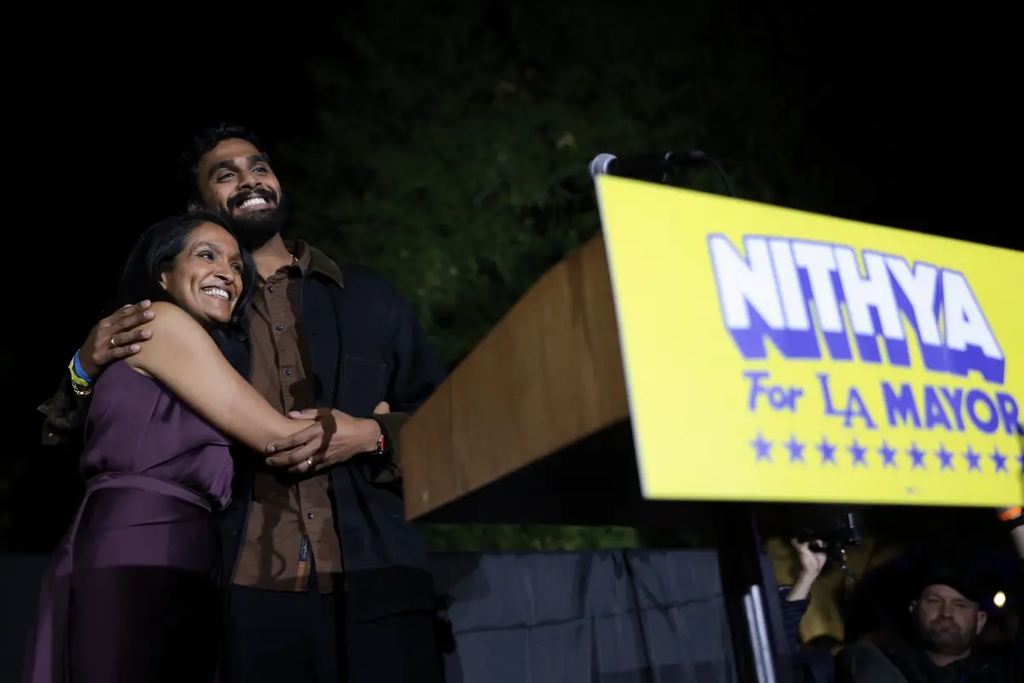
The race for City Hall in Los Angeles just took an unbelievable turn. Progressive city councilmember Nithya Raman continues to widen her lead over incumbent Mayor Karen Bass as ballot counting advances across Los Angeles County. What many political observers predicted would be a hard-fought, down-to-the-wire reelection battle for Mayor Bass is quickly turning into an unmistakable mandate for generational change.
Vote updates released by election officials show Raman pulling ahead with steady, late-counted ballot momentum. In election night rooms and neighborhood gatherings from Silver Lake to the San Fernando Valley, the energy has shifted dramatically. While Raman has remained cautious—urging supporters at the Greek Theatre to stay calm while the county registrar finishes processing every vote—election models and race observers now project that she is on the brink of becoming the next mayor of Los Angeles.
Understanding how Raman pulled this off requires examining what went wrong for the incumbent, how Los Angeles voters reached their breaking point, and what this power shift means for the future of America’s second-largest city.
The Ballot Count: How Raman Built Unstoppable Momentum
In Los Angeles elections, late-counted vote-by-mail ballots traditionally lean younger, more renter-heavy, and distinctly progressive. Raman’s campaign counted on that exact dynamic, and the numbers are proving their ground game right.
Early returns on election night initially suggested a tighter margin. However, as day-after batches rolled in from across the city, Raman expanded her edge from a modest lead into a comfortable cushion. Analytical desks, including Decision Desk HQ, moved to call the outcome in Raman’s favor as the remaining universe of uncounted mail-in ballots heavily favored her strongholds.
The $0 Secret To Launching Your Entire Online Empire
Why pay hundreds every month for separate software? Build funnels, send emails, and make sales with Systeme.io completely free.
Get Started For $0Free Forever • No Credit Card Needed • Beginner-Friendly
Raman built her coalition by winning overwhelming margins among young voters, renters, working-class families, and grassroots civic organizers. Meanwhile, Bass struggled to hit the turnout numbers she needed in her traditional base across South Los Angeles and the Westside.
The shift mirrors wider political changes happening across the Golden State. Voters are signaling deep exhaustion with the status quo, demanding leaders who address everyday affordability rather than relying on legacy name recognition. It is a trend visible in recent state-level debates, including how California just blocked Trump Gavin Newsom signs shocking election laws right before midterms to respond directly to changing voter expectations.
Why Karen Bass Lost Her Grip on City Hall
When Karen Bass took the oath of office in late 2022, she arrived with immense goodwill. She was a seasoned organizer, a former state Assembly speaker, and a respected veteran member of the U.S. House of Representatives. She ran on a promise to declare an emergency on homelessness from day one and clean up the streets through her flagship “Inside Safe” program.
Four years later, the realities of governing a city as sprawling and complex as Los Angeles caught up with her.
1. Homelessness and Street Conditions Remained Intractable
Bass staked her entire mayoralty on visible progress with homelessness. While her administration spent hundreds of millions of dollars moving thousands of unhoused people into temporary hotel and motel rooms, permanent housing solutions moved at an agonizing pace. Encampments often returned to the same street corners weeks after cleanups. Voters grew tired of massive spending that produced little visible difference on the sidewalk.
2. The Unaffordable Cost of Living
Los Angeles has become unaffordable for ordinary workers, teachers, and creatives. Rent consumes more than half of an average paycheck for a majority of Angelenos, and buying a house has drifted out of reach for anyone without extreme wealth. The reality that you need to make $228,000 just to buy an average home in California and 81% of us cannot became a central grievance during this election cycle. Raman successfully argued that Bass moved too slowly to protect renters and failed to build the high volume of public, deed-restricted affordable housing the city needs.
3. Crisis Management and the Fire Season Fallout
Voters also weighed how City Hall reacted to disasters and basic municipal services. The administration’s response to devastating seasonal wildfires, severe weather emergencies, and urban safety concerns drew steady criticism from both neighborhood groups and business associations. Disasters in Southern California—such as when the Norte fire scorches over 570 acres in Southern California—continually highlighted gaps in infrastructure readiness and emergency management that left residents feeling unprotected.
4. Backlash Over Police Budgets and Traditional Politics
Bass tried to build a middle-of-the-road governing coalition. She raised the Los Angeles Police Department budget and pushed to recruit more officers to reassure conservative homeowners and business leaders. Instead of solidifying her support, this move alienated progressive activists and civil rights organizers who had knocked on doors for her in 2022. When police unions and real estate interests poured millions of dollars into attacks against Raman, it backfired by rallying grass-roots enthusiasm squarely behind the challenger.
Who Is Nithya Raman? The Urban Planner Making History
Nithya Raman is not your conventional municipal politician. Born in Kerala, India, she moved to the United States as a young child and grew up dedicated to community planning. She studied at Harvard University before earning a master’s degree in urban planning from the Massachusetts Institute of Technology.
Before running for office, Raman worked inside city planning circles and organized neighborhood homelessness outreach groups in the Hollywood Hills and Silver Lake. In 2020, she shook City Hall by defeating an entrenched incumbent councilmember, becoming the first progressive insurgent to take a council seat in nearly two decades.
Her victory now carries major historical significance:
- She is positioned to become the first Indian-origin mayor of Los Angeles.
- She brings an academic background in urban planning directly to the chief executive office at City Hall.
- She represents an unapologetic break from traditional corporate-backed municipal politics.
Raman’s campaign ran modern, culturally sharp outreach that connected directly with working-class Angelenos. From informal pop-up discussions and bike rides through city neighborhoods to direct discussions about tenant rights, Raman presented herself not as a distant politician, but as a resident facing the same city challenges as everyone else.
What Changes for Los Angeles Under Mayor Raman?
A Raman administration will rethink how City Hall allocates its budget and handles long-term planning. Angelenos should anticipate immediate shifts in three primary areas:
Overhauling the Approach to Housing and Homelessness
Instead of relying on costly hotel vouchers and sweeps, Raman wants to direct resources into social housing, rapid construction of permanent units, and expanded legal defense funds for tenants facing eviction. Her MIT urban planning background means zoning reforms and speeding up city permitting for multi-family affordable developments will take center stage.
Reimagining Public Safety and City Services
Raman’s platform calls for expanding non-police emergency response units, such as mental health crisis teams and unarmed traffic workers. Her goal is to free up sworn officers to concentrate on serious, violent crimes while handling community disputes with trained social workers.
Send, Spend & Hold Money Worldwide Without Hidden Fees
Transfer money internationally at the real exchange rate and hold 40+ currencies in one account.
Open a Wise AccountMid-market rate • Fast transfers • 40+ currencies
Modern Public Transit and Walkable Neighborhoods
Raman is a strong advocate for public transit, protected bike lanes, and pedestrian safety. With Los Angeles preparing to host major global sporting events, including the upcoming Olympic and Paralympic Games, Raman wants to accelerate transit expansion to break the city’s dependence on car traffic and ease gridlock.
Frequently Asked Questions (FAQs)
Who won the Los Angeles mayoral election?
Nithya Raman holds a decisive lead over incumbent Mayor Karen Bass, with major election analysts projecting her victory as county ballot counting nears completion.
Why did Karen Bass lose her reelection bid?
Voters expressed deep frustration over slow progress on homelessness, rising housing and rental costs, and ongoing concerns about public safety and city services, leading to a surge of support for Raman’s progressive, planning-centered platform.
What is Nithya Raman’s professional background?
Raman earned her bachelor’s degree from Harvard and a master’s in urban planning from MIT. She worked as an urban planner, homelessness advocate, and was elected to the Los Angeles City Council representing District 4 in 2020.
When will the next mayor take office?
Once the Los Angeles County Registrar-Recorder/County Clerk certifies the official election results, the winner will take the oath of office in December to begin a four-year mayoral term.
The shift at Los Angeles City Hall signals a transformative chapter for local governance. Angelenos sent a definitive message at the ballot box that temporary fixes and conventional political alliances are no longer enough to solve the city’s deepest challenges. As Raman prepares to take the lead, the entire country will be watching to see if her community-first urban planning approach can turn the city around.
