
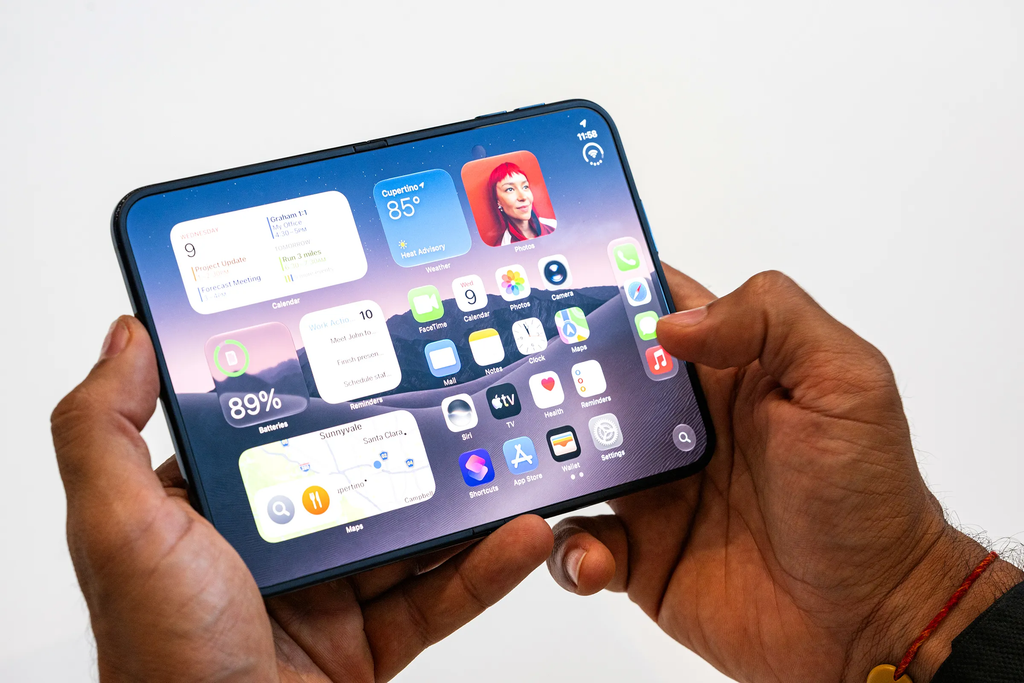
Apple has officially put an end to years of internet rumors, concept renders, and waiting games. The company’s very first foldable smartphone, the iPhone Duo, has arrived in retail stores worldwide. After watching competitors like Samsung and Google push several generations of foldables into the market, Apple took its time to enter the arena. Now that customers can walk into stores and hold one, the massive question is clear: has Apple solved the big annoyances that have kept regular people away from folding phones, or is this just an ultra-expensive party trick?
The tech world has been buzzing nonstop since pre-orders opened, but touching the hardware in person changes the conversation completely. From the feel of the hinge to the look of the crease and the real-world battery life, here is an honest, straightforward breakdown of everything the iPhone Duo brings to the table, what it gets right, and whether it makes sense for your wallet.
What Exactly Is the iPhone Duo?
The iPhone Duo is Apple’s first book-style folding smartphone. Unlike clamshell flip phones that snap down into tiny squares, the Duo closes like a small passport and opens up into a mini tablet.
When closed, you interact with an external 5.4-inch Super Retina XDR cover display. It looks and behaves like a compact iPhone. You can text, take quick phone calls, check notifications, scroll through social feeds, or snap photos without opening the device.
When you unfold it, the device reveals a 7.6-inch flexible OLED display. This inner screen gives you the screen real estate of a small iPad, letting you run two full-sized apps side-by-side, read documents, watch widescreen videos, or edit photos with plenty of breathing room.
The $0 Secret To Launching Your Entire Online Empire
Why pay hundreds every month for separate software? Build funnels, send emails, and make sales with Systeme.io completely free.
Get Started For $0Free Forever • No Credit Card Needed • Beginner-Friendly
For quick updates and community discussions on trending tech releases, you can check out Whatsbuzzn on Facebook and join the conversation on X.
Design, Hardware, and That Famous Screen Crease
The number one complaint people have had about folding phones for years is the middle crease. It is the visible dip down the center where the screen bends in half. Many people also worry about soft plastic screen protectors getting dented by fingernails.
Apple approached this design problem with a new mechanical hinge and a custom display finish.
The Display and the Near-Invisible Crease
Apple engineered the inner screen using a custom teardrop hinge mechanism paired with an ultra-thin glass layer and a nano-texture coating.
When looking directly at the opened 7.6-inch panel, the crease is almost impossible to spot. If you turn the screen sideways under harsh fluorescent retail lights, you can see a slight wave, but running your finger across it feels significantly smoother than older folding handsets.
Both displays run on Apple’s ProMotion technology, meaning they refresh dynamically up to 120Hz. Everything looks butter-smooth, whether you are swiping through menus or reading long web articles. Both panels also reach up to 3,000 nits of peak brightness outdoors, so you will have no trouble reading your screen in direct sunlight.
Build Quality and Everyday Pocket Feel
Holding the iPhone Duo closed feels surprising. It measures only 11.3 mm thick when shut, and opens out to an ultra-lean 5.2 mm profile. In comparison to thick, brick-like foldables from past years, the Duo slips easily into average jeans pockets.
The frame is crafted from Grade 5 titanium, keeping the overall weight around 254 grams. While it is heavier than a standard base iPhone, it is surprisingly close in weight to larger flagship phones like the Pro Max tier. The device comes finished in two understated colors: Night Sky and Star White.
For full technical specifications directly from the manufacturer, review the official Apple Newsroom iPhone Duo Announcement.
Power and Performance: The A20 Pro Chip
Under the hood, the iPhone Duo runs on Apple’s flagship A20 Pro processor, built on an ultra-dense 2-nanometer architecture. Driving two separate screens—one of which has a large tablet resolution—requires serious graphical muscle, and the A20 Pro handles it effortlessly.
Apple paired the processor with 12GB of unified RAM across all storage tiers (256GB, 512GB, 1TB, and 2TB). This bump in memory is crucial because foldables are built for multitasking. Switching back and forth between demanding apps, photo editing tools, and background browser tabs happens without any lag or app reloads.
A built-in vapor chamber cooling system keeps the titanium chassis from getting uncomfortably warm during heavy work sessions or extended video streaming.
Software Magic: How iOS 27 Adapts to the Fold
Hardware is only half the battle when making a folding phone. If the software is clunky, the extra screen size is useless. The Duo launches with iOS 27.1, which introduces specialized software mechanics designed specifically for this new shape.
Side-by-Side Split Screen
For the first time on an iPhone, you can use true side-by-side multitasking. You can open Safari on the left side of the screen while taking notes on the right. You can drag a photo directly out of your camera roll and drop it straight into an email or a messaging app.
You can also save “App Pairs.” If you frequently use your banking app alongside a spreadsheet, you can tap one icon on your home screen to launch both apps instantly side by side.
Send, Spend & Hold Money Worldwide Without Hidden Fees
Transfer money internationally at the real exchange rate and hold 40+ currencies in one account.
Open a Wise AccountMid-market rate • Fast transfers • 40+ currencies
Flex Mode and Standby
The hinge holds firm at various angles between 45 and 135 degrees. When you fold the phone halfway and place it down on a table:
- The top half displays your media, video call, or document.
- The bottom half automatically turns into an ergonomic typing keyboard, a trackpad, or media playback controls.
When you place the folded phone on your bedside table or work desk, it triggers a custom Standby mode showing your calendar, clocks, and live tracking widgets.
Siri AI and Contextual Help
iOS 27 brings a major step forward for Apple’s voice assistant, integrating on-device intelligence that can see what is on your screen. If you are looking at a restaurant menu or a flight confirmation on the big screen, you can ask Siri to summarize details or add reminders straight into your calendar without typing anything.
Cameras: Big Upgrades with a Different Approach
Foldable phones often make compromises on camera hardware due to thin internal spacing. Apple took an interesting path with the Duo’s camera system.
The Rear Camera Setup
On the back, you get a dual-lens 48-megapixel camera layout:
- 48MP Main Fusion Camera: Features a large sensor, sensor-shift optical image stabilization, and built-in 2x optical zoom crops.
- 48MP Ultra-Wide Camera: Offers a wide 120-degree field of view along with macro capability for close-up shots.
Photos taken with the main lens look sharp, vibrant, and natural. Night mode photos capture clean shadows without washing out street lamps or skin tones.
Outer Display Mirroring for Selfies
Because the phone has an exterior screen, you do not have to settle for small selfie lenses when taking high-quality portraits. You can open the camera, enable “Duo Preview,” turn the phone around, and use the flagship 48MP main sensor to take selfies or record 4K video while framing yourself perfectly on the cover screen.
If you are taking photos of friends or children, the outer display can show a live preview so they can check their hair and pose, or it can display small animated icons (called “Kid Cue”) to grab a toddler’s attention right before the shutter clicks.
The Under-Screen FaceTime Lens
On the inner 7.6-inch screen, Apple eliminated punch-hole cutouts and notches by hiding the FaceTime camera completely underneath the display glass. When you are reading, playing games, or watching movies, the display pixels cover the camera completely.
When a video call starts, those pixels turn off instantly to let light into the lens. It is tuned for casual FaceTime and conference meetings, while the exterior cover camera handles high-definition video calls.
The $0 Secret To Launching Your Entire Online Empire
Why pay hundreds every month for separate software? Build funnels, send emails, and make sales with Systeme.io completely free.
Get Started For $0Free Forever • No Credit Card Needed • Beginner-Friendly
To stay on top of quick camera tests and real-world gadget reviews, keep up with Whatsbuzzn on Instagram.
Battery Life and Everyday Charging
Folding phones feature two large screens that require significant power. Apple solved this with a split dual-battery layout packing an estimated 4,883 mAh capacity.
Under mixed real-world testing—using the outer screen for messaging and quick tasks during work hours, and unfolding the large screen in the evening for videos and web reading—the Duo easily delivers a full 24-hour day of regular use.
When it comes to charging:
- Wired Fast Charging: Delivers up to a 50% charge in about 20 minutes when plugged into a 30W or higher power brick.
- Wireless Charging: Supports MagSafe and Qi2 magnetic wireless charging, getting you to 50% in roughly 30 minutes.
One detail to keep in mind: the iPhone Duo is eSIM-only worldwide. Apple removed the physical SIM card slot completely to maximize internal space for cooling and battery capacity. If your carrier does not support eSIM yet, you will need to switch to an eSIM plan before setting up this device.
For a deeper technical dive into device tear-downs, cellular bands, and global certifications, visit GSMArena iPhone Duo Specifications.
The Price: How Much Does the iPhone Duo Cost?
There is no sugarcoating it: the iPhone Duo is a true luxury item.
- 256GB: $1,999
- 512GB: $2,199
- 1TB: $2,399
- 2TB: $2,599
In international markets, taxes and import fees push the price even higher. In the UK, it starts at £1,999. In Europe, pricing starts around €2,299. In India, early reports put the starting price around ₹2,99,900.
Because of the steep retail price, carrier trade-in deals and financing programs will be the primary route most consumers take to buy this phone. Handing in an iPhone 15 Pro, iPhone 16 Pro, or iPhone 17 Pro can slash anywhere from $800 to $1,000 off the total balance over a standard 36-month plan.
Pros and Cons: A Quick Honest Look
What We Love
- Brilliant display hinge: The nano-texture finish and teardrop hinge make the screen crease almost completely disappear during regular viewing.
- Compact when closed: At just 11.3 mm thick, it does not feel like you are carrying two glued-together smartphones.
- Smooth multi-window software: iOS 27 makes running two applications simultaneously intuitive and fast.
- Fast performance: The 2nm A20 Pro chip and 12GB RAM handle heavy tasks without stuttering.
- Strong water and dust resistance: An IP68 durability rating offers real peace of mind against splashes, spills, and dust particles.
What Could Be Better
- Very high price tag: Starting at $1,999, it costs as much as a top-tier MacBook Pro or a phone and an iPad combined.
- No dedicated optical periscope zoom: You get a 2x sensor crop rather than a dedicated 5x telephoto glass lens found on the Pro Max.
- Side Touch ID instead of Face ID: To keep the bezel around the folding display razor-thin, biometric unlocking is handled by a fingerprint sensor built into the side power button rather than 3D Face ID.
- No physical SIM tray: You must use an active eSIM.
Frequently Asked Questions (FAQs)
Does the iPhone Duo work with the Apple Pencil?
The inner 7.6-inch display features stylus support, and Apple is rolling out compatibility for a compact Apple Pencil model designed specifically for the foldable lineup. However, the phone does not have an internal slot to store a pencil, meaning you will need a case with an integrated pen holder if you plan to sketch on the go.
Is the iPhone Duo waterproof?
The iPhone Duo carries an official IP68 rating. This means it is tested to withstand everyday dust exposure as well as submersion in freshwater up to 6 meters deep for up to 30 minutes. While you shouldn’t take it diving in saltwater pools, you do not need to panic if it gets caught in heavy rain or accidental sink spills.
Can I run three apps at once on the inner screen?
iOS 27.1 focuses strictly on two-app side-by-side multitasking to maintain high readability and smooth performance. While you cannot tile three or four app windows across the display, you can open a third app inside a temporary floating Quick Note or use Picture-in-Picture for video playback while two apps remain active underneath.
Is the screen fragile?
The outer cover display is protected by Ceramic Shield 2 glass, which holds up exceptionally well against everyday drops and scratches. The inner folding panel uses ultra-thin flexible glass topped with a protective nano-texture layer. While it is far more durable than early foldables from five years ago, you should still avoid pressing sharp objects or fingernails aggressively into the surface.
Does the phone have Face ID?
No. The iPhone Duo uses a fast, secure Touch ID fingerprint sensor embedded directly into the side power button. You can also unlock the device automatically if you are wearing an authenticated Apple Watch.
The iPhone Duo represents Apple’s biggest hardware shift in nearly a decade. It bridges the gap between a portable pocket phone and a productivity tablet without making the device feel clumsy or unfinished. The near-invisible crease, lightweight titanium frame, and smooth iOS multitasking make it one of the most polished folding devices to hit retail shelves.
At $1,999, it is not a casual impulse purchase, and anyone who prefers simple one-handed phones will likely stick with standard models. But for mobile professionals, avid readers, and tech enthusiasts who want tablet productivity tucked neatly inside their pocket, the wait for Apple’s foldable era was well worth it.
