
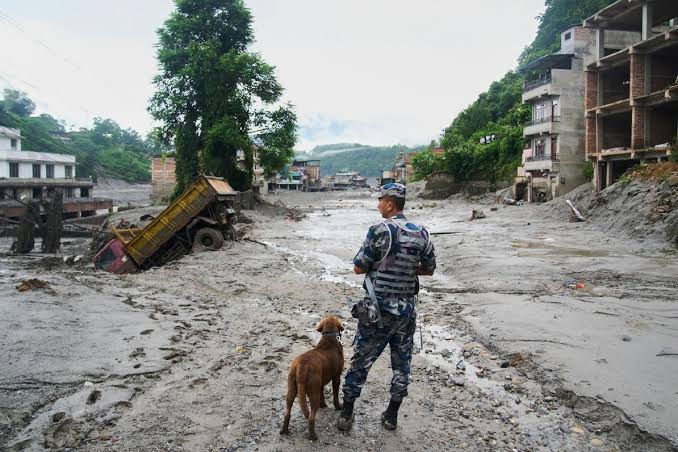
Search and rescue teams in Nepal and China have resumed emergency operations along their shared mountain border after a dangerous barrier lake began to stabilize. The immediate threat of a second massive wave of water has temporarily eased, giving rescue crews a critical window to look for survivors buried under thick mud and heavy debris.
The tragedy began when a sudden glacier collapse high in the Himalayas triggered catastrophic flash floods and landslides. The resulting torrent of water, mud, and rocks tore through mountain villages, swept away key roads, and destroyed vital border post infrastructure.
The combined death toll across both countries has now passed 500 people, with officials warning that the number could rise significantly in the coming days. More than 1,000 people remain missing, including hundreds of local residents, hydropower plant workers, and international tourists who were visiting the popular mountain region.
Emergency responders are working in extremely difficult conditions. Broken communications, destroyed bridges, and unstable mountain slopes are making every step of the rescue mission dangerous and slow.
How the Glacial Collapse Triggered the Deadly Wave
The disaster struck without warning when a massive section of a Himalayan glacier gave way. Experts believe that a mixture of ice, rock, and loose earth collapsed high up in the mountains, possibly triggered by recent weather changes or underground movement.
The $0 Secret To Launching Your Entire Online Empire
Why pay hundreds every month for separate software? Build funnels, send emails, and make sales with Systeme.io completely free.
Get Started For $0Free Forever • No Credit Card Needed • Beginner-Friendly
When the glacier broke apart, it poured millions of tons of ice and debris directly into local river valleys. As the water surged down the narrow mountain channels, it gathered momentum and picked up trees, boulders, and soil along the way.
Reports indicate that the wall of water reached heights of up to 15 meters as it moved downstream at speeds close to 200 kilometers per hour. People living in nearby towns had only minutes to run for higher ground as the roaring wave crashed into their homes.
The sudden movement of water overwhelmed local river systems, including the Bhotekoshi and Trishuli rivers. Entire communities along the riverbanks were flooded within moments, leaving little time for formal warnings or organized evacuations.
Understanding extreme weather events and natural hazards has become a major focus for researchers worldwide. Today, many scientific teams rely on early warning networks and modern tracking systems to monitor glacier stability, a topic closely linked to developments in technology and AI that help map environmental risks from space.
The Barrier Lake Scare That Paused Rescue Work
Rescue operations ran into a dangerous complication when a massive slide of rocks and mud blocked the main river channel, creating an artificial dam. Water quickly began pooling behind this natural wall, forming what scientists call a barrier lake.
Within 24 hours, the lake trapped an estimated two million cubic meters of water. Environmental experts warned that if the mud wall gave way all at once, it would release another destructive tsunami of water down the valley, putting rescue crews and survivors in immediate danger.
Because of this threat, authorities on both sides of the border ordered search teams to stop work and move to higher ground. In parts of Nepal’s Rasuwa and Nuwakot districts, residents who had just returned to search for missing family members were told to evacuate again right away.
On the Chinese side in Tibet, rescue vehicles and military personnel were temporarily pulled back while hydrological engineers surveyed the lake using drones and aerial sensors. Water levels continued to rise, and state media reported that the lake began spilling over its top edge.
Fortunately, the overflowing water did not cause the entire dam to collapse instantly. Instead, water began trickling out in a steady stream, reducing the pressure behind the blockage. Once the immediate risk of a sudden burst lowered, command centers authorized emergency teams to return to the disaster site.
According to reports from Al Jazeera, weather forecasts still predict additional rainfall in the mountain catchment area. This means the barrier lake remains under constant monitoring, as any new rain could push water levels back into the danger zone.
Heavy Toll on Human Lives and Missing Tourists
The human loss caused by the flood is staggering. More than 500 deaths have been confirmed so far, with the vast majority recorded in Nepal’s northern mountain districts. On the Chinese side of the border in Tibet’s Gyirong County, authorities have confirmed multiple fatalities while hundreds remain uncontactable.
One of the most concerning aspects of this disaster is the huge number of missing foreign nationals. The border area between Kathmandu and Lhasa is a famous international travel corridor. It attracts thousands of mountain trekkers, nature lovers, and religious pilgrims every year.
More than 500 foreign citizens are currently reported missing in Nepal alone. Government reports indicate that the missing list includes:
- Over 280 citizens from India, many of whom were pilgrims traveling on the Kailash Mansarovar Yatra.
- Around 90 travelers from the United States.
- Over 30 tourists from Australia.
- Dozens of visitors from the United Kingdom, Canada, and several European nations.
In Tibet, Chinese authorities reported that more than 250 foreign visitors were among the missing population in Gyirong County. Families around the world are waiting anxiously for news as phone networks in the mountains remain completely down.
Embassy staff from several countries have set up emergency contact points in Kathmandu to assist families trying to trace their loved ones. However, verifying names and locations is moving slowly because many small villages in the flood zone have been entirely cut off from the outside world.
Send, Spend & Hold Money Worldwide Without Hidden Fees
Transfer money internationally at the real exchange rate and hold 40+ currencies in one account.
Open a Wise AccountMid-market rate • Fast transfers • 40+ currencies
Trapped in the Dark: The Tunnel Rescue Operation
One of the most dramatic rescue efforts took place deep inside a mountain at the Upper Trishuli-1 Hydropower Project. When the flash flood hit the valley, millions of gallons of water and thick mud poured into the entrance of the hydro station’s underground tunnels.
Approximately 100 workers were stuck inside the dark tunnel complex. Heavy mud covered both the entry and exit points, sealing off air shafts and cutting off power to the facility.
Nepali military personnel and specialized rescue workers arrived at the site by helicopter. Using heavy earth-moving equipment, shovels, and bare hands, rescue crews worked through the night to clear tonnes of wet mud blocking the main tunnel doorway.
After hours of intense labor, emergency teams managed to breach the mud wall and reach the trapped workers. Soldiers successfully brought out scores of workers who had survived in the dark for over two days.
Many of the rescued workers suffered from hypothermia, shock, and minor injuries. They were given immediate medical care at field posts before being flown to larger medical facilities. Search crews are still checking secondary shafts to make sure no other staff members remain trapped underground.
Destruction of Border Posts, Bridges, and Roads
The sheer power of the water left whole towns in ruins. The historic Nepal-China Friendship Bridge, which connects the two nations and carries millions of dollars in daily trade, was completely washed away by the torrent.
At the Gyirong Port border crossing, satellite images published by Reuters show widespread destruction. The floodwaters destroyed customs inspection buildings, immigration offices, police compounds, and residential quarters for border staff. Concrete structures were broken into pieces, while vehicles were swept miles down the river.
In Nepal’s Nuwakot district, the riverfront town of Bidur suffered massive damage. Important buildings, including government offices, commercial bank branches, and local markets, were reduced to mud-soaked rubble.
Transportation through the region has ground to a complete halt. More than 40 kilometers of mountain roads have been erased or buried under massive rockslides. Dozens of smaller concrete and wooden bridges that connect remote villages to main highways no longer exist.
With ground access blocked, helicopters are the only way to move people and supplies. Military aircraft are landing every few minutes at makeshift helipads, dropping off rice, clean drinking water, and blankets, while carrying injured victims back to hospitals in Kathmandu.
The $0 Secret To Launching Your Entire Online Empire
Why pay hundreds every month for separate software? Build funnels, send emails, and make sales with Systeme.io completely free.
Get Started For $0Free Forever • No Credit Card Needed • Beginner-Friendly
International Offers of Aid and Local Rescue Efforts
As news of the disaster spread, governments around the world offered immediate help. Countries including India, the United States, China, the United Kingdom, Japan, South Korea, Sri Lanka, and Bangladesh expressed their solidarity and offered to send specialized search-and-rescue teams.
Nepal’s government expressed gratitude for the international support but clarified its current plan. Foreign Ministry officials explained that local military and police agencies have deployed over 30,000 security personnel to handle the physical search operations.
Local authorities noted that having too many foreign ground units in tight mountain passes could create traffic and logistics problems while roads are closed. Instead of foreign rescue teams, Nepal has requested financial support, medical supplies, and long-term recovery aid to help rebuild destroyed communities.
In modern times, public awareness about natural disasters relies heavily on fast digital communication. Independent journalists, online news publishers, and digital content creators play a vital role in sharing real-time updates and emergency relief links. Many digital media operations use specialized systems similar to techniques learned in YouTube automation to publish video updates rapidly during major global news events.
Why Himalayan Glaciers Are Becoming More Unstable
This catastrophe has once again put the spotlight on the environmental fragility of the Himalayan mountain range. Climate experts have long warned that rising global temperatures are melting glaciers in high-altitude regions at an unprecedented rate.
When glaciers melt rapidly, water collects in large pools behind natural dams made of loose rock and ice. These structures are far less stable than man-made concrete dams. A small earth tremor, heavy rainstorm, or falling rock can cause the natural wall to break, resulting in a Glacial Lake Outburst Flood.
Researchers from international mountain organizations note that events like this are no longer isolated incidents. Over the past decade, the Himalayas have experienced several severe flash floods caused by glacier collapses and sudden cloudbursts.
Local residents in mountain valleys are paying the highest price for these environmental changes. Without improved monitoring systems, better road infrastructure, and early warning sirens, communities living near glacier rivers remain at risk whenever extreme weather strikes.
Personal Stories of Loss and Survival
Behind the rising numbers and disaster reports are heartbreaking stories of ordinary people caught in a sudden tragedy. Survivors at emergency relief camps have described moments of pure terror as the floodwaters reached their homes.
At the Bidur military camp, families gathered outside medical tents hoping for news about missing relatives. Many survivors lost everything they owned in a matter of minutes.
One local resident shared how he was working in his garden when he heard a noise that sounded like thunder coming down the mountain. Within seconds, water began filling the street. He grabbed his young daughter and ran up the hillside, watching helplessly as the flood swept away his house and small store.
At hospitals in Kathmandu, crowds of people stood outside waiting rooms to check survivor lists. Relatives of foreign tourists have also traveled to the capital to work with local rescue agencies and embassies, holding onto hope that their missing family members were simply stranded in areas without mobile phone service.
The Long Road to Recovery
Even as search crews continue to search through the mud, attention is beginning to turn toward the long recovery effort ahead. Restoring basic infrastructure along the Nepal-China border will take months, if not years.
Engineers will need to rebuild dozens of miles of lost highways, erect temporary bridges, and restore electricity grids destroyed by the mudslides. The destruction of the border checkpoint also impacts cross-border trade, stopping the movement of goods between Nepal and China.
Relief organizations are working to provide temporary shelter, clean water, food rations, and medical care to thousands of displaced residents. Preventing the spread of waterborne diseases in crowded evacuation centers is now a top priority for local health workers.
Government leaders have promised financial aid for families who lost their homes, but rebuilding mountain towns built along steep riverbanks remains a massive engineering challenge.
Frequently Asked Questions (FAQs)
What caused the catastrophic flash flood along the Nepal-China border?
The flash flood was caused by a massive glacier collapse high in the Himalayas. Millions of tons of ice, rock, and mud surged into mountain river channels, creating a high-speed wave of water that swept through valleys in Nepal and Tibet.
Why were search and rescue operations temporarily stopped?
Operations were paused because a landslide blocked a major river, creating a temporary barrier lake. Authorities worried the mud dam would burst and cause a second flood wave. Once the lake began overflowing safely without collapsing the dam, rescue work resumed.
How many people have been affected by the disaster?
The confirmed death toll has exceeded 500 across Nepal and China. More than 1,000 people are still reported missing, including local residents, hydropower station workers, and hundreds of foreign tourists and pilgrims.
Are international teams helping with the rescue mission?
Many countries have offered search-and-rescue teams. Nepal has deployed over 30,000 of its own military and security personnel for direct search operations, while welcoming international financial aid, food, and medical supplies.
Is it safe to travel to the Nepal-Tibet border region right now?
No. Authorities have suspended border travel permits, key highways are destroyed, and secondary landslide risks remain high due to ongoing rainfall and unstable mountain slopes.
Staying Connected and Informed
As the situation along the Nepal-China border unfolds, rescue teams are continuing their search efforts in the hope of finding more survivors. The disaster serves as a sobering reminder of how vulnerable mountain communities are to sudden natural hazards.
Keeping track of global events, breaking news, and environmental stories helps us understand the changes happening around our world. To learn more about our mission to bring clear, accessible stories to readers everywhere, visit our about page. If you have questions or want to reach out to our editorial team, check out our contact page.
You can also follow along with our latest updates across our official social channels:
- Join our community on Instagram for daily news updates and visuals.
- Connect with us on Facebook to share your thoughts on trending stories.
- Follow our official feed on X / Twitter to stay informed on breaking news as it happens.
