
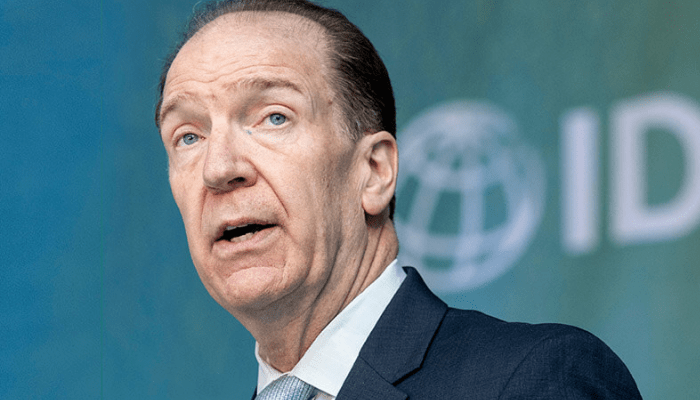
When you need urgent cash from a bank, putting up your car or land as security is often the fastest way to get approved. But what happens if you put up almost everything you own, and then find yourself unable to pay back? That is the core of a major warning recently delivered to Nigeria by David Malpass, the former president of the World Bank Group.
In a recent policy research paper, the former global finance chief warned that Nigeria’s growing reliance on collateral-backed borrowing could turn into a serious trap. The strategy might bring in quick US dollars today, but it risks making future debt problems much harder to fix. This warning comes at a critical time for Nigeria, as economic managers search for fast foreign currency to stabilize the naira and fund national expenditure.
Understanding national debt can sound complicated with all the financial terms thrown around by experts. But the core idea is simple: borrowing money by locking up future national assets creates risks that every citizen should understand. At WhatsBuzzn, our mission is to break down major economic news into simple, clear language so everyone can stay informed about decisions shaping our country’s future.
Let us explore what collateral-backed borrowing really means, why the former World Bank boss is raising red flags, and how these decisions could affect daily life across Nigeria.
What Is Collateral-Backed Borrowing?
To understand why international financial leaders are worried, it helps to start with the basics. Collateral-backed borrowing simply means taking a loan while pledging a specific asset or future revenue stream as a guarantee to the lender. If the borrower fails to repay the loan on time, the lender gets direct legal rights to seize that asset or take over that income stream.
Build Funnels, Email Lists & Sell Online With One Free Tool
Create funnels, send emails, and sell online using Systeme.io without paying for multiple tools.
Create Free AccountFree forever • No credit card • Beginner-friendly
For everyday individuals, this works like taking a pawn shop loan or a secured car loan. For a country, collateralized sovereign debt usually involves pledging national natural resources or financial instruments. In past years, resource-rich nations have often pledged future crude oil sales to secure international funding. More recently, governments have started using complex financial contracts, such as pledging local government bonds in exchange for foreign currency loans.
When a government borrows money through standard channels, like issuing international Eurobonds, it promises to repay the money based on its general reputation and future revenue. No specific physical asset or bond is tied directly to that debt. However, when global market conditions make standard borrowing too expensive, governments turn to collateralized deals. Lenders like these deals because they get extra protection, but the long-term trade-offs for the borrowing nation can be steep.
Who Is David Malpass and What Did He Warn About?
David Malpass served as the President of the World Bank Group between 2019 and 2023. During his tenure, he closely tracked how developing nations handle national debt and economic shocks. His latest warning came in a World Bank Policy Research Working Paper titled Public Debt and Central Banks, which was published as part of the World Bank Group Annual Bank Conference on Development Economics.
In the paper, Malpass examined the heavy debt loads facing low and middle-income nations like Nigeria, Angola, and Senegal. He pointed out that private lenders are increasingly offering complex, secured loan structures to high-risk sovereign nations. Many of these transactions include non-disclosure clauses, which hide the exact details of the deal from the public and international observers.
Malpass warned that these sophisticated collateralized transactions are creating what he called a “race toward seniority” among lenders. When lenders demand high-value collateral before handing over cash, they move themselves to the front of the line for repayment. If the country ever runs into financial trouble and needs to renegotiate its debts, these collateralized lenders will demand their payout first, leaving very little room for fair debt workouts.
He noted that tying up national assets in secured deals creates a web of legal claims that can paralyze a nation during economic crises. Instead of helping countries build long-term debt sustainability, these structured deals often protect lender interests while leaving the host country exposed to deeper financial trouble down the road.
Why Is Nigeria Using Collateral-Backed Loans Right Now?
To see why Nigeria is taking this path, it is important to look at the economic pressure facing the nation. Global interest rates have remained high over recent years, driven by central banks in developed countries fighting inflation. This shift made issuing standard Eurobonds extremely expensive for developing economies. If Nigeria tried to issue traditional Eurobonds today, it would have to pay very high interest rates to convince global investors to buy them.
At the same time, Nigeria has faced an urgent need for foreign currency liquidity. The country needs US dollars to clear foreign exchange backlogs, support foreign exchange reserves, import necessary goods, and maintain confidence in the naira. With standard international capital markets demanding high interest payments, economic officials turned toward structured financing facilities.
A clear example of this approach came when Nigeria drew $1.5 billion from a $5 billion financing facility arranged with First Abu Dhabi Bank. To secure this hard-currency funding without issuing high-yield Eurobonds, Nigeria agreed to pledge Federal Government securities worth roughly 133 percent of any amount drawn. For the full $5 billion facility, Nigeria would have to pledge about $6.65 billion in naira-denominated government bonds as security.
While this mechanism allows the government to get quick dollar liquidity in the short term, it locks up massive amounts of domestic assets. It gives foreign lenders direct claims over local securities, creating a safety net for the lender while increasing the risk burden on the borrowing state.
The Big Risks of Collateral-Backed Borrowing
While securing quick cash can relieve immediate pressure, relying heavily on collateralized debt carries severe risks. Here are the primary reasons why economists and international organizations are sounding the alarm.
1. It Makes Future Debt Restructuring a Nightmare
If a country ever faces a severe financial crisis and cannot meet its debt obligations, it usually negotiates with all its creditors to adjust payment schedules or reduce interest rates. This process is known as debt restructuring.
When a large portion of national debt is backed by collateral, restructuring becomes extremely hard. Creditors holding collateral have no reason to negotiate lower payments because they already hold rights over valuable assets or bonds. Unsecured creditors, knowing that collateralized lenders are prioritized, will refuse to accept cuts unless everyone takes a fair share. This dynamic can cause negotiations to break down entirely, leaving the country stuck in economic limbo.
2. Reduced Transparency and Hidden Liabilities
Many collateralized loan agreements come with non-disclosure clauses or complex derivative structures, such as total return swaps. These structures make it hard for citizens, analysts, and international monitors to figure out how much the country actually owes.
When financial arrangements are kept out of clear public view, it becomes difficult to assess the true health of the nation’s balance sheet. Hidden liabilities can accumulate silently until they suddenly blow up into a full-scale fiscal crisis.
3. High Collateral Demands Lock Up Valuable National Assets
In deals where the government pledges 133 percent of the loan value in securities or resources, the country gives away far more value than it receives in cash. If market conditions shift or currency values fluctuate, the government may be forced to post even more collateral to maintain the deal.
This requirement ties up valuable national financial instruments that could otherwise be used to support domestic bank liquidity, fund local infrastructure, or back domestic development projects.
4. It Harms Investor Trust and Credit Ratings
International credit rating agencies look closely at how transparent and sustainable a country’s debt strategy is. When a government relies on hidden derivative deals and collateral pledges, rating agencies often view it as a sign of financial distress.
A lower credit rating makes future borrowing even more expensive and can discourage long-term foreign direct investment. Instead of building lasting confidence, quick-fix collateral deals can make foreign investors more cautious about putting money into the country’s real economy.
What Are Other Global Financial Institutions Saying?
David Malpass is not the only voice raising concerns about Nigeria’s recent financial arrangements. Other major international institutions have voiced similar cautions over derivative-based sovereign transactions.
In recent economic evaluations, the International Monetary Fund (IMF) warned that complex derivative arrangements, including total return swaps, obscure a government’s true liabilities. The IMF stressed that these complex structures make it difficult for investors, lawmakers, and creditors to accurately value or monitor sovereign debt levels.
Similarly, global rating agency Fitch Ratings pointed out that structured financing deals can weaken transparency and create contingent liabilities that do not show up in conventional debt numbers. Fitch noted that pledging large amounts of domestic government bonds for hard-currency liquidity could negatively affect Nigeria’s credit assessments over time.
These warnings from the World Bank, the IMF, and credit rating agencies highlight a clear global consensus: while collateralized financing provides short-term cash relief, it creates long-term structural vulnerabilities that cannot be ignored.
How Does This Economic Strategy Impact Everyday Nigerians?
It is easy to view sovereign debt discussions as distant political debates that do not affect daily life. However, national borrowing strategies directly impact the economic environment that every Nigerian navigates each day.
When a government spends a large portion of its revenue paying off high-priority debt obligations, less money remains available for public services. Budgets for healthcare, education, road construction, and energy infrastructure get squeezed. Over time, poor public infrastructure drives up business costs and lowers the general quality of life.
Furthermore, heavy reliance on collateralized deals to defend the naira or gain short-term dollar liquidity can create unpredictable currency swings. When local currency value drops sharply, prices for food, fuel, electronics, and imported goods rise quickly. This inflation erodes household purchasing power, making it harder for families to make ends meet.
Economic stability is the foundation of individual growth and business opportunity. Just as exploring new digital careers like YouTube automation or adopting modern tools in technology and AI can create personal financial stability, sound national debt policy creates the macroeconomic stability needed for local businesses to thrive.
Build Funnels, Email Lists & Sell Online With One Free Tool
Create funnels, send emails, and sell online using Systeme.io without paying for multiple tools.
Create Free AccountFree forever • No credit card • Beginner-friendly
What Options Does Nigeria Have Moving Forward?
Avoiding the risks of collateral-backed borrowing does not mean Nigeria should stop seeking growth capital. Instead, it means switching to sustainable, transparent economic strategies that build real wealth.
Former World Bank President David Malpass noted that despite current debt challenges, Nigeria retains massive long-term potential. He highlighted that sustained structural reforms in exchange-rate management, agriculture, taxation, and the oil sector could unlock substantial economic growth.
Here are key steps Nigeria can take to improve its financial position without relying on risky collateral deals:
- Boost Revenue Through Broad-Based Reforms: Expanding the tax base fairly without overburdening small businesses can provide stable, predictable government revenue.
- Increase Export Diversification: Relying heavily on crude oil exports leaves the economy vulnerable to global price swings. Supporting non-oil exports, agriculture, manufacturing, and tech services brings in genuine foreign exchange.
- Improve Debt Transparency: Making all sovereign debt agreements fully transparent builds trust with international investors, credit agencies, and the public.
- Maintain Exchange Rate Reforms: Allowing a transparent, market-reflective exchange rate encourages foreign direct investment and reduces the need for emergency dollar borrowing.
- Prioritize Domestic Production: Strengthening local production reduces the country’s import bill, easing pressure on foreign reserves naturally rather than through borrowed liquidity.
Frequently Asked Questions (FAQs)
What is collateral-backed borrowing in sovereign finance?
Collateral-backed borrowing occurs when a government secures a loan by pledging national assets, natural resources, or domestic government bonds to the lender. If the government defaults on the loan, the lender has a legal right to seize the pledged assets or claim specific revenue streams.
Why did former World Bank President David Malpass warn Nigeria?
David Malpass warned that collateralized loans create a race toward seniority among lenders, making debt less transparent and much harder to restructure if Nigeria faces financial distress in the future. He stressed that these deals often protect lender interests rather than helping the country achieve long-term economic stability.
What asset did Nigeria pledge in its recent Abu Dhabi bank loan?
In its recent $1.5 billion drawdown from a $5 billion facility with First Abu Dhabi Bank, Nigeria agreed to pledge Federal Government securities (domestic naira-denominated bonds) worth approximately 133 percent of the borrowed amount as collateral for foreign currency liquidity.
How does high government debt affect regular citizens?
High debt levels mean a larger share of the national budget goes toward debt servicing rather than vital public services like education, healthcare, and infrastructure. It can also lead to currency instability and higher inflation, which increases the everyday cost of living.
Are collateralized loans illegal for countries?
No, collateralized loans are legal financial agreements. However, international financial bodies like the World Bank and IMF caution against them because they reduce debt transparency, create hidden liabilities, and complicate future debt resolution.
Sustainable Growth Over Quick Financial Fixes
Managing a nation’s economy requires balancing urgent short-term needs with long-term financial health. While securing fast foreign exchange through collateral-backed borrowing offers temporary relief, the warnings from David Malpass and global institutions serve as an important reminder: short-term fixes should never jeopardize future stability.
Building a resilient Nigerian economy depends on genuine structural reforms, strong production, transparent governance, and sustainable debt management. By focusing on long-term wealth creation rather than complex borrowing tactics, Nigeria can protect its national assets and build a prosperous future for all its citizens.
If you have questions or want to share your thoughts on Nigeria’s economic future, feel free to reach out through our contact page. You can also stay connected with our community and get the latest viral insights by following us on Instagram, liking our page on Facebook, and joining the conversation on X (formerly Twitter).
