
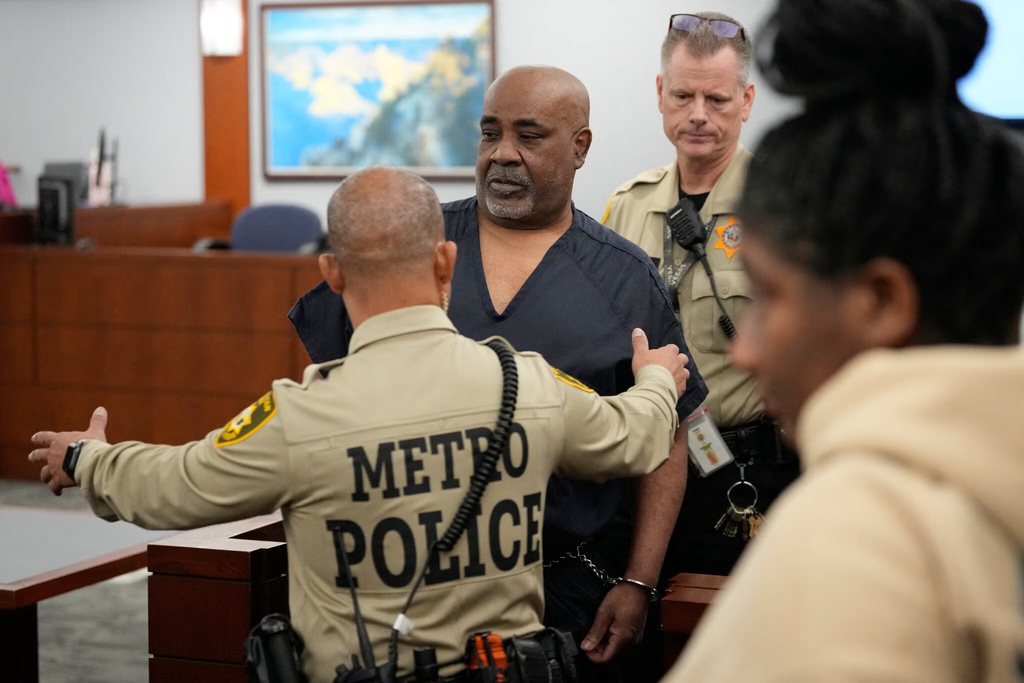
Nearly thirty years after gunfire on the Las Vegas Strip silenced one of the greatest voices in music history, a courtroom in Nevada finally delivered the reckoning hip-hop fans waited decades to see. Duane “Keffe D” Davis, a 63-year-old former gang leader, was sentenced to 40 years to life in state prison for orchestrating the September 1996 drive-by shooting that killed Tupac Shakur.
Clark County District Court Judge Carli Kierny handed down the sentence on Tuesday, October 13, 2026, officially closing the first and only criminal prosecution ever brought in connection with Shakur’s death. For millions around the globe who grew up listening to Shakur’s poetry, pain, and revolutionary spirit, the moment felt surreal. A cold case that spawned hundreds of conspiracy theories, books, documentaries, and heartbreak finally met its match inside a quiet Las Vegas courtroom.
Davis, who sat at the defense table in prison scrubs, learned that he must serve four full decades before he can even think about asking for parole. Taking into account the 731 days of credit he received for time already spent in jail since his September 2023 arrest, the math is straightforward. At 63 years old, Davis will almost certainly spend the rest of his natural life behind bars.
The Moment the Gavel Fell: Inside the Courtroom
The sentencing hearing was heavy with emotion, decades of grief, and sharp judicial words. When Judge Carli Kierny addressed the courtroom, she did not hold back. She directly pushed back against the defense’s argument that Davis was an aging grandfather who had long moved past his violent street days in Compton.
Judge Kierny looked directly at Davis and made it clear that time does not wash away blood. She told the courtroom that for years, Davis carried an attitude that he could simply talk about his involvement, claim he was an older man living a reformed life, and walk away clean. Her words cut through the room: you do not get to take a man from his family, snatch away his life, destroy his future, and simply walk away because decades have passed.
The $0 Secret To Launching Your Entire Online Empire
Why pay hundreds every month for separate software? Build funnels, send emails, and make sales with Systeme.io completely free.
Get Started For $0Free Forever • No Credit Card Needed • Beginner-Friendly
Tupac’s family members were present to witness the moment they spent half their lives waiting for. Shakur’s sister, Sekyiwa Shakur, stood before the court and delivered a victim impact statement that silenced every person in the room. Speaking with steady emotion, she told Davis that it was finally time for him to sit down and contemplate what he stole from the world, not just from her family. Her words captured the quiet agony of losing a brother whose voice continues to inspire people worldwide, while his killer walked free for almost three decades.
Tupac’s stepbrother, Maurice “Mopreme” Shakur, also addressed the court, reminding the judge of the profound void left behind when Tupac died at just 25 years old. Throughout the statements, Davis stared straight ahead, keeping an emotionless face. Though his defense team insisted they plan to file appeals, the weight of the sentence landed hard. The man who spent years bragging on camera about being a street kingpin looked visibly diminished as court officers escorted him out of the room.
What Really Happened on September 7, 1996?
To understand how Duane Davis ended up with a life sentence in 2026, you have to rewind to the night that changed music culture forever: Saturday, September 7, 1996.
That evening, Las Vegas was buzzing. Mike Tyson had just defeated Bruce Seldon in a heavyweight championship boxing match at the MGM Grand hotel. Tupac Shakur was in attendance alongside Marion “Suge” Knight, the imposing boss of Death Row Records. Death Row was riding the highest wave in rap music, but they were deeply entangled with the Mob Piru Bloods, a notorious Compton street gang.
In the lobby of the MGM Grand shortly after the fight, a fight broke out. Tupac and his crew spotted Orlando “Baby Lane” Anderson, a prominent member of the rival South Side Compton Crips. Months earlier, Anderson and his associates had allegedly jumped a Death Row affiliate and stolen a gold Death Row medallion at a shopping mall in Lakewood, California. When Tupac spotted Anderson by the casino elevators, he confronted him immediately. Security cameras captured Shakur punching Anderson, followed by Knight and several members of their entourage kicking and beating Anderson on the casino floor.
Orlando Anderson limped away bruised, humiliated, and hungry for payback. He immediately called his uncle, Duane “Keffe D” Davis, who was a high-ranking shot caller for the South Side Compton Crips.
Davis was already in Las Vegas for the fight. Furious that his nephew had been jumped in public, Davis went to work. According to prosecutors and official records from the Las Vegas Metropolitan Police Department, Davis secured a .40-caliber Glock handgun from an associate. He rounded up four men, hopped into a rented white Cadillac, and began hunting for Tupac and Suge Knight across the neon-lit streets of Vegas.
Later that night, Knight was driving a black BMW 750iL sedan with Shakur in the passenger seat, heading toward Club 662. At around 11:15 PM, the BMW stopped at a red light at East Flamingo Road and Koval Lane. A convoy of cars with fans and bodyguards sat around them.
Suddenly, the white Cadillac pulled up along the passenger side of the BMW. A hand extended from the rear window, and rapid gunfire tore into the night. Four bullets struck Shakur in the chest, arm, and thigh. Suge Knight suffered bullet fragments to the head. The white Cadillac sped off into the desert night, vanishing into the shadows.
Tupac was rushed to University Medical Center. Doctors removed his right lung in an attempt to stop internal bleeding, but the damage was catastrophic. Six days later, on September 13, 1996, Tupac Amaru Shakur took his last breath. He was only 25 years old.
The Killer Who Could Not Keep His Mouth Shut
For more than twenty years, Tupac’s murder was treated as one of the ultimate cold cases in modern American history. Fans wondered how a global superstar could be executed on one of the busiest streets in the world, with dozens of witnesses, and nobody ever faced charges. Rumors flew everywhere, blaming government agencies, East Coast rivals, and inside jobs.
In reality, the truth was hidden in plain sight. Duane Davis simply could not resist the spotlight.
The turn of events that led to Davis’s downfall began back in 2008. Federal investigators and Los Angeles police were investigating the 1997 drive-by murder of Christopher Wallace, better known as The Notorious B.I.G. Faced with potential federal drug charges that could have put him away for decades, Davis sat down with investigators for a series of interviews under a legal proffer agreement.
During those recorded interviews, Davis confessed to his role in Shakur’s killing. He told investigators that he was in the front passenger seat of the white Cadillac, that he handed the gun into the backseat, and that his nephew Orlando Anderson pulled the trigger. Under the terms of that proffer agreement, the statements he made in that private room could not be used against him directly in a new prosecution—as long as he kept his mouth shut.
Davis, however, became reckless.
Send, Spend & Hold Money Worldwide Without Hidden Fees
Transfer money internationally at the real exchange rate and hold 40+ currencies in one account.
Open a Wise AccountMid-market rate • Fast transfers • 40+ currencies
Believing that he was immune from prosecution, Davis went on a massive public tour. He appeared on popular YouTube channels, sat down for television documentaries on BET and A&E, and recounted the murder beat by beat. In 2019, he published a tell-all memoir titled Compton Street Legend. In the book, Davis described every detail of that fateful night in Las Vegas: obtaining the firearm, driving around searching for Shakur, spotting Tupac standing out of the BMW’s sunroof waving to female fans, making a U-turn, and pulling up alongside the car to open fire.
Davis thought he was untouchable because everyone else who was in that white Cadillac with him was already dead:
- Orlando “Baby Lane” Anderson was killed in an unrelated gang shootout in Compton in 1998.
- Terrence “Bubble Up” Brown, the driver of the Cadillac, was found shot to death in Compton in 2011.
- DeAndre “Freaky” Smith, who sat next to Anderson in the back, died in 2004.
Davis was the last surviving man from the Cadillac. He believed that with no physical gun, no surviving accomplices, and decades gone by, police would never bother to file charges. He miscalculated.
Homicide detectives in Las Vegas reopened the case files, using Davis’s own public interviews, his published memoir, and his recorded statements as roadmaps. In July 2023, SWAT teams served a search warrant at Davis’s home in Henderson, Nevada, seizing computers, electronics, and copies of his book. In September 2023, a grand jury indicted Davis on first-degree murder charges.
His own ego had walked him straight into a murder trial.
Nevada Law and the Myth of the Trigger Puller
One of the most common questions people ask about this verdict is simple: if Duane Davis did not pull the trigger, how could he be convicted of first-degree murder?
The answer lies in Nevada’s legal system. Under Nevada law, anyone who aids, abets, conspires, or encourages someone else to commit a crime is equally responsible as the person who pulls the trigger. The law does not distinguish between the mastermind who plans the hit and provides the gun, and the shooter who pulls the trigger.
During the trial in Clark County District Court, prosecutors Marc DiGiacomo and Binu Palal laid out a clear argument for the jury. They did not need to prove Davis fired the fatal shots. They only needed to prove that Davis was the field general on the ground:
- He obtained the illegal weapon used in the attack.
- He organized the crew inside the white Cadillac to hunt down Shakur.
- He directed the vehicle to flank Tupac’s car after spotting him on Flamingo Road.
- He handed the gun into the back seat knowing exactly what was about to happen.
The defense attorney, Michael Sanft, attempted to argue that Davis was merely an exaggerator and an opportunist who told tall tales on podcasts to make quick money and keep his name alive. Sanft argued that there was no physical fingerprint, no DNA, and no weapon recovered from the scene linking Davis to the crime.
The twelve jurors were not convinced. After listening to days of testimony, police interviews, and Davis’s own voice describing the murder in clinical detail, the jury deliberated for less than three hours on August 31, 2026, before returning a unanimous verdict: guilty of first-degree murder with a deadly weapon and gang enhancement.
The $0 Secret To Launching Your Entire Online Empire
Why pay hundreds every month for separate software? Build funnels, send emails, and make sales with Systeme.io completely free.
Get Started For $0Free Forever • No Credit Card Needed • Beginner-Friendly
The Legal Chaos of the Music Industry
The resolution of Tupac Shakur’s murder case reminds us how deeply violence and courtroom battles have cast long shadows over hip-hop culture. For decades, artists, executives, and street crews lived in a world where real-world danger and business rivalries collided with devastating consequences.
We see echoes of this drama across generations of the music industry. High-profile courtrooms have repeatedly become the stage where street rivalries and superstar careers meet. Just recently, hip-hop fans watched the dramatic twists in Lil Durk’s high-stakes murder-for-hire trial, proving that legal entanglements continue to follow big-name artists even today.
At the same time, the industry continues to reel from massive legal fallout involving iconic figures of the 1990s. The ongoing headlines surrounding Sean “Diddy” Combs and the chaotic legal battles rocking his empire show just how messy and complicated the business behind the music has always been. High-profile reputations are fragile, and cases can unravel in unpredictable ways, much like the shocking turns when a Jay-Z accuser admitted her serious claims were completely false.
The tragedy of Tupac’s death is that he was caught in an era when young, brilliant Black creatives were exposed to genuine danger without the security infrastructure, management wisdom, or maturity needed to navigate it. Tupac had the intellect to reshape the world, but he was surrounded by chaos. Seeing modern superstars like Davido openly planning an early retirement from music highlights how exhausting and hazardous the global spotlight can be when artists do not set clear boundaries early in their careers.
Tupac never had the chance to step away. He was taken before he could reach his prime.
What Tupac Shakur Lost—and What the World Missed
When Tupac died on September 13, 1996, the world did not just lose an extraordinary chart-topping rapper. It lost one of the most prolific cultural forces of modern times.
Consider what Shakur accomplished before turning 25:
- He released four seminal solo albums, including 2Pacalypse Now, Me Against the World, and the genre-defining double-disc classic All Eyez on Me.
- He recorded hundreds of unreleased songs, poems, and writings that would fuel seven posthumous studio albums.
- He starred in critically acclaimed films like Juice, Poetic Justice, Above the Rim, and Gridlock’d, proving he was a naturally gifted dramatic actor with Hollywood superstar appeal.
- He spoke fearlessly about police brutality, urban poverty, mental health, systemic racism, and the struggles of young Black mothers in anthems like “Dear Mama,” “Brenda’s Got a Baby,” and “Keep Ya Head Up.”
Tupac was contradictions in motion: vulnerable yet fierce, volatile yet deeply tender, politically radical yet trapped in street beefs. When he spoke, people listened because he refused to hide his flaws.
Davis’s sentencing cannot bring Tupac back. It cannot give us the movies he would have directed, the books he would have published, or the political leadership he likely would have provided as he grew older. What this sentence does do, however, is strip away the arrogant myth that someone could execute an icon in cold blood and laugh about it forever.
Key Highlights of the Case
To see how the pieces fit together across thirty years, here is a clear breakdown of the critical milestones that shaped this historic case:
- September 7, 1996: Orlando Anderson is assaulted by Tupac Shakur and Death Row associates at the MGM Grand in Las Vegas. Hours later, a white Cadillac pulls alongside Suge Knight’s BMW at Flamingo and Koval, firing multiple rounds into the vehicle.
- September 13, 1996: Tupac Shakur dies from his injuries at University Medical Center at the age of 25.
- May 29, 1998: Orlando Anderson is killed in an unrelated gang shootout at a Compton car wash, leaving investigators with no primary shooting suspect alive.
- 2008: Duane Davis makes recorded admissions to federal investigators under a proffer agreement while seeking protection from unrelated drug charges.
- 2018–2019: Davis conducts multiple public interviews on video platforms and publishes his book, Compton Street Legend, publicly claiming responsibility for orchestrating the shooting.
- July 17, 2023: Las Vegas police execute a search warrant at Davis’s home in Henderson, Nevada, recovering crucial evidence that reactivates the prosecution.
- September 29, 2023: A grand jury indicts Davis on charges of murder with a deadly weapon with a gang enhancement.
- August 31, 2026: A Clark County jury finds Duane Davis guilty of first-degree murder after less than three hours of deliberation.
- October 13, 2026: Judge Carli Kierny sentences Davis to 40 years to life in Nevada state prison.
Frequently Asked Questions (FAQs)
Did Duane Davis actually fire the gun that killed Tupac Shakur?
No. Prosecutors never claimed that Davis held or fired the gun. According to Davis’s own previous statements and courtroom evidence, his nephew, Orlando “Baby Lane” Anderson, was seated in the rear passenger seat and fired the fatal shots. Under Nevada law, someone who plans, procures the weapon for, and coordinates a fatal attack is legally guilty of first-degree murder, just like the person who pulled the trigger.
Why did it take nearly 30 years to charge and sentence Duane Davis?
For many years, police faced an uncooperative street culture, inconsistent witness accounts, and a lack of direct physical evidence like fingerprints or the murder weapon. The big shift happened when Davis began openly bragging about his participation in published memoirs and podcast interviews. Those public admissions allowed prosecutors to build a bulletproof case around his voluntary confessions, which were no longer protected by confidential police agreements.
Can Duane Davis be released on parole before 40 years?
No. The sentence handed down by Judge Carli Kierny requires Davis to serve a mandatory minimum of 40 years before becoming eligible for parole consideration. Davis received 731 days of credit for time served in custody since September 2023. Because he is 63 years old, he will not be eligible for parole until he is well over 100 years old, effectively making this a life sentence.
Did Marion “Suge” Knight testify at the trial?
No, Suge Knight did not testify. Knight, who is currently serving a 28-year prison sentence in California for an unrelated 2015 fatal hit-and-run, consistently refused to cooperate with law enforcement or take the stand in the trial against Duane Davis, adhering to his longtime stance of refusing to cooperate with police investigations.
What happened to the other men who were inside the white Cadillac?
All three other men who were inside the white Cadillac on the night of the shooting are deceased:
- Orlando Anderson was killed in a Compton shooting in 1998.
- Terrence Brown was killed in California in 2011.
- DeAndre Smith died in 2004. Duane Davis was the sole surviving passenger from the car, making him the only person alive who could be held accountable.
Will Duane Davis appeal this sentence?
Yes. Davis’s defense team confirmed immediately following the sentencing hearing that they intend to file an appeal with the Nevada appellate courts. They are expected to challenge the admissibility of Davis’s 2019 memoir and argue that his earlier statements to law enforcement should not have been used against him. However, legal experts note that overturning a unanimous jury verdict backed by years of voluntary public confessions is an uphill climb.
Justice moves slowly, but it does not forget. For thirty years, the world wondered if anyone would ever answer for the bullets fired on Flamingo Road. Duane Davis believed that time, street codes, and clever deals had cleared his path to a comfortable retirement. Instead, his own pride and need for attention unraveled him.
As Duane Davis begins serving his decades behind prison walls, the hip-hop community can finally take a collective breath. The legal system has spoken, the conspiracy theories have lost their grip, and the man who orchestrated the murder of Tupac Shakur has run completely out of time. Tupac’s music, message, and legacy remain immortal—while his killer will spend the rest of his days inside a cell.
